

2025 Easily pass UiPath-SAIv1 Exam with our Dumps & PDF Test Engine
UiPath-SAIv1 PDF Pass Leader, UiPath-SAIv1 Latest Real Test
NEW QUESTION # 39
What are the options available in the Export Now tab of the Export Files dialog box in Document Manager?
- A. Download to Excel. Download, and Export to Al Center.
- B. Download to Excel. Export to Al Center, and Export All.
- C. Download to Excel and Export All.
- D. Export to Al Center, Export All. and Download.
Answer: B
Explanation:
Document Understanding documentation, when using the "Export Now" tab in the Export Files dialog box within the Document Manager, the available options include:
* Download to Excel - This allows downloading the dataset locally in an Excel format.
* Export to AI Center - This exports the data directly to the AI Center for use in model training or evaluation.
* Export All - This option exports all documents regardless of labeling or filtering status.
These features are designed to facilitate exporting labeled data for further processing in AI Center, or locally for offline analysis
NEW QUESTION # 40
When should a UiPath Communications Mining taxonomy be imported?
- A. Before starting the model training.
- B. After pruning and reorganizing a taxonomy.
- C. As part of the "Increase coverage" phase.
- D. When new labels must be added to the taxonomy.
Answer: A
Explanation:
In UiPath Communications Mining, importing a taxonomy should be done before starting model training. The taxonomy, which includes labels and categories, defines how the data will be classified and structured during the training process. It is essential to have a well-defined taxonomy to ensure accurate predictions and classifications. Importing the taxonomy before training allows the model to learn from it, enhancing its performance. Changes to the taxonomy can be made later, but the initial import is crucial at the start of the training phase to guide the model effectively.
(Source: UiPath Docs on Communications Mining)
NEW QUESTION # 41
While training a UiPath Communications Mining model, the Search feature was used to pin a certain label on a few communications. After retraining, the new model version starts to predict the tagged label but infrequently and with low confidence.
According to best practices, what would be the correct next step to improve the model's predictions for the label, in the "Explore" phase of training?
- A. Use the "Low confidence" training mode to pin the label to more communications.
- B. Use the "Rebalance" training mode to pin the label to more communications.
- C. Use the 'Teach" training mode to pin the label to more communications.
- D. Use the "Search" feature to pin the label to more communications.
Answer: C
NEW QUESTION # 42
Which UiPath Studio activity creates a Data Labeling Action in UiPath Action Center?
- A. Create Labeling Task activity
- B. Create External Task activity
- C. Create Document Labeling Action activity
- D. Create Labeling Action activity
Answer: C
NEW QUESTION # 43
What is the relationship between AI Center and UiPath Document Understanding?
- A. AI Center is the infrastructure on top of which UiPath Document Understanding machine learning models run.
- B. Document Understanding is the infrastructure on which AI Center machine learning models run.
- C. Document Understanding is the infrastructure on which AI Center digitization runs.
- D. AI Center is the infrastructure on top of which UiPath Document Understanding digitization runs.
Answer: A
NEW QUESTION # 44
What information does the comparison between two cohorts display on the Comparison page in UiPath Communications Mining?
- A. Verbatim content for each label.
- B. Entity count for each metadata.
- C. Total verbatim count and proportion for each label.
- D. Differences in verbatim length between Group A and Group B.
Answer: C
Explanation:
According to the UiPath documentation, UiPath Communications Mining is a tool that enables you to analyze text-based communications data, such as customer feedback, support tickets, or chat transcripts, using natural language processing (NLP) and machine learning (ML) techniques1. One of the features of UiPath Communications Mining is the Comparison page, which allows you to compare two cohorts of verbatims based on different criteria, such as date range, source, metadata, or label2. The Comparison page displays the following information for each cohort3:
* Total verbatim count: The number of verbatims in the cohort.
* Proportion for each label: The percentage of verbatims in the cohort that are assigned to each label. A label is a category or a topic that is relevant for the analysis, such as sentiment, intent, or issue type.
Labels can be predefined or custom-defined by the user.
* Statistical significance: The p-value that indicates whether the difference in proportions between the two cohorts is statistically significant or not. A p-value less than 0.05 means that the difference is unlikely to be due to chance.
The Comparison page also provides a visual representation of the proportions for each label using a bar chart, and allows the user to drill down into the verbatim content for each label by clicking on the bars3. Therefore, the correct answer is A.
References:
1: About Communications Mining 2: Communications Mining - Comparing Cohorts 3: Communications Mining - Comparison Page
NEW QUESTION # 45
Which environment variable is relevant for Evaluation pipelines?
- A. eval.enable_ocr
- B. eval.enable_qpu
- C. eval.use_cuda
- D. eval.redo_ocr
Answer: D
NEW QUESTION # 46
What is the purpose of UiPath Communications Mining?
- A. Generate code for automation processes.
- B. Design user interfaces.
- C. Analyze financial data.
- D. Process unstructured communication data using NLP.
Answer: D
Explanation:
UiPath Communications Mining uses Natural Language Processing (NLP) to analyze and process unstructured communication data such as emails, chat logs, and other textual inputs. This enables automation to identify actionable insights from large volumes of communication data.
NEW QUESTION # 47
What is DOM in the context of Document Understanding?
- A. Digitized Object Model is an XML object containing information such as page data, content, and coordinates for every image identified in the file.
- B. Data Object Model is a YAML object containing information such as name, content type, text length, and the number of pages.
- C. Document Object Model is a JSON object containing information such as name, content type, text length, and the number of pages.
- D. Digitize Object Module is an XML object containing information such as mandatory field names, types, and values
Answer: A
Explanation:
In UiPath Document Understanding, the Digitized Object Model (DOM) is an XML structure that contains detailed information about the document being processed. This includes data such as the content of each page, the coordinates of each element within the document, and additional metadata. The DOM is created during the digitization process, where scanned or image-based documents are converted into machine-readable formats for further processing, such as classification and data extraction.
For more details, refer to:
* UiPath Document Understanding Documentation: Digitization and the DOM
* Digitize Document Activity: Working with DOM
NEW QUESTION # 48
How do you load a taxonomy from a given non-default location text file into a variable?
Instructions: Drag the steps found on the "Left" and drop them on the "Right" in the correct order.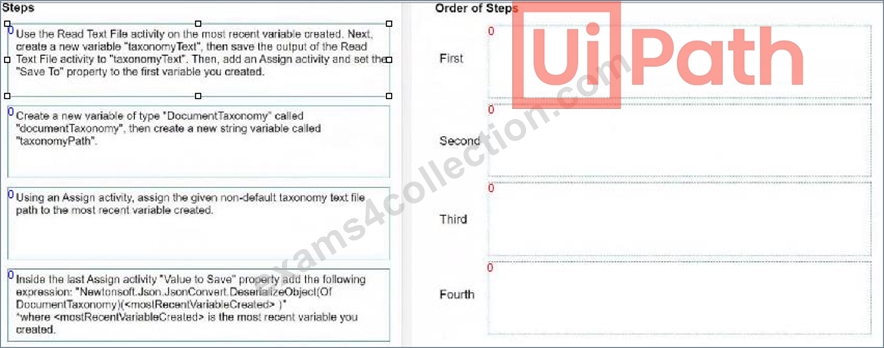
Answer:
Explanation: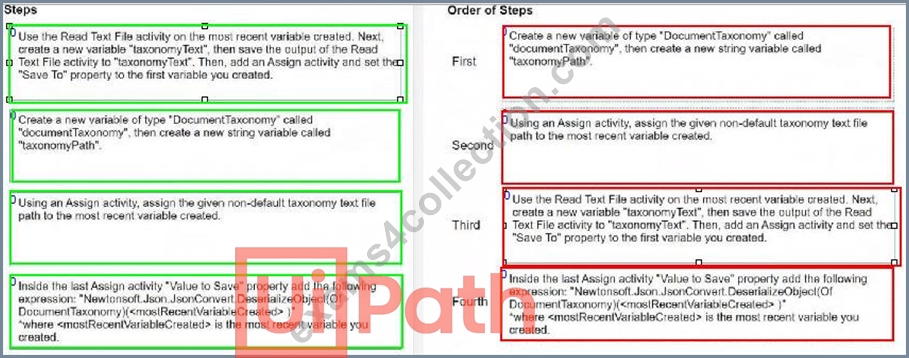
NEW QUESTION # 49
Which of the following is a characteristic of a poorly-performing model in UiPath Communications Mining?
- A. All of the labels in the dataset have at least 25 training examples.
- B. The model makes correct predictions across the majority of the dataset.
- C. Many of the labels in the taxonomy have amber or red performance warnings.
- D. 2% of the dataset has been reviewed by a model trainer.
Answer: C
NEW QUESTION # 50
What are the three types of classifier trainers available in packages UiPath.lntelligentOCR.Activities and UiPath.DocumentUnderstanding.ML.Activities?
- A. Machine Learning Classifier Trainer, Language Based Classifier, and Keyword Based Classifier Trainer.
- B. Intelligent Keyword Classifier Trainer, Language Based Classifier Trainer, and Image Based Classifier Trainer.
- C. Image Based Classifier Trainer, Format Based Classifier Trainer, and Machine Learning Classifier Trainer.
- D. Keyword Based Classifier Trainer, Intelligent Keyword Classifier Trainer, and Machine Learning Classifier Trainer.
Answer: D
Explanation:
UiPath provides three types of classifier trainers to optimize document classification: Keyword Based Classifier Trainer, Intelligent Keyword Classifier Trainer, and Machine Learning Classifier Trainer.
These trainers are used to teach the system how to categorize documents based on keywords, intelligent learning patterns, or machine learning techniques for more complex classifications.(Source: UiPath Classifier Trainer documentation
NEW QUESTION # 51
When creating a training dataset, what is the recommended number of samples for the Classification fields?
- A. 5-10 document samples from each class.
- B. 20-50 document samples from each class.
- C. 50-200 document samples from each class.
- D. 10-20 document samples from each class.
Answer: B
Explanation:
According to the UiPath documentation, the recommended number of samples for the classification fields depends on the number of document types and layouts that you want to classify. The more document types and layouts you have, the more samples you need to cover the diversity of your data. However, a general guideline is to have at least 20-50 document samples from each class, as this would provide enough data for the classifiers to learn from12. A large number of samples per layout is not mandatory, as the classifiers can generalize from other layouts as well3.
References: 1: Document Classification Training Overview 2: Document Classification Training Related Activities 3: Training High Performing Models
NEW QUESTION # 52
What happens during the Classify stage of the Document Understanding Framework?
- A. The target fields are extracted from the document and sent to Action Center for human validation.
- B. The extracted data is exported as a dataset.
- C. The documents are included in one of the taxonomy document types or skipped.
- D. The OCR engine is used to extract text from the image document.
Answer: C
NEW QUESTION # 53
Which of the following extractors can be used for Data Extraction Scope activity?
- A. Full Extractor. Machine Learning Extractor, Intelligent Form Extractor, and Regex Based Extractor.
- B. Intelligent Form Extractor, Machine Learning Extractor. Logic Extractor, and Regex Based Extractor.
- C. Regex Based Extractor. Form Extractor. Intelligent Form Extractor, and Machine Learning Extractor.
- D. Form Extractor Incremental Extractor Machine Learning Extractor and Intelligent Form Extractor
Answer: C
Explanation:
The Data Extraction Scope activity provides a scope for extractor activities, enabling you to configure them according to the document types defined in your taxonomy. The output of the activity is stored in an ExtractionResult variable, containing all automatically extracted data, and can be used as input for the Export Extraction Results activity. This activity also features a Configure Extractors wizard, which lets you specify exactly what fields from the document types defined in the taxonomy you want to extract1.
The extractors that can be used for Data Extraction Scope activity are:
* Regex Based Extractor: This extractor enables you to use regular expressions to extract data from text documents. You can define your own expressions or use the predefined ones from the Regex Based Extractor Configuration wizard2.
* Form Extractor: This extractor enables you to extract data from semi-structured documents, such as invoices, receipts, or purchase orders, based on the position and relative distance of the fields. You can define the templates for each document type using the Form Extractor Configuration wizard3.
* Intelligent Form Extractor: This extractor enables you to extract data from semi-structured documents, such as invoices, receipts, or purchase orders, based on the labels and values of the fields. You can define the fields for each document type using the Intelligent Form Extractor Configuration wizard.
* Machine Learning Extractor: This extractor enables you to extract data from any type of document, using a machine learning model that is trained on your data. You can use the predefined models from UiPath or your own custom models hosted on AI Center or other platforms. You can configure the fields and the model for each document type using the Machine Learning Extractor Configuration wizard.
References: 1: Data Extraction Scope 2: Regex Based Extractor 3: Form Extractor 4: Intelligent Form Extractor
5: Machine Learning Extractor
NEW QUESTION # 54
What is the purpose of the End Process in the Document Understanding Process?
- A. End Process sets the queue transaction status as Successful in case of no exception, and as Failed in case of an exception with their corresponding Business or System Exception, and the post processing
/cleaning if required. - B. End Process in the Document Understanding Process silently shuts down the Virtual Machine so that another robot can use it.
- C. End Process is a feature in the Document Understanding Process that exports the extracted data into a readable document format.
- D. The purpose of the End Process in the Document Understanding Process is to generate a summary report of the processing statistics and performance metrics.
Answer: A
Explanation:
The End Process is the final stage of the Document Understanding Process, which is a fully functional UiPath Studio project template based on a document processing flowchart. The End Process is responsible for setting the queue transaction status, logging the results, and performing any post processing or cleaning actions if needed. The End Process sets the queue transaction status as Successful if the document was processed without any exception, and as Failed if an exception occurred, either a Business Exception (such as invalid data) or a System Exception (such as network failure). The End Process also adds the extracted data and the validation status as output arguments to the queue transaction. The End Process also logs the processing statistics, such as the number of documents processed, the number of exceptions, the average processing time, and the accuracy rate. The End Process also performs any post processing or cleaning actions, such as deleting temporary files, closing applications, or sending notifications1.
References: 1: Document Understanding Process: Studio Template
NEW QUESTION # 55
Which activity enables the identification of the document type by using any classifier?
- A. Digitize Document activity.
- B. Classify Document Scope activity.
- C. Present Classification Station activity.
- D. Train Classifiers Scope activity.
Answer: B
NEW QUESTION # 56
Under what condition can a dataset be edited in UiPath AI Center?
- A. If it is not being used in any active pipeline.
- B. If it is not linked to any data labeling session.
- C. If it has not been modified within the last 24 hours.
- D. There are no restrictions in editing a dataset.
Answer: A
Explanation:
According to the UiPath documentation, a dataset is a folder of storage containing arbitrary sub-folders and files that allows machine learning models in your project to access new data points. You can edit a dataset's name, description, or content from the Datasets > [Dataset Name] page, by clicking Edit dataset. However, you can only edit a dataset if it is not currently being used in an active pipeline. A pipeline is a sequence of steps that defines how to train, test, and deploy a machine learning model. If a dataset is being used in an active pipeline, you will see a lock icon next to it, indicating that it cannot be edited. You can either wait for the pipeline to finish or stop it before editing the dataset.
References:
* AI Center - Managing Datasets
* AI Center - About Datasets
* AI Center - About Pipelines
NEW QUESTION # 57
What is the recommended number of documents per vendor to train the initial dataset?
- A. 0
- B. 1
- C. 2
- D. 3
Answer: B
Explanation:
According to the UiPath documentation, the recommended number of documents per vendor to train the initial dataset is 10. This means that for each vendor that provides a specific type of document, such as invoices or receipts, you should have at least 10 samples of their documents in your training dataset. This helps to ensure that the dataset is balanced and representative of the real-world data, and that the machine learning model can learn from the variations and features of each vendor's documents. Having too few documents per vendor can lead to poor model performance and accuracy, while having too many documents from a single vendor can cause overfitting and bias1.
References: 1: Document Understanding - Training High Performing Models
NEW QUESTION # 58
......
UiPath-SAIv1 Dumps Ensure Your Passing: https://www.exams4collection.com/UiPath-SAIv1-latest-braindumps.html
Valid UiPath-SAIv1 Test Answers & UiPath-SAIv1 Exam PDF: https://drive.google.com/open?id=1TVEe9cbzEsj7BRgWSCyl5REiR_4TLTGl
