

[2025] New DP-203 exam dumps Use Updated Microsoft Exam
Verified DP-203 Dumps Q&As - DP-203 Test Engine with Correct Answers
Where can I find good help with Microsoft DP-203 preparation?
If you want to learn Microsoft DP-203 exam preparation then the first thing is to find the best Microsoft DP-203 questions. You must be wondering where can you find the best Microsoft DP-203 questions for your DP-203 exam preparation. The best resource I have come across is the Microsoft Official Academic Course (MOAC) which is a series of courses that have been created by the same people who have been involved in the creation of the Microsoft DP-203 course. Microsoft DP-203 Dumps includes all the essential topics that are needed to answer a question on this exam. These are real instructors that are working with you every step of the way. It is like being back in school again but this time it would be better than ever before. It is like having your own classroom and not having to worry about all those other students around you. The MOAC allows you to learn at your own pace and it comes with a practice exam that helps you test your knowledge as you progress through each course. The practice exams allow you to test your knowledge and see where you need more studying so that you will know what topics to focus on more before taking the actual Microsoft DP-203 exam.
NEW QUESTION # 46
You are designing an Azure Databricks table. The table will ingest an average of 20 million streaming events per day.
You need to persist the events in the table for use in incremental load pipeline jobs in Azure Databricks. The solution must minimize storage costs and incremental load times.
What should you include in the solution?
- A. Sink to Azure Queue storage.
- B. Include a watermark column.
- C. Partition by DateTime fields.
- D. Use a JSON format for physical data storage.
Answer: A
Explanation:
Explanation
The Databricks ABS-AQS connector uses Azure Queue Storage (AQS) to provide an optimized file source that lets you find new files written to an Azure Blob storage (ABS) container without repeatedly listing all of the files.
This provides two major advantages:
* Lower latency: no need to list nested directory structures on ABS, which is slow and resource intensive.
* Lower costs: no more costly LIST API requests made to ABS.
Reference:
https://docs.microsoft.com/en-us/azure/databricks/spark/latest/structured-streaming/aqs
NEW QUESTION # 47
You are building a database in an Azure Synapse Analytics serverless SQL pool.
You have data stored in Parquet files in an Azure Data Lake Storage Gen2 container.
Records are structured as shown in the following sample.
{
"id": 123,
"address_housenumber": "19c",
"address_line": "Memory Lane",
"applicant1_name": "Jane",
"applicant2_name": "Dev"
}
The records contain two applicants at most.
You need to build a table that includes only the address fields.
How should you complete the Transact-SQL statement? To answer, select the appropriate options in the answer area.
NOTE: Each correct selection is worth one point.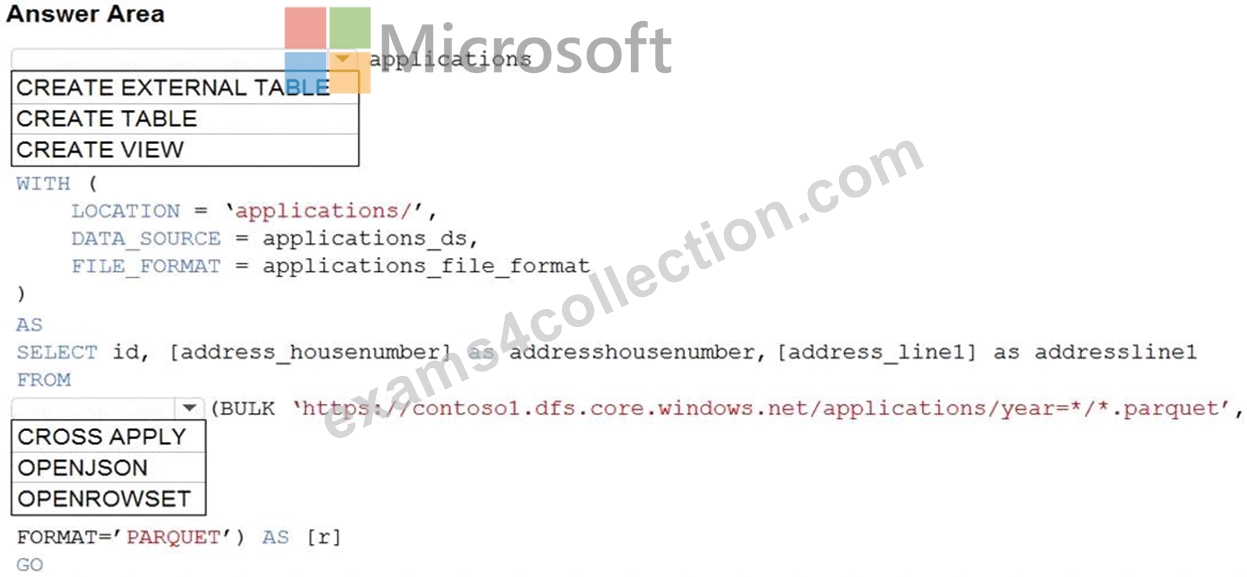
Answer:
Explanation: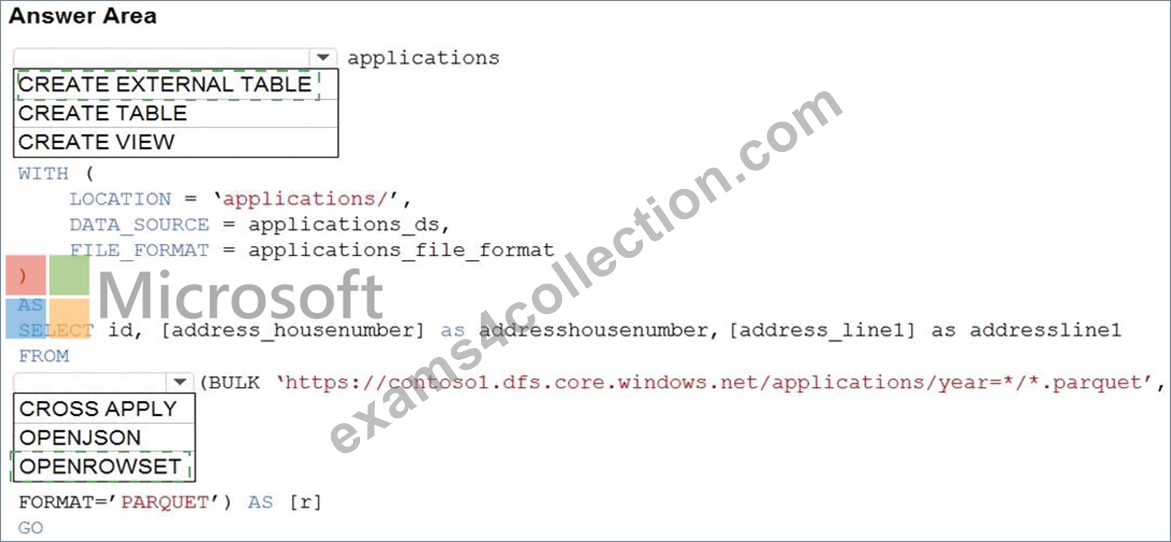
Explanation
Box 1: CREATE EXTERNAL TABLE
An external table points to data located in Hadoop, Azure Storage blob, or Azure Data Lake Storage. External tables are used to read data from files or write data to files in Azure Storage. With Synapse SQL, you can use external tables to read external data using dedicated SQL pool or serverless SQL pool.
Syntax:
CREATE EXTERNAL TABLE { database_name.schema_name.table_name | schema_name.table_name | table_name } ( <column_definition> [ ,...n ] ) WITH ( LOCATION = 'folder_or_filepath', DATA_SOURCE = external_data_source_name, FILE_FORMAT = external_file_format_name Box 2. OPENROWSET When using serverless SQL pool, CETAS is used to create an external table and export query results to Azure Storage Blob or Azure Data Lake Storage Gen2.
Example:
AS
SELECT decennialTime, stateName, SUM(population) AS population
FROM
OPENROWSET(BULK
'https://azureopendatastorage.blob.core.windows.net/censusdatacontainer/release/us_population_county/year=*/* FORMAT='PARQUET') AS [r] GROUP BY decennialTime, stateName GO Reference:
https://docs.microsoft.com/en-us/azure/synapse-analytics/sql/develop-tables-external-tables
NEW QUESTION # 48
You have files and folders in Azure Data Lake Storage Gen2 for an Azure Synapse workspace as shown in the following exhibit.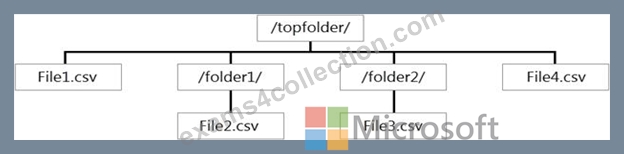
You create an external table named ExtTable that has LOCATION='/topfolder/'.
When you query ExtTable by using an Azure Synapse Analytics serverless SQL pool, which files are returned?
- A. File2.csv and File3.csv only
- B. File1.csv, File2.csv, File3.csv, and File4.csv
- C. File1.csv only
- D. File1.csv and File4.csv only
Answer: B
Explanation:
To run a T-SQL query over a set of files within a folder or set of folders while treating them as a single entity or rowset, provide a path to a folder or a pattern (using wildcards) over a set of files or folders.
Reference:
https://docs.microsoft.com/en-us/azure/synapse-analytics/sql/query-data-storage#query-multiple-files-or-folders
NEW QUESTION # 49
You have an Azure subscription that contains an Azure Data Factory data pipeline named Pipeline1, a Log Analytics workspace named LA1, and a storage account named account1.
You need to retain pipeline-run data for 90 days. The solution must meet the following requirements:
* The pipeline-run data must be removed automatically after 90 days.
* Ongoing costs must be minimized.
Which two actions should you perform? Each correct answer presents part of the solution. NOTE: Each correct selection is worth one point.
- A. Configure Pipeline1 to send logs to LA1.
- B. From the Diagnostic settings (classic) settings of account1. set the retention period to 90 days.
- C. Configure Pipeline1 to send logs to account1.
- D. From the Data Retention settings of LA1, set the data retention period to 90 days.
Answer: A,B
NEW QUESTION # 50
You have an Azure Synapse Analytics dedicated SQL Pool1. Pool1 contains a partitioned fact table named dbo.Sales and a staging table named stg.Sales that has the matching table and partition definitions.
You need to overwrite the content of the first partition in dbo.Sales with the content of the same partition in stg.Sales. The solution must minimize load times.
What should you do?
- A. Insert the data from stg.Sales into dbo.Sales.
- B. Switch the first partition from stg.Sales to dbo. Sales.
- C. Update dbo.Sales from stg.Sales.
- D. Switch the first partition from dbo.Sales to stg.Sales.
Answer: D
NEW QUESTION # 51
You need to implement versioned changes to the integration pipelines. The solution must meet the data integration requirements.
In which order should you perform the actions? To answer, move all actions from the list of actions to the answer area and arrange them in the correct order.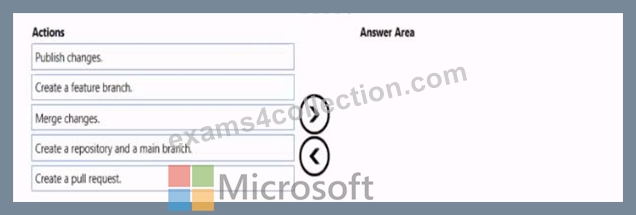
Answer:
Explanation: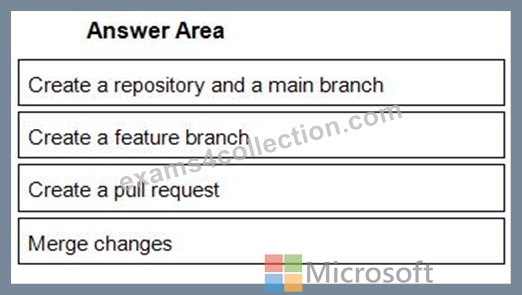
1 - Create a repository and a main branch
2 - Create a feature branch
3 - Create a pull request
4 - Merge changes
Reference:
https://docs.microsoft.com/en-us/azure/devops/pipelines/repos/pipeline-options-for-git
NEW QUESTION # 52
You need to ensure that the Twitter feed data can be analyzed in the dedicated SQL pool. The solution must meet the customer sentiment analytics requirements.
Which three Transaction-SQL DDL commands should you run in sequence? To answer, move the appropriate commands from the list of commands to the answer area and arrange them in the correct order.
NOTE: More than one order of answer choices is correct. You will receive credit for any of the correct orders you select.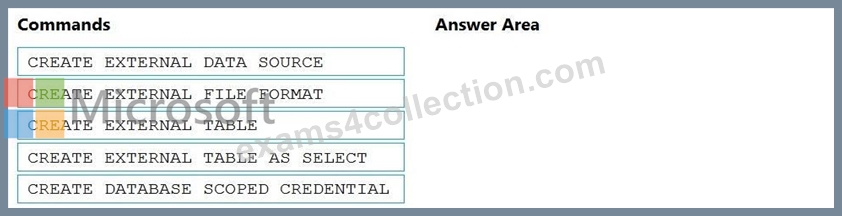
Answer:
Explanation: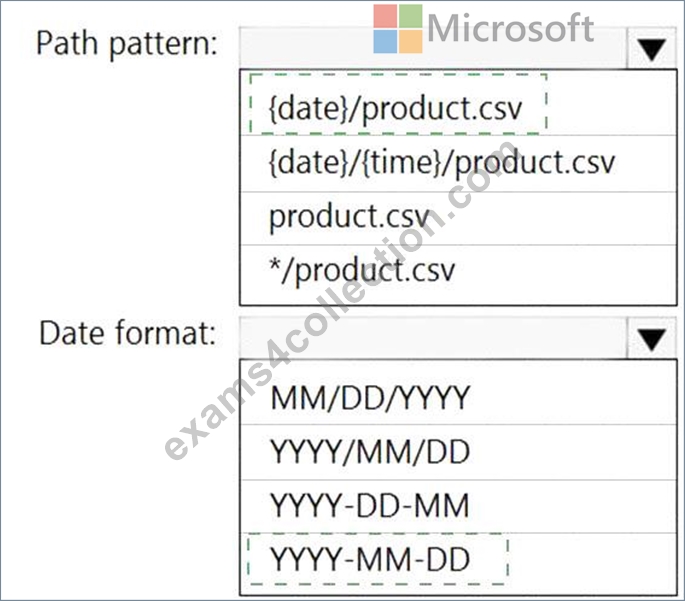
Explanation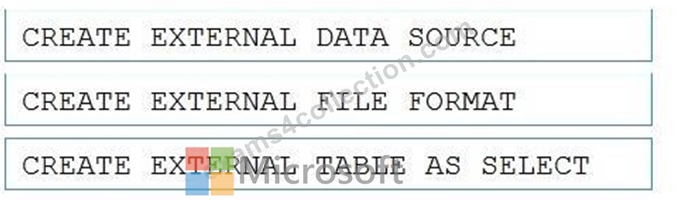
Scenario: Allow Contoso users to use PolyBase in an Azure Synapse Analytics dedicated SQL pool to query the content of the data records that host the Twitter feeds. Data must be protected by using row-level security (RLS). The users must be authenticated by using their own Azure AD credentials.
Box 1: CREATE EXTERNAL DATA SOURCE
External data sources are used to connect to storage accounts.
Box 2: CREATE EXTERNAL FILE FORMAT
CREATE EXTERNAL FILE FORMAT creates an external file format object that defines external data stored in Azure Blob Storage or Azure Data Lake Storage. Creating an external file format is a prerequisite for creating an external table.
Box 3: CREATE EXTERNAL TABLE AS SELECT
When used in conjunction with the CREATE TABLE AS SELECT statement, selecting from an external table imports data into a table within the SQL pool. In addition to the COPY statement, external tables are useful for loading data.
Reference:
https://docs.microsoft.com/en-us/azure/synapse-analytics/sql/develop-tables-external-tables
NEW QUESTION # 53
Which Azure Data Factory components should you recommend using together to import the daily inventory data from the SQL server to Azure Data Lake Storage? To answer, select the appropriate options in the answer area.
NOTE: Each correct selection is worth one point.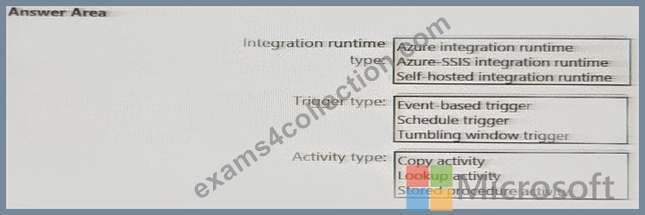
Answer:
Explanation: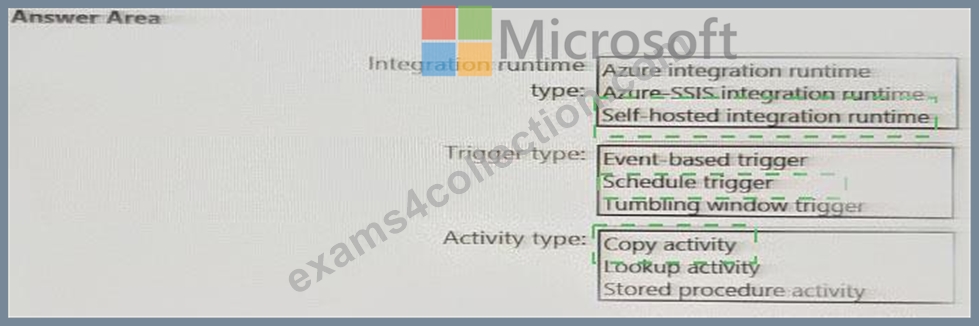
NEW QUESTION # 54
You have an Azure subscription that is linked to a hybrid Azure Active Directory (Azure AD) tenant. The subscription contains an Azure Synapse Analytics SQL pool named Pool1.
You need to recommend an authentication solution for Pool1. The solution must support multi-factor authentication (MFA) and database-level authentication.
Which authentication solution or solutions should you include in the recommendation? To answer, select the appropriate options in the answer area.
NOTE: Each correct selection is worth one point.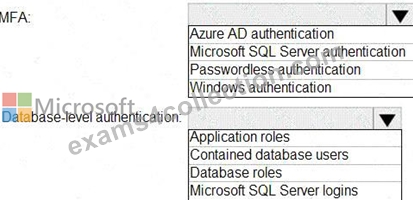
Answer:
Explanation: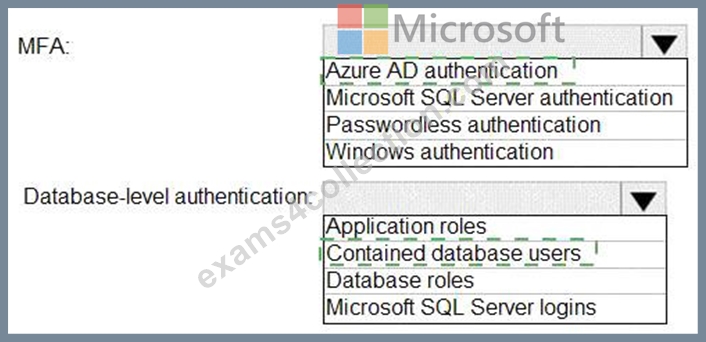
Explanation: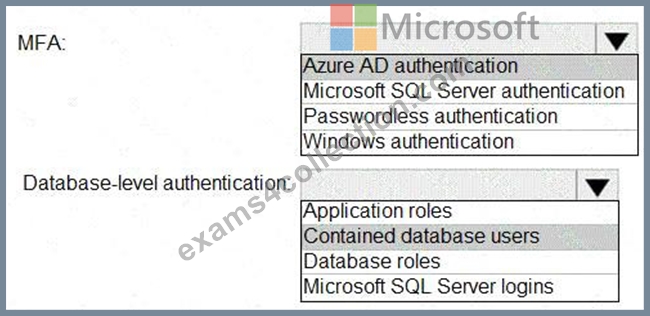
Box 1: Azure AD authentication
Azure Active Directory authentication supports Multi-Factor authentication through Active Directory Universal Authentication.
Box 2: Contained database users
Azure Active Directory Uses contained database users to authenticate identities at the database level.
Reference:
https://docs.microsoft.com/en-us/azure/synapse-analytics/sql-data-warehouse/sql-data-warehouse- authentication
NEW QUESTION # 55
You use Azure Data Lake Storage Gen2 to store data that data scientists and data engineers will query by using Azure Databricks interactive notebooks. Users will have access only to the Data Lake Storage folders that relate to the projects on which they work.
You need to recommend which authentication methods to use for Databricks and Data Lake Storage to provide the users with the appropriate access. The solution must minimize administrative effort and development effort.
Which authentication method should you recommend for each Azure service? To answer, select the appropriate options in the answer area.
NOTE: Each correct selection is worth one point.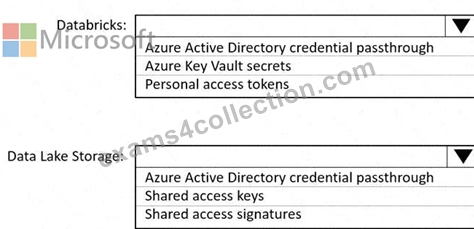
Answer:
Explanation: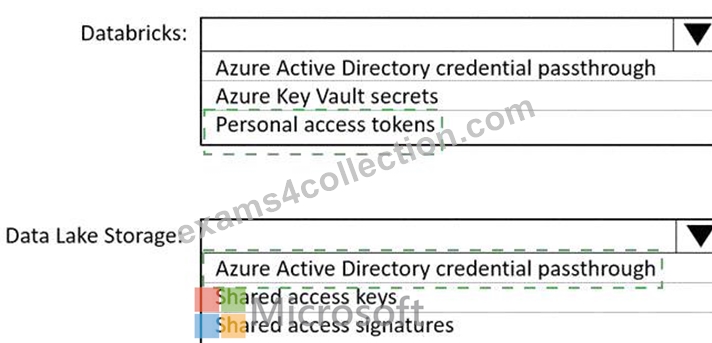
Explanation: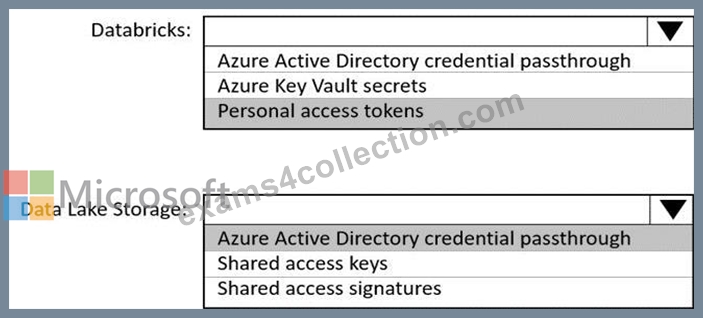
Box 1: Personal access tokens
You can use storage shared access signatures (SAS) to access an Azure Data Lake Storage Gen2 storage account directly. With SAS, you can restrict access to a storage account using temporary tokens with fine- grained access control.
You can add multiple storage accounts and configure respective SAS token providers in the same Spark session.
Box 2: Azure Active Directory credential passthrough
You can authenticate automatically to Azure Data Lake Storage Gen1 (ADLS Gen1) and Azure Data Lake Storage Gen2 (ADLS Gen2) from Azure Databricks clusters using the same Azure Active Directory (Azure AD) identity that you use to log into Azure Databricks. When you enable your cluster for Azure Data Lake Storage credential passthrough, commands that you run on that cluster can read and write data in Azure Data Lake Storage without requiring you to configure service principal credentials for access to storage.
After configuring Azure Data Lake Storage credential passthrough and creating storage containers, you can access data directly in Azure Data Lake Storage Gen1 using an adl:// path and Azure Data Lake Storage Gen2 using an abfss:// path:
Reference:
https://docs.microsoft.com/en-us/azure/databricks/data/data-sources/azure/adls-gen2/azure-datalake-gen2-sas- access
https://docs.microsoft.com/en-us/azure/databricks/security/credential-passthrough/adls-passthrough
NEW QUESTION # 56
You are building an Azure Synapse Analytics dedicated SQL pool that will contain a fact table for transactions from the first half of the year 2020.
You need to ensure that the table meets the following requirements:
Minimizes the processing time to delete data that is older than 10 years Minimizes the I/O for queries that use year-to-date values How should you complete the Transact-SQL statement? To answer, select the appropriate options in the answer area.
NOTE: Each correct selection is worth one point.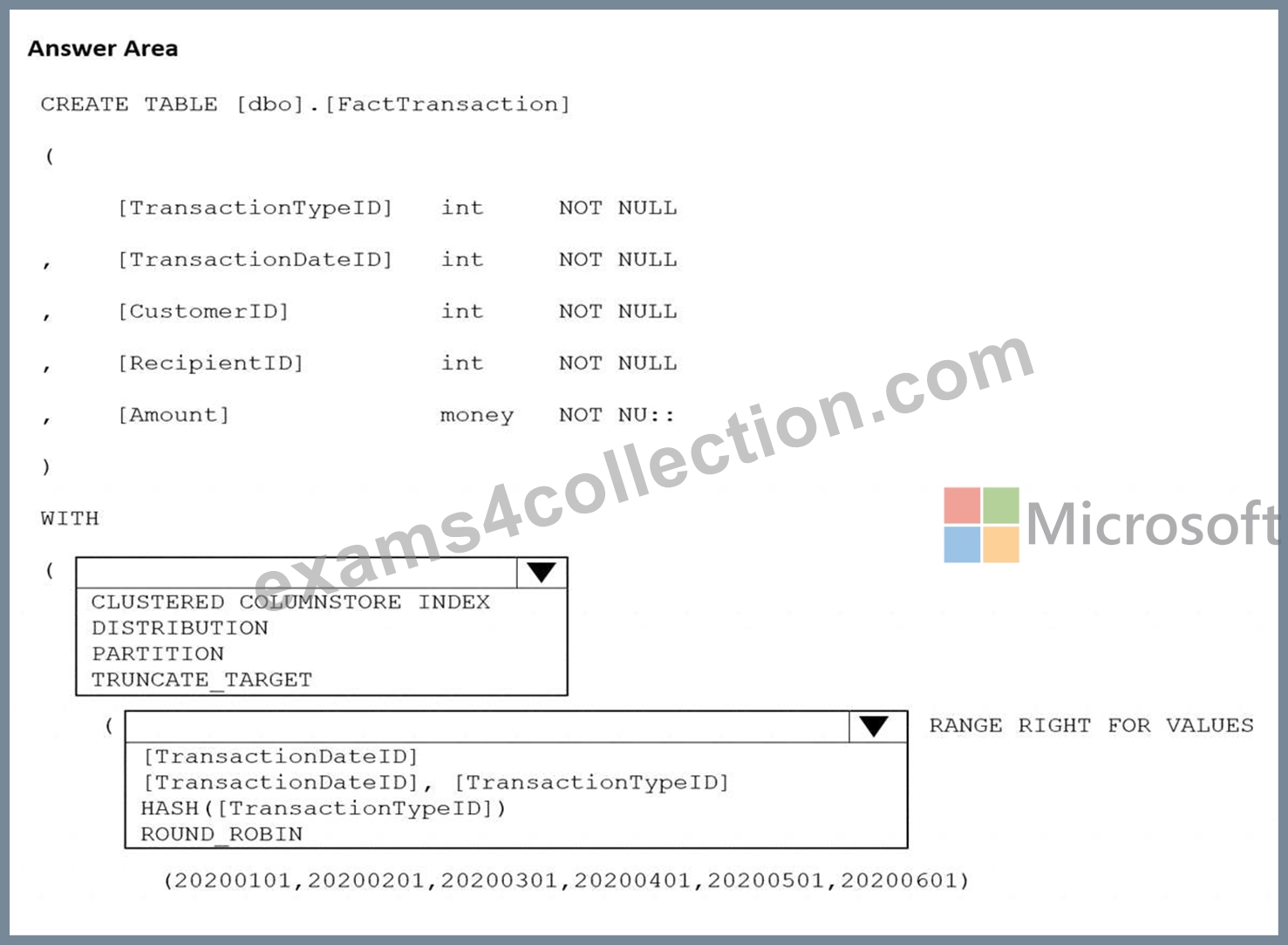
Answer:
Explanation: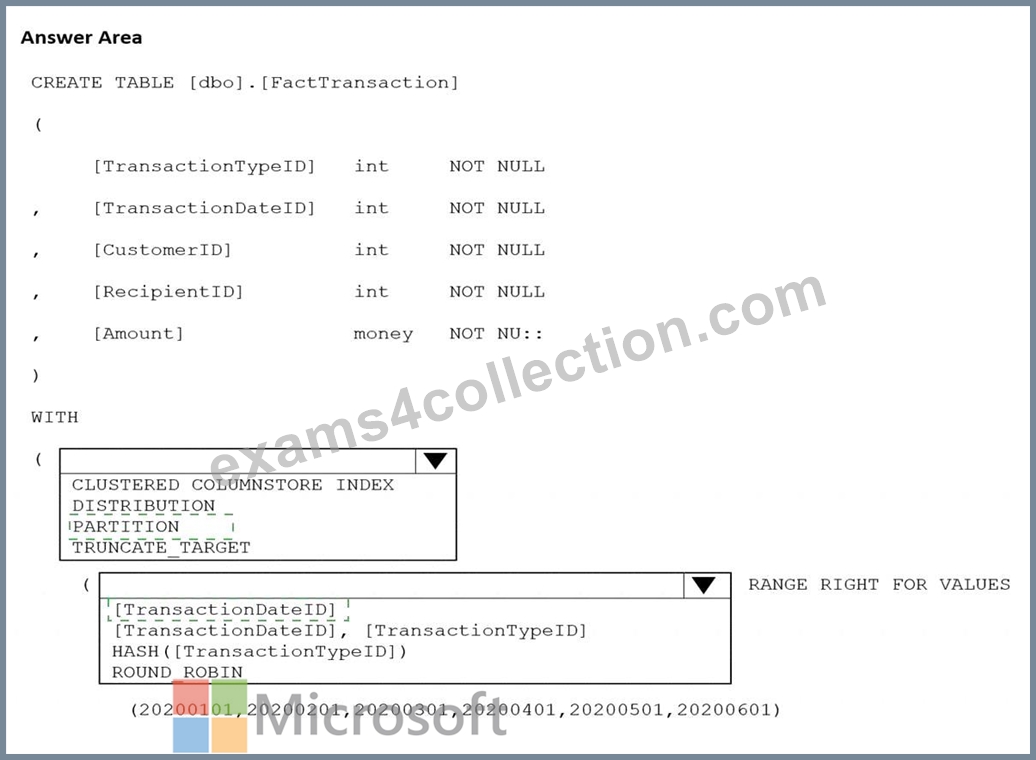
Explanation
Table Description automatically generated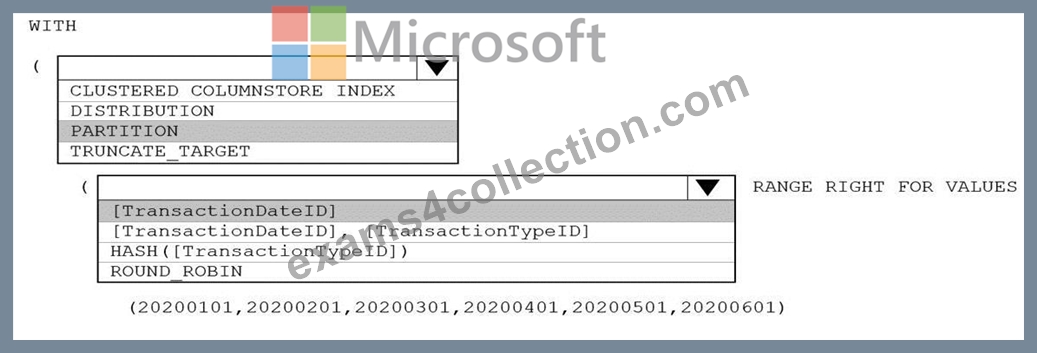
Box 1: PARTITION
RANGE RIGHT FOR VALUES is used with PARTITION.
Part 2: [TransactionDateID]
Partition on the date column.
Example: Creating a RANGE RIGHT partition function on a datetime column The following partition function partitions a table or index into 12 partitions, one for each month of a year's worth of values in a datetime column.
CREATE PARTITION FUNCTION [myDateRangePF1] (datetime)
AS RANGE RIGHT FOR VALUES ('20030201', '20030301', '20030401',
'20030501', '20030601', '20030701', '20030801',
'20030901', '20031001', '20031101', '20031201');
Reference:
https://docs.microsoft.com/en-us/sql/t-sql/statements/create-partition-function-transact-sql
NEW QUESTION # 57
Note: This question is part of a series of questions that present the same scenario. Each question in the series contains a unique solution that might meet the stated goals. Some question sets might have more than one correct solution, while others might not have a correct solution.
After you answer a question in this section, you will NOT be able to return to it. As a result, these questions will not appear in the review screen.
You have an Azure Synapse Analytics dedicated SQL pool that contains a table named Table1.
You have files that are ingested and loaded into an Azure Data Lake Storage Gen2 container named container1.
You plan to insert data from the files in container1 into Table1 and transform the dat a. Each row of data in the files will produce one row in the serving layer of Table1.
You need to ensure that when the source data files are loaded to container1, the DateTime is stored as an additional column in Table1.
Solution: You use an Azure Synapse Analytics serverless SQL pool to create an external table that has an additional DateTime column.
Does this meet the goal?
- A. No
- B. Yes
Answer: A
Explanation:
Instead use the derived column transformation to generate new columns in your data flow or to modify existing fields.
Reference:
https://docs.microsoft.com/en-us/azure/data-factory/data-flow-derived-column
NEW QUESTION # 58
You have an Azure subscription that contains the following resources:
An Azure Active Directory (Azure AD) tenant that contains a security group named Group1 An Azure Synapse Analytics SQL pool named Pool1 You need to control the access of Group1 to specific columns and rows in a table in Pool1.
Which Transact-SQL commands should you use? To answer, select the appropriate options in the answer area.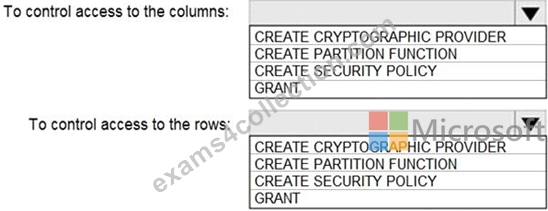
Answer:
Explanation: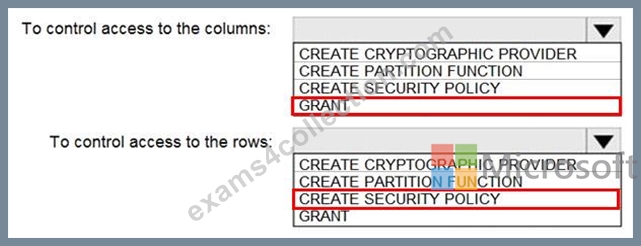
Reference:
https://docs.microsoft.com/en-us/azure/synapse-analytics/sql-data-warehouse/column-level-security
NEW QUESTION # 59
You are designing a statistical analysis solution that will use custom proprietary1 Python functions on near real-time data from Azure Event Hubs.
You need to recommend which Azure service to use to perform the statistical analysis. The solution must minimize latency.
What should you recommend?
- A. Azure SQL Database
- B. Azure Stream Analytics
- C. Azure Databricks
- D. Azure Synapse Analytics
Answer: B
Explanation:
Reference:
https://docs.microsoft.com/en-us/azure/event-hubs/process-data-azure-stream-analytics
NEW QUESTION # 60
You have an Azure subscription that is linked to a hybrid Azure Active Directory (Azure AD) tenant. The subscription contains an Azure Synapse Analytics SQL pool named Pool1.
You need to recommend an authentication solution for Pool1. The solution must support multi-factor authentication (MFA) and database-level authentication.
Which authentication solution or solutions should you include in the recommendation? To answer, select the appropriate options in the answer area.
NOTE: Each correct selection is worth one point.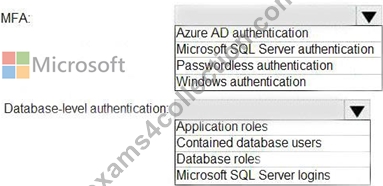
Answer:
Explanation: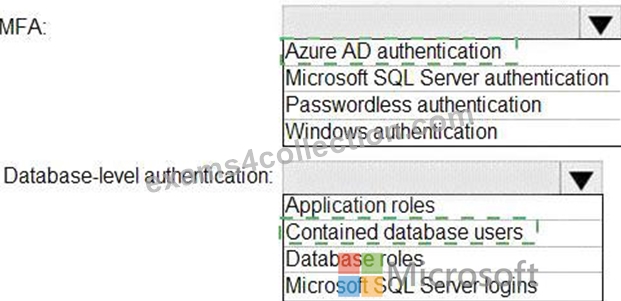
Explanation
Graphical user interface, text, application, chat or text message Description automatically generated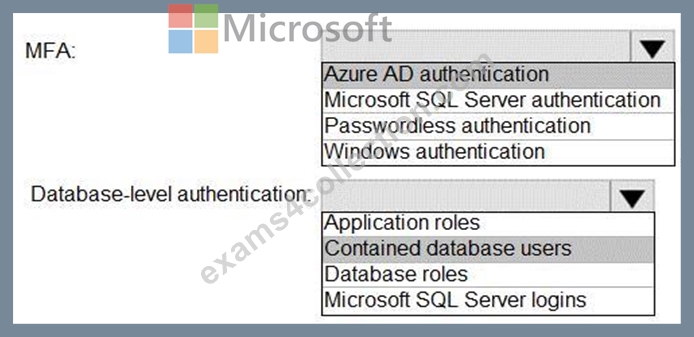
Box 1: Azure AD authentication
Azure Active Directory authentication supports Multi-Factor authentication through Active Directory Universal Authentication.
Box 2: Contained database users
Azure Active Directory Uses contained database users to authenticate identities at the database level.
Reference:
https://docs.microsoft.com/en-us/azure/synapse-analytics/sql-data-warehouse/sql-data-warehouse-authentication
NEW QUESTION # 61
You have two fact tables named Flight and Weather. Queries targeting the tables will be based on the join between the following columns.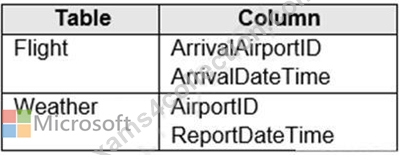
You need to recommend a solution that maximizes query performance.
What should you include in the recommendation?
- A. In each table, create a column as a composite of the other two columns in the table.
- B. In the tables use a hash distribution of ArrivalDateTime and ReportDateTime.
- C. In each table, create an identity column.
- D. In the tables use a hash distribution of ArrivaIAirportID and AirportlD.
Answer: D
Explanation:
Hash-distribution improves query performance on large fact tables.
Incorrect Answers:
A: Do not use a date column for hash distribution. All data for the same date lands in the same distribution. If several users are all filtering on the same date, then only 1 of the 60 distributions do all the processing work.
NEW QUESTION # 62
You are planning the deployment of Azure Data Lake Storage Gen2.
You have the following two reports that will access the data lake:
* Report1: Reads three columns from a file that contains 50 columns.
* Report2: Queries a single record based on a timestamp.
You need to recommend in which format to store the data in the data lake to support the reports. The solution must minimize read times.
What should you recommend for each report? To answer, select the appropriate options in the answer area.
NOTE: Each correct selection is worth one point.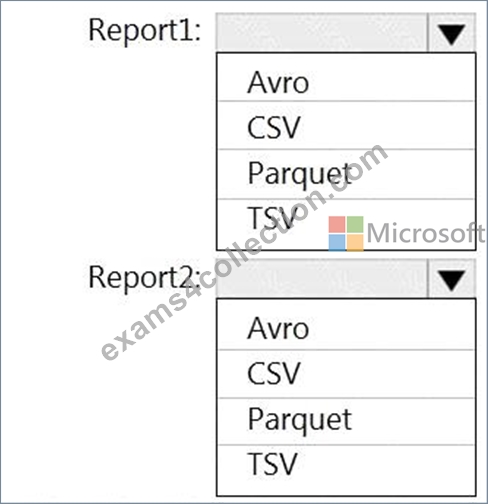
Answer:
Explanation: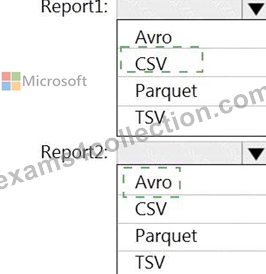
Explanation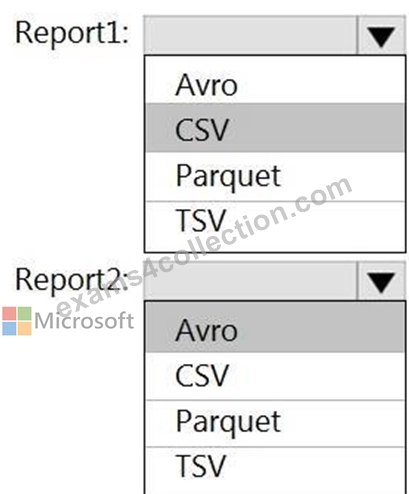
Report1: CSV
CSV: The destination writes records as delimited data.
Report2: AVRO
AVRO supports timestamps.
Not Parquet, TSV: Not options for Azure Data Lake Storage Gen2.
Reference:
https://streamsets.com/documentation/datacollector/latest/help/datacollector/UserGuide/Destinations/ADLS-G2-
NEW QUESTION # 63
You have two Azure Storage accounts named Storage1 and Storage2. Each account holds one container and has the hierarchical namespace enabled. The system has files that contain data stored in the Apache Parquet format.
You need to copy folders and files from Storage1 to Storage2 by using a Data Factory copy activity. The solution must meet the following requirements:
No transformations must be performed.
The original folder structure must be retained.
Minimize time required to perform the copy activity.
How should you configure the copy activity? To answer, select the appropriate options in the answer area.
NOTE: Each correct selection is worth one point.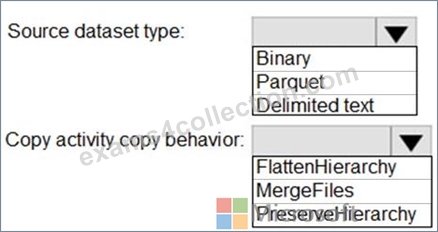
Answer:
Explanation: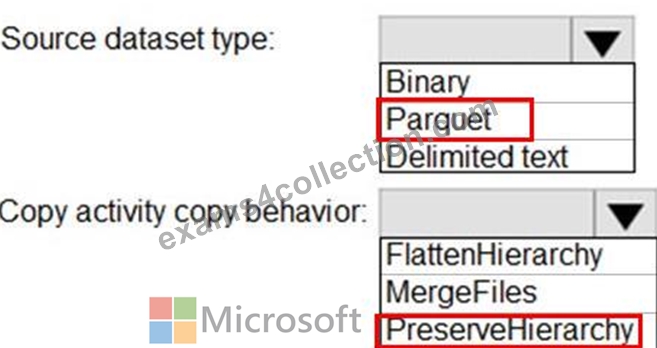
Reference:
https://docs.microsoft.com/en-us/azure/data-factory/format-parquet
https://docs.microsoft.com/en-us/azure/data-factory/connector-azure-data-lake-storage
NEW QUESTION # 64
......
The DP-203 exam is intended for data engineers, data architects, and other IT professionals who are responsible for designing, implementing, and managing data solutions on Azure. It is ideal for individuals who have experience with Azure-based data solutions and want to validate their skills with a globally recognized certification. Additionally, the DP-203 exam is an excellent choice for professionals who want to enhance their career prospects and increase their earning potential in the field of data engineering.
Pass Your DP-203 Dumps as PDF Updated on 2025 With 365 Questions: https://www.exams4collection.com/DP-203-latest-braindumps.html
Microsoft DP-203 Real Exam Questions and Answers FREE: https://drive.google.com/open?id=1kkGQGzpbwRNKe4N-qEatyEi_9nNEq1_1
