

[Aug 09, 2026] NS0-094 Free Exam Questions with Quality Guaranteed
NS0-094 Free Exam Files Downloaded Instantly
NEW QUESTION # 25
On a NetApp FAS9000 system, which two field replaceable units (FRUs) are supported for replacement without takeover? (Choose two.)
- A. I/O module
- B. NVRAM module
- C. DCPM module
- D. caching module
Answer: A,B
Explanation:
FRUs on FAS9000 Supporting Replacement Without Takeover:
A). (I/O Module): I/O modules can be replaced hot (without takeover) to maintain system uptime during hardware servicing.
D). (NVRAM Module): NVRAM modules on FAS9000 can also be replaced without a node takeover, ensuring data integrity during replacement.
NEW QUESTION # 26
A 4-node NetApp ONTAP cluster sent an AutoSupport message for a single power supply failure in the cluster. The alert shows a failure for both node-1 and node-4. Why are two different nodes affected by the failure?
- A. There is a failover of node-2 to node-1.
- B. Both node-1 and node-4 are in the same chassis.
- C. There is a failover of node-3 to node-4.
- D. There is a failure in cluster interconnect switch-1.
Answer: B
Explanation:
A single power supply is shared by the controllers installed in the same chassis. Therefore, one failed power supply can generate alerts for both nodes that reside in that chassis.
NEW QUESTION # 27
You receive the following AutoSupport message:
When researching, you discover the following output:
What action do you take to resolve this issue?
- A. Update the firmware on the cluster switches.
- B. Replace the SFP on port e0a on node-02.
- C. Replace the SFP on port e0a on node-01.
- D. Update the RCF file on the cluster switches.
Answer: B
Explanation:
The degraded health output identifies Node-02 port e0a with link_flapping, indicating an unstable physical connection on that node port. Replacing the SFP on the affected port is the appropriate corrective action.
NEW QUESTION # 28
A storage administrator is troubleshooting a 4-node cluster, where one node is reporting "cluster port is down" alerts. The node has recently been recabled to new cluster switches. The cluster ping-cluster command shows communication failures between the affected node and its partners over the cluster network. All physical cables have been verified as properly seated and undamaged. Which configuration is causing this problem?
- A. An incorrect gateway is defined for the management network.
- B. An incorrect intercluster LIF is configured.
- C. The SVM data LIFs are on the wrong ports.
- D. The MTU size on the new cluster switches is mismatched with the nodes.
Answer: D
Explanation:
Cluster ports require consistent MTU settings between the ONTAP nodes and the cluster switches. After recabling to new cluster switches, an MTU mismatch can cause cluster network communication failures even when the physical cabling is correct.
NEW QUESTION # 29
Your customer notices that their AFF A220 high-availability (HA) system is showing Single-Path HA.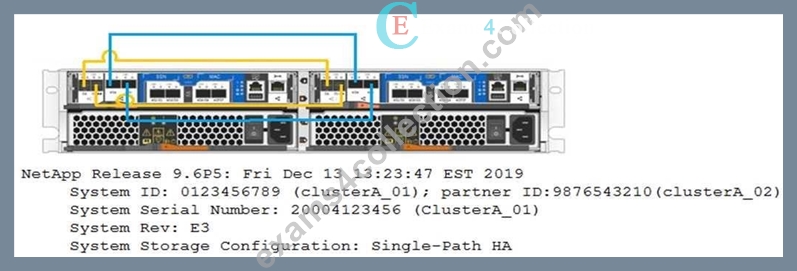
How do you make the system into multipath HA?
- A. 0c and 0d on both controllers should be connected.
- B. 0a and 0b on both controllers should be connected.
- C. 0a and 0d on both controllers should be connected
- D. 0a and 0c on both controllers should be connected.
Answer: D
Explanation:
In a NetApp high-availability (HA) configuration, multipath HA ensures redundancy by providing two independent paths from each controller to the connected storage. If the system is currently showing Single-Path HA, it means only one path is operational or connected, which is a potential single point of failure.
To convert the configuration to multipath HA, additional cabling must be configured to establish the second path. For the AFF A220 system, the correct connections are as follows:
Explanation of the Correct answer:
AFF A220 Port Configuration for HA:
Each controller in an AFF A220 has ports labeled 0a, 0b, 0c, and 0d for connectivity.
In a multipath HA configuration, each controller must have two independent paths to the connected storage via the partner controller's disk shelves.
Correct Cabling for Multipath HA:
Port 0a on both controllers must be connected to the corresponding port (e.g., disk shelf stack or Inter-Switch Link).
Port 0c on both controllers must also be connected to complete the redundant path.
These connections ensure that there are two independent data paths between the controllers and the storage system, providing fault tolerance in case one path fails.
Single-Path HA to Multipath HA:
If the system currently shows Single-Path HA, it is likely that only one set of ports (e.g., 0a and
0b) are cabled.
Adding the additional connections on 0a and 0c establishes the second path required for multipath HA.
NEW QUESTION # 30
A 4-node NetApp ONTAP cluster sent an alert that one of the cluster interconnect switches has failed. After replacement, the system administrator notices that half of the cluster LIFs are not on their home ports. Which parameter must the system administrator enable to automatically migrate the cluster LIFs?
- A. allow-lb-migrate
- B. auto-revert
- C. failover-policy
- D. home-port
Answer: B
Explanation:
Enabling auto-revert allows cluster LIFs to automatically migrate back to their designated home ports after the failed cluster switch has been replaced and connectivity is restored.
NEW QUESTION # 31
You need to upgrade your cluster switches to a new version of firmware. Which command do you use to prevent automatic case creation?
- A. system node autosupport invoke -node * -type all -message SUPPRESS=5h
- B. system node autosupport invoke -node * -type all -message STOP=5h
- C. system node autosupport invoke -node * -type all -message IGNORE=5h
- D. system node autosupport invoke -node * -type all -message MAINT=5h
Answer: D
Explanation:
The system node autosupport invoke -message MAINT=5h command places the system into a maintenance window for five hours, preventing automatic support case creation during planned activities such as switch firmware upgrades.
NEW QUESTION # 32
You have upgraded your cluster from ONTAP 9.5 software to ONTAP 9.7 software. After two days, you notice that the upgrade is causing issues. You decide to revert to ONTAP 9.5 software.
Which two actions do you need to complete before you revert? (Choose two.)
- A. Delete all Snapshot copies from the past two days.
- B. Wipe your config and restore from backup.
- C. Reinstall your boot media and install ONTAP 9.5 software.
- D. Revert from ONTAP 9.7 software to ONTAP 9.6 software and then to ONTAP 9.5 software.
Answer: B,C
Explanation:
Reverting to a previous ONTAP version requires careful preparation because ONTAP upgrades often introduce irreversible changes. To successfully revert, the following actions are needed:
C). Reinstall your boot media and install ONTAP 9.5 software
You need to reinstall the older version of ONTAP (9.5) on the boot media because the current version (9.7) has been installed as part of the upgrade. The reinstallation ensures that the system boots with ONTAP 9.5.
Steps:
Boot the node into maintenance mode.
Perform the reinstallation using the appropriate ONTAP 9.5 image.
D). Wipe your config and restore from backup
A revert requires wiping the configuration because ONTAP upgrades may have made changes to the cluster configuration or WAFL metadata. Restoring the configuration from a backup ensures consistency with the older ONTAP version.
Steps:
Back up the current cluster configuration before proceeding.
Use the restored backup after the revert is complete to reconfigure the system.
NEW QUESTION # 33
A storage administrator receives an alert that an aggregate is in a "degraded" state. What is the cause of this issue?
- A. A SnapMirror relationship has failed to update.
- B. The aggregate has run out of free space.
- C. One or more drives in the aggregate have failed.
- D. An administrator has accidentally taken the aggregate offline.
Answer: C
Explanation:
An aggregate enters a degraded state when one or more disks within the aggregate have failed or are unavailable, reducing RAID protection and requiring corrective action such as disk replacement or reconstruction.
NEW QUESTION # 34
You have a NetApp ONTAP cluster that is serving both SMB over 10Gbe and FC data. An application owner has started to complain about poor performance and asks you to research the issue. When looking through EMS messages, you see the following output:
Which defective component triggers the EMS message?
- A. fiber cable
- B. adapter card in slot 2
- C. 10Gbe module
- D. 32G FC module
Answer: D
Explanation:
The EMS message identifies low transmit power from the SFP in FC target adapter 2c. This points to the FC optical module/transceiver on that FC port as the defective component.
NEW QUESTION # 35
You have an air-gapped NetApp ONTAP based system that has recently had a node panic, and the node is back online. To assist in troubleshooting, the NetApp Support team has asked you to submit the core file for analysis. Which two methods do you use to access the core files from the ONTAP controllers in this environment? (Choose two.)
- A. Use the system node coredump upload command.
- B. Use the system node autosupport invoke command.
- C. Collect files from the SPI of the affected nodes.
- D. Use the system node coredump external-device command.
Answer: C,D
Explanation:
The system node coredump external-device command is used in air-gapped environments to copy core files to an external storage device for transfer and analysis. Core files can also be accessed and collected through the Service Processor Infrastructure (SPI) of the affected nodes.
NEW QUESTION # 36
A node has unexpectedly failed and is unresponsive through its node management interface.
Which two commands from the Service Processor are helpful to determine the root cause?
(Choose two.)
- A. system log
- B. event log show
- C. system core
- D. sp status -d
Answer: B,C
Explanation:
To determine the root cause of an unexpected node failure using the Service Processor (SP), the following commands are helpful:
1. event log show
What it does:
Displays recent events logged by the Service Processor. This includes hardware failures, environmental alerts, or other events that may have caused the node failure.
2. system core
What it does:
Shows information about any core dumps that were generated during the failure. A core dump provides a snapshot of the system state at the time of the failure, which can be analyzed to identify the root cause.
NEW QUESTION # 37
Which two tools can you use to invoke AutoSupport? (Choose two.)
- A. NetApp Cloud Insights
- B. the SmartSolve tool
- C. CLI
- D. the NetApp Active IQ website
Answer: C,D
Explanation:
To invoke AutoSupport in ONTAP, the following tools can be used:
1. CLI (Command Line Interface)
How to use:
Run the command:
python
Copy code
autosupport invoke -node <nodename> -type all
This triggers AutoSupport to collect and send logs and system information.
2. NetApp Active IQ website
How to use:
Log in to the Active IQ portal and use its interface to request an AutoSupport message from the connected ONTAP systems.
NEW QUESTION # 38
Which two factors can increase the chances of experiencing a NetApp WAFL inconsistency on an aggregate? (Choose two.)
- A. ignoring NetApp Active IQ health risks
- B. using outdated disk firmware
- C. upgrading frequently
- D. constantly running at high load
Answer: A,B
Explanation:
A). Ignoring NetApp Active IQ health risks
NetApp Active IQ provides proactive monitoring and alerts for system health risks, including risks related to WAFL inconsistencies. Ignoring these alerts can lead to unresolved issues such as metadata corruption, hardware failures, or system misconfigurations, increasing the chances of WAFL inconsistencies.
Examples of Active IQ Risks:
Disk health warnings.
High write latency or metadata bottlenecks.
Aggregates running out of space.
C). Using outdated disk firmware
Outdated disk firmware can cause performance issues, drive failures, or incorrect handling of I/O operations, potentially leading to WAFL inconsistencies. Disk firmware updates often include fixes for critical issues that improve reliability and prevent data corruption.
Importance:
Keeping firmware updated ensures compatibility with ONTAP and minimizes risks of disk-level errors that can propagate to WAFL.
NEW QUESTION # 39
After a panic, the customer asks you to explain the error "watchdog timeout." Which explanation would be appropriate?
- A. An optional component included with Active IQ Unified Manager.
It notifies a user if watchdog fails to reach the storage system within a certain period. - B. An optional software that monitors system performance.
An overloaded system fails to reset the watchdog and watchdog induces a system panic. - C. A service that monitors network activity and protects data.
A watchdog induces system panic to protect data if malicious activity is detected. - D. A service that detects and recovers from computer malfunctions.
A hardware or software error prevents update of watchdog and it induces a system panic.
Answer: D
Explanation:
What Is a Watchdog Timeout?
The watchdog is a software or hardware mechanism that monitors the system's health and ensures it is operating correctly.
If the system fails to respond or update the watchdog timer within the specified time, the watchdog triggers a system panic to avoid further corruption or damage.
Cause of Watchdog Timeout:
This usually occurs due to:
A hardware failure (e.g., CPU or memory issue).
A software bug causing a system hang or crash.
The panic ensures the system stops operation to preserve data integrity and aid in troubleshooting.
NEW QUESTION # 40
You just replaced the boot media on a NetApp AFF C80 system in a data center, and you need to reinstall NetApp ONTAP software on the boot media. However, a USB stick containing the ONTAP image is not available. Which two commands can you use to recover the boot media?
(Choose two.)
- A. boot_ontap maint
- B. netboot
- C. boot_recovery -partner
- D. boot_diags
Answer: B,C
Explanation:
The netboot command is used to boot the system over the network and load the ONTAP image when a USB device is unavailable. The boot_recovery -partner command restores the boot media configuration and retrieves required recovery information from the HA partner after the ONTAP image has been loaded.
NEW QUESTION # 41
At what stage is a write acknowledged to a client?
- A. when the write is present in the local node RAM and NVRAM
- B. when the write is present in the NVRAM on the local node and its HA partner
- C. when the write has been flushed to disk
- D. when the write has been flushed from NVRAM to RAM
Answer: B
Explanation:
Write Acknowledgment in NetApp ONTAP:
In a clustered ONTAP system, write requests are acknowledged to the client only after they are securely stored in NVRAM on both the local node and its HA (High Availability) partner. This ensures redundancy and data protection in case of a node failure.
NEW QUESTION # 42
......
Q&As with Explanations Verified & Correct Answers: https://www.exams4collection.com/NS0-094-latest-braindumps.html
