

Get Fortinet FCP_FAZ_AN-7.4 Dumps Questions [2026] To Gain Brilliant Result
FCP_FAZ_AN-7.4 dumps - Exams4Collection - 100% Passing Guarantee
NEW QUESTION # 21
An administrator fortinet, is able to view logs and perform device management tasks, such as adding and removing registered devices. However, administrator fortinet is not able to create a mall server that can be used to send email.
What could be the problem?
- A. Fortinet is assigned the Restricted_ User administrator profile.
- B. Fortinet is assigned the Standard_ User administrator profile.
- C. ADOM mode is configured with Advanced mode.
- D. A trusted host is configured.
Answer: B
NEW QUESTION # 22
A playbook contains five tasks in total. An administrator runs the playbook and four out of five tasks finish successfully, but one task fails.
What will be the status of the playbook after it is run?
- A. Attention required
- B. Failed
- C. Upstream_failed
- D. Success
Answer: A
Explanation:
In FortiAnalyzer, when a playbook is run, each task's status impacts the overall playbook status. Here's what happens based on task outcomes:
Status When All Tasks Succeed:
If all tasks finish successfully, the playbook status is marked as Success.
Status When Some Tasks Fail:
If one or more tasks in the playbook fail, but others succeed, the playbook status generally changes to Attention required. This status indicates that the playbook completed execution but requires review due to one or more tasks failing.
This is different from a complete Failed status, which is used if the playbook cannot proceed due to a critical error in an early task, often one that upstream tasks depend on.
Option Analysis:
A . Attention required: This is correct as the playbook has completed, but with partial success and a task requiring review.
B . Upstream_failed: This status is used if a task cannot run because a prerequisite or "upstream" task failed. Since four out of five tasks completed, this is not the case here.
C . Failed: This status would imply that the playbook completely failed, which does not match the scenario where only one task out of five failed.
D . Success: This status would apply if all tasks had completed successfully, which is not the case here.
Conclusion:
Correct Answe r : A. Attention required
The playbook status reflects that it completed, but an error occurred in one of the tasks, prompting the administrator to review the failed task.
Reference:
FortiAnalyzer 7.4.1 documentation on playbook execution statuses and task error handling.
NEW QUESTION # 23
What remote authentication servers can you configure to validate your FortiAnalyzer administrator logons? (Choose three)
- A. LDAP
- B. TACACS+
- C. RADIUS
- D. PKI
- E. Local
Answer: A,B,C
NEW QUESTION # 24
Refer to the exhibit.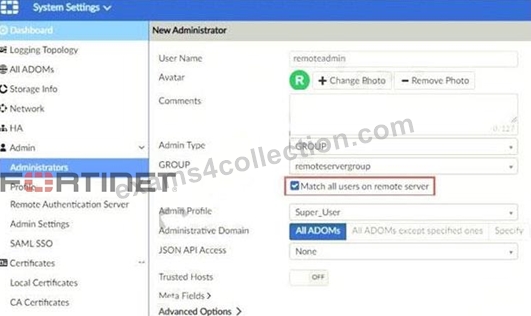
The exhibit shows "remoteservergroup" is an authentication server group with LDAP and RADIUS servers.
Which two statements express the significance of enabling "Match all users on remote server" when configuring a new administrator? (Choose two.)
- A. It creates a wildcard administrator using LDAP and RADIUS servers.
- B. It allows administrators to use two-factor authentication.
- C. Use remoteadmin from LDAP and RADIUS servers will be able to log in to FortiAnalyzer at anytime.
- D. Administrator can log in to FortiAnalyzer using their credentials on remote servers LDAP and RADIUS.
Answer: A,D
NEW QUESTION # 25
Refer to the exhibit.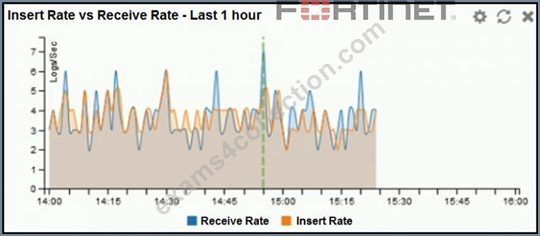
What does the data point at 14:55 tell you?
- A. Raw logs are reaching FortiAnalyzer faster than they can be indexed
- B. The sqlplugind daemon is behind in log indexing by two logs
- C. Logs are being dropped
- D. The received rate is almost at its maximum for this device
Answer: A
NEW QUESTION # 26
Which two statements are true regarding log fetching on FortiAnalyzer? (Choose two.)
- A. Log fetching allows the administrator to fetch analytics logs from another FortiAnalyzer for redundancy.
- B. A FortiAnalyzer device can perform either the fetch server or client role, and it can perform two roles at the same time with the same FortiAnalyzer devices at the other end.
- C. Log fetching allows the administrator to run queries and reports against historical data by retrieving archived logs from one FortiAnalyzer device and sending them to another FortiAnalyzer device.
- D. Log fetching can be done only on two FortiAnalyzer devices that are running the same firmware version.
Answer: C,D
NEW QUESTION # 27
Exhibit.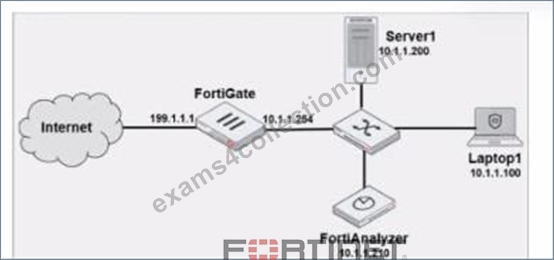
Laptop1 is used by severaladministratorsto manage FotiAnalyzer. You want to configure a generic text filter that matches all login attempts to the web interface generated by any user other than admin'', and coming from Laptop1.
Which filter will achieve the desired result?
- A. Operation-login and performed_on==''GU(10.1.1.120)' and user!=admin
- B. Operation-login and srcip== 10.1.1.100 and dstip==10.1.1.1.210 and user==admin
- C. Operation-login and dstip==10.1.1.210 and user!-admin
- D. Operation-login and performed_on==''GUI(10.1.1.100)' and user!=admin
Answer: D
Explanation:
The objective is to create a filter that identifies all login attempts to the FortiAnalyzer web interface (GUI) coming fromLaptop1(IP 10.1.1.100) and excludes the admin user. This filter should match any user other than admin.
* Filter Components Analysis:
* Operation-login: This portion of the filter will target login actions specifically, which is correct for filtering login attempts.
* performed_on==''GUI(10.1.1.100)': This indicates that the login attempt must occur on the GUI interface and originate from the specified IP, which matches Laptop1's IP address (10.1.1.100). This ensures that the filter only matches GUI logins from this specific device.
* user!=admin: This part excludes logins by the admin user, meeting the requirement to capture only non-admin users.
* Option Analysis:
* Option A: Correctly specifies theOperation-login,performed_on==''GUI(10.1.1.100)', and user!=admin. This setup effectively filters login attempts to the GUI from Laptop1, excluding the admin user.
* Option B: Uses the incorrect IP 10.1.1.120 in the performed_on filter, which does not match Laptop1's IP (10.1.1.100).
* Option C: This option includessrcip==10.1.1.100anddstip==10.1.1.210but incorrectly specifies user==admininstead ofuser!=admin, which does not match the requirement to exclude admin users.
* Option D: This option does not specify theperformed_onfield to restrict it to the GUI and only includesdstip(destination IP) withoutsrcip. It also incorrectly uses user!-admin instead of the correct syntaxuser!=admin.
Conclusion:
* Correct Answer:A. Operation-login and performed_on==''GUI(10.1.1.100)' and user!=admin
* This filter precisely captures the required conditions: login attempts from Laptop1 to the GUI interface by any user except admin.
References:
* FortiAnalyzer 7.4.1 documentation on log filters, syntax for login operations, and GUI login tracking.
NEW QUESTION # 28
Which FortiAnalyzer feature allows you to use a proactive approach when managing your network security?
- A. Threat hunting
- B. Incidents dashboard
- C. Outbreak alert services
- D. FortiView Monitor
Answer: A
Explanation:
FortiAnalyzer offers several features for monitoring, alerting, and incident management, each serving different purposes. Let's examine each option to determine which one best supports a proactive security approach.
* Option A - FortiView Monitor:
* FortiView is a visualization tool that provides real-time and historical insights into network traffic, threats, and logs. While it gives visibility into network activity, it is generally more reactive than proactive, as it relies on existing log data and incidents.
* Conclusion:Incorrect.
* Option B - Outbreak Alert Services:
* Outbreak Alert Services in FortiAnalyzer notify administrators of emerging threats and outbreaks based on FortiGuard intelligence. This is beneficial for awareness of potential threats but does not offer a hands-on, investigative approach. It's more of a notification service rather than an active, proactive investigation tool.
* Conclusion:Incorrect.
* Option C - Incidents Dashboard:
* The Incidents Dashboard provides a summary of incidents and current security statuses within the network. While it assists with ongoing incident response, it is used to manage and track existing incidents rather than proactively identifying new threats.
* Conclusion:Incorrect.
* Option D - Threat Hunting:
* Threat Hunting in FortiAnalyzer enables security analysts to actively search for hidden threats or malicious activities within the network by leveraging historical data, analytics, and intelligence.
This is a proactive approach as it allows analysts to seek out threats before they escalate into incidents.
* Conclusion:Correct.
Conclusion:
* Correct Answer:D. Threat hunting
* Threat hunting is the most proactive feature among the options, as it involves actively searching for threats within the network rather than reacting to already detected incidents.
References:
* FortiAnalyzer 7.4.1 documentation on Threat Hunting and proactive security measures.
NEW QUESTION # 29
What types of logs will FortiAnalyzer store?
- A. Traffic/Event/Security, Data Leak Prevention (DLP) archive, Quarantine.
- B. Traffic/Event/Security, Data Leak Prevention (DLP) archive, Quarantine, and IPS (Intrusion Protection System) Packets.
- C. Traffic/Event, Data Leak Prevention (DLP) archive, Quarantine, and IPS (Intrusion Protection System) Packets.
- D. Data Leak Prevention (DLP) archive, Quarantine, and IPS (Intrusion Protection System) Packets.
Answer: B
NEW QUESTION # 30
Refer to the exhibit.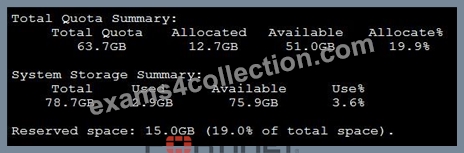
Why is the total quota less than the total system storage?
- A. The logfiled process is just estimating the total quota
- B. Some space is reserved for system use, such as storage of compression files, upload files and temporary report files
- C. 3.6% of the system storage is already being used
- D. The oftpd process has not archived the logs yet
Answer: B
NEW QUESTION # 31
What are two effects of enabling auto-cache in a FortiAnalyzer report? (Choose two.)
- A. The generation time for reports is decreased.
- B. The size of newly generated reports is optimized to conserve disk space.
- C. When new logs are received, the hard-cache data is updated automatically.
- D. FortiAnalyzer local cache is used to store generated reports.
Answer: A,D
Explanation:
Enablingauto-cachein FortiAnalyzer reports is designed to improve the efficiency and speed of report generation by leveraging cached data. Let's analyze each option to determine which effects are correct.
* Option A - The Generation Time for Reports is Decreased:
* When auto-cache is enabled, FortiAnalyzer can use previously cached data instead of reprocessing all log data from scratch each time a report is generated. This results in faster report generation times, especially for recurring reports that use similar datasets.
* Conclusion:Correct.
* Option B - Hard-Cache Data is Automatically Updated When New Logs are Received:
* Enabling auto-cache does not immediately update the cache with every new log received. Instead, the cache is updated when reports are generated, based on the existing logs up to that point.
Therefore, auto-cache does not constantly refresh with each incoming log, which would be inefficient.
* Conclusion:Incorrect.
* Option C - FortiAnalyzer Local Cache is Used to Store Generated Reports:
* Auto-cache utilizes FortiAnalyzer's local cache to store data used in reports, reducing the need to retrieve and process logs repeatedly. This cached data can be reused for subsequent report generation, enhancing performance.
* Conclusion:Correct.
* Option D - The Size of Newly Generated Reports is Optimized to Conserve Disk Space:
* Auto-cache does not directly impact the size of the report files themselves. It focuses on performance optimization through cached data for faster access, but it does not compress or optimize the storage size of the generated report.
* Conclusion:Incorrect.
Conclusion:
* Correct Answer:A. The generation time for reports is decreasedandC. FortiAnalyzer local cache is used to store generated reports.
* Enabling auto-cache helps reduce report generation time by using locally cached data and optimizes report processing, though it does not impact report size or continuously update with each new log.
References:
* FortiAnalyzer 7.4.1 documentation on report caching, auto-cache functionality, and report generation optimizations.
NEW QUESTION # 32
In order for FortiAnalyzer to collect logs from a FortiGate device, what configuration is required?
(Choose two.)
- A. Log encryption must be enabled
- B. ADOMs must be enabled
- C. FortiGate must be registered with FortiAnalyzer
- D. Remote logging must be enabled on FortiGate
Answer: C,D
NEW QUESTION # 33
Which statement about sending notifications with incident updates is true?
- A. Each connector used can have different notification settings.
- B. You must configure an output profile to send notifications by email.
- C. Notifications can be sent only when an incident is created or deleted.
- D. Each incident can send notifications to a single external platform.
Answer: A
NEW QUESTION # 34
Which two constraints can impact the amount of reserved disk space required by FortiAnalyzer?
(Choose two.)
- A. RAID level
- B. Disk size
- C. Total quota
- D. License type
Answer: A,B
NEW QUESTION # 35
Which two statements about playbook execution are true? (Choose two)
- A. The Playbook Monitor provides troubleshooting logs
- B. You can <un the default debugging playbook to investigate playbook errors.
- C. FortiAnalyzer will not commit changes made by a Failed playbook
Answer: A,C
Explanation:
O Even I the playbook status is Failed, individual tasks may have succeeded.
NEW QUESTION # 36
Which two statements are true regarding high availability (HA) on FortiAnalyzer? (Choose two.)
- A. FortiAnalyzer HA can function without VRRP. and VRRP is required only if you have more than two FortiAnalyzer devices in a cluster.
- B. FortiAnalyzer HA supports synchronization of logs as well as some system and configuration settings.
- C. FortiAnalyzer HA implementation is supported by many public cloud infrastructures such as AWS, Microsoft Azure, and Google Cloud.
- D. All devices in a FortiAnalyzer HA cluster must run in the same operation mode: analyzer or collector.
Answer: B,D
NEW QUESTION # 37
Which statement about sending notifications with incident update is true?
- A. If you use multiple fabric connectors, all connectors must have the same settings.
- B. Notifications can be sent only by email.
- C. You can send notifications to multiple external platforms.
- D. Notifications can be sent only when an incident is updated or deleted.
Answer: C
Explanation:
In FortiOS and FortiAnalyzer, incident notifications can be sent to multiple external platforms, not limited to a single method such as email. Fortinet's security fabric and integration capabilities allow notifications to be sent through various fabric connectors and third-party integrations. This flexibility is designed to ensure that incident updates reach relevant personnel or systems using preferred communication channels, such as email, Syslog, SNMP, or integration with SIEM platforms.
Let's review each answer option for clarity:
* Option A: You can send notifications to multiple external platforms
* This is correct. Fortinet's notification system is capable of sending updates to multiple platforms, thanks to its support for fabric connectors and external integrations. This includes options such as email, Syslog, SNMP, and others based on configured connectors.
* Option B: Notifications can be sent only by email
* This is incorrect. Although email is a common method, FortiOS and FortiAnalyzer support multiple notification methods through various connectors, allowing notifications to be directed to different platforms as per the organization's setup.
* Option C: If you use multiple fabric connectors, all connectors must have the same settings
* This is incorrect. Each fabric connector can have its unique configuration, allowing different connectors to be tailored for specific notification and integration requirements.
* Option D: Notifications can be sent only when an incident is updated or deleted
* This is incorrect. Notifications can be sent upon the creation of incidents, as well as upon updates or deletion, depending on the configuration.
* According to FortiOS and FortiAnalyzer 7.4.1 documentation, notifications for incidents can be configured across various platforms by using multiple connectors, and they are not limited to email alone. This capability is part of the Fortinet Security Fabric, allowing for a broad range of integrations with external systems and platforms for effective incident response.
NEW QUESTION # 38
Which statement is true when you are upgrading the firmware on an HA cluster made up of two FortiAnalyzer devices?
- A. Both FortiAnalyzer devices will be upgraded at the same time.
- B. First, upgrade the secondary device, and then upgrade the primary device.
- C. You can enable uninterruptible-upgrade so that the normal FortiAnalyzer operations are not interrupted while the cluster firmware upgrades.
- D. You can perform the firmware upgrade using only a console connection.
Answer: B
NEW QUESTION # 39
Which two statements are correct regarding the export and import of playbooks? (Choose two.)
- A. Playbooks can be exported and imported only within the same FortiAnalyzer.
- B. A playbook that was disabled when it was exported, will be disabled when it is imported.
- C. You can import a playbook even if there is another one with the same name in the destination.
- D. You can export only one playbook at a time.
Answer: B,C
NEW QUESTION # 40
What is included in the disk quota for each ADOM on the FortiAnalyzer?
- A. Archive logs and analytics logs
- B. Raw logs, archive files, SQL database tables
- C. SQL tables and archive files
- D. Raw logs and archive files
Answer: A
NEW QUESTION # 41
Which two statements about exporting and importing playbacks are true? (Choose two.)
- A. A playbook that was disabled when it was exported mil be disabled when it is imported.
- B. Playbooks can so imported 10 a different FortiAnayzer device, but only if the connectors already exist
- C. You can export only one playbook at a time.
- D. You can import a playbook even if there is another one win the same name in the destination
Answer: C,D
NEW QUESTION # 42
......
Get 100% Passing Success With True FCP_FAZ_AN-7.4 Exam: https://www.exams4collection.com/FCP_FAZ_AN-7.4-latest-braindumps.html
Premium Quality Fortinet FCP_FAZ_AN-7.4 Online dumps: https://drive.google.com/open?id=1AJrcUmj5GlC3oz7Gnf8NAyPDlh6TBGkm
