

Latest CompTIA CAS-005 Practice Test Questions, CompTIA SecurityX Certification Exam Exam Dumps
Nov-2025 Pass CompTIA CAS-005 Exam in First Attempt Easily
NEW QUESTION # 120
A company reduced its staff 60 days ago, and applications are now starting to fail. The security analyst is investigating to determine if there is malicious intent for the application failures. The security analyst reviews the following logs:
Mar 5 22:09:50 akj3 sshd[21502]: Success login for userOl from 192.168.2.5 Mar 5 22:10:00 akj3 sshd[21502]: Failed login for userID from 192.168.2.5 Which of the following is the most likely reason for the application failures?
- A. The user's account was set as a service account.
- B. The root password has been changed.
- C. The user's home directory was deleted.
- D. The user does not have sudo access.
Answer: C
Explanation:
Comprehensive and Detailed Step-by-Step Explanation:
When an employee leaves a company, their home directory might be deleted along with their account, leading to application failures if the directory contained configuration files, dependencies, or system scripts.
NEW QUESTION # 121
An organization recently implemented a purchasing freeze that has impacted endpoint life-cycle management efforts. Which of the following should a security manager do to reduce risk without replacing the endpoints?
- A. Dispose of end-of-support devices
- B. Deploy EDR
- C. Remove unneeded services
- D. Reimage the system
Answer: C
Explanation:
Removing unnecessary services from existing endpoints reduces the attack surface by minimizing the number of potential vulnerabilities attackers could exploit. This is a cost-effective method to harden devices without requiring new purchases, aligning perfectly with a purchasing freeze. Deploying new EDR solutions or disposing of devices would likely conflict with the resource freeze, and reimaging systems does not address minimizing services proactively.
NEW QUESTION # 122
A user reports application access issues to the help desk. The help desk reviews the logs for the user: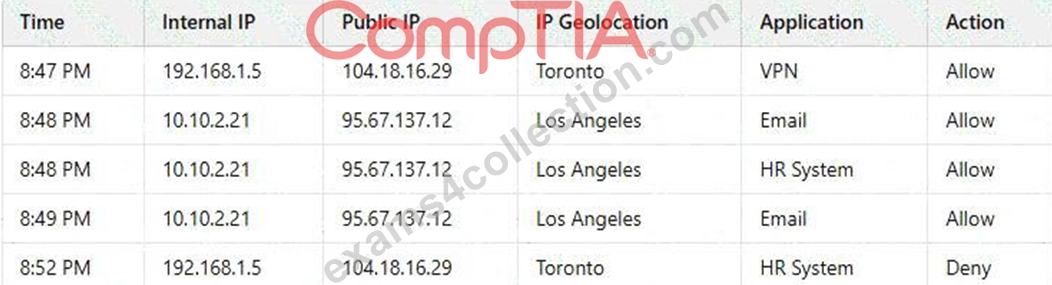
Which of the following is most likely the reason for the issue?
- A. The user is not allowed to access the human resources system outside of business hours.
- B. The user did not attempt to connect from an approved subnet.
- C. A threat actor has compromised the user's account and attempted to log in.
- D. The user inadvertently tripped the geoblock rule in NGFW.
Answer: D
Explanation:
The logs show that the user connected fromToronto (104.18.16.29)andLos Angeles (95.67.137.12)within minutes. The sudden location change is a typical trigger forgeoblocking in a Next-Generation Firewall (NGFW), leading to theHR System being denied.
* A compromised account (B)would show failed login attempts or unusual activities, but all other access attempts were allowed.
* Business hours restriction (C)is unlikely since the user was granted access earlier.
* Approved subnet issues (D)would affect all applications, not just HR System access.
Reference:CompTIA SecurityX (CAS-005) Exam Objectives- Domain 4.0(Security Operations), Section onFirewall Rules and Network Traffic Analysis
NEW QUESTION # 123
A cybersecurity architect is reviewing the detection and monitoring capabilities for a global company that recently made multiple acquisitions. The architect discovers that the acquired companies use different vendors for detection and monitoring. The architect's goal is to:
- Create a collection of use cases to help detect known threats
- Include those use cases in a centralized library for use across all
of the companies
Which of the following is the best way to achieve this goal?
- A. TAXII/STIX library
- B. Sigma rules
- C. UBA rules and use cases
- D. Ariel Query Language
Answer: B
Explanation:
To create a collection of use cases for detecting known threats and include them in a centralized library for use across multiple companies with different vendors, Sigma rules are the best option.
Vendor-Agnostic Format: Sigma rules are a generic and open standard for writing SIEM (Security Information and Event Management) rules. They can be translated to specific query languages of different SIEM systems, making them highly versatile and applicable across various platforms.
Centralized Rule Management: By using Sigma rules, the cybersecurity architect can create a centralized library of detection rules that can be easily shared and implemented across different detection and monitoring systems used by the acquired companies. This ensures consistency in threat detection capabilities.
Ease of Use and Flexibility: Sigma provides a structured and straightforward format for defining detection logic. It allows for the easy creation, modification, and sharing of rules, facilitating collaboration and standardization across the organization.
NEW QUESTION # 124
A security architect is implementing more restrictive policies to improve secure coding practices.
Which of the following solutions are the best ways to improve the security coding practices?
(Choose two.)
- A. Implement a SAST tool along the pipeline for every new commit.
- B. Define security gates and tests along the CI/CD flow with strict exception rules.
- C. Hire a third-party company to perform regular software tests, including quality and unity tests.
- D. Perform regular code reviews and implement pair programming methodology.
- E. Deliver regular training for the software developers based on best practices.
- F. Perform regular vulnerability assessments on production software, defining tight SLAs for treatment.
Answer: A,E
NEW QUESTION # 125
A security officer received several complaints from users about excessive MPA push notifications at night The security team investigates and suspects malicious activities regarding user account authentication Which of the following is the best way for the security officer to restrict MI~A notifications''
- A. Provisioning FID02 devices
- B. Configuring prompt-driven MFA
- C. Deploying a text message based on MFA
- D. Enabling OTP via email
Answer: B
NEW QUESTION # 126
An organization that performs real-time financial processing is implementing a new backup solution. Given the following business requirements:
* The backup solution must reduce the risk of potential backup compromise.
* The backup solution must be resilient to a ransomware attack.
* The time to restore from backups is less important than backup data integrity.
* Multiple copies of production data must be maintained.
Which of the following backup strategies best meets these requirements?
- A. Setting up anti-tampering on the databases to ensure data cannot be changed unintentionally
- B. Enabling remote journaling on the databases to ensure real-time transactions are mirrored
- C. Creating a secondary, immutable database and adding live data on a continuous basis
- D. Utilizing two connected storage arrays and ensuring the arrays constantly sync
Answer: C
Explanation:
Animmutable databasepreventsmodifications or deletions, ensuring resilience against ransomware while maintaining multiple copies of data.
Reference:CompTIA SecurityX (CAS-005) Exam Objectives- Domain 3.0 (Security Engineering), Section onData Protection & Backup Strategies
NEW QUESTION # 127
A systems administrator wants to use existing resources to automate reporting from disparate security appliances that do not currently communicate. Which of the following is the best way to meet this objective?
- A. Migrating application usage logs to on-premises storage
- B. Combining back-end application storage into a single, relational database
- C. Configuring an API Integration to aggregate the different data sets
- D. Purchasing and deploying commercial off the shelf aggregation software
Answer: C
Explanation:
The best way to automate reporting from disparate security appliances that do not currently communicate is to configure an API Integration to aggregate the different data sets. Here's why:
* Interoperability: APIs allow different systems to communicate and share data, even if they were not originally designed to work together. This enables the integration of various security appliances into a unified reporting system.
* Automation: API integrations can automate the process of data collection, aggregation, and reporting, reducing manual effort and increasing efficiency.
* Scalability: APIs provide a scalable solution that can easily be extended to include additional security appliances or data sources as needed.
* References:
* CompTIA Security+ SY0-601 Study Guide by Mike Chapple and David Seidl
* NIST Special Publication 800-95: Guide to Secure Web Services
* OWASP API Security Top Ten
NEW QUESTION # 128
An organization recently implemented a purchasing freeze that has impacted endpoint life-cycle management efforts. Which of the following should a security manager do to reduce risk without replacing the endpoints?
- A. Dispose of end-of-support devices
- B. Deploy EDR
- C. Remove unneeded services
- D. Reimage the system
Answer: C
Explanation:
Removing unnecessary services from existing endpoints reduces the attack surface by minimizing the number of potential vulnerabilities attackers could exploit. This is a cost-effective method to harden devices without requiring new purchases, aligning perfectly with a purchasing freeze. Deploying new EDR solutions or disposing of devices would likely conflict with the resource freeze, and reimaging systems does not address minimizing services proactively.
Reference:CompTIA SecurityX CAS-005, Domain 3.0: Implement endpoint security controls and hardening techniques.
NEW QUESTION # 129
During a forensic review of a cybersecurity incident, a security engineer collected a portion of the payload used by an attacker on a comprised web server. Given the following portion of the code:
Which of the following best describes this incident?
- A. SQL injection
- B. Stored XSS
- C. Command injection
- D. XSRF attack
Answer: B
Explanation:
The provided code snippet shows a script that captures the user's cookies and sends them to a remote server. This type of attack is characteristic of Cross-Site Scripting (XSS), specifically stored XSS, where the malicious script is stored on the target server (e.g., in a database) and executed in the context of users who visit the infected web page.
Stored XSS: The provided code snippet matches the pattern of a stored XSS attack, where the script is injected into a web page, and when users visit the page, the script executes and sends the user's cookies to the attacker's server.
NEW QUESTION # 130
A software company deployed a new application based on its internal code repository Several customers are reporting anti-malware alerts on workstations used to test the application Which of the following is the most likely cause of the alerts?
- A. Misconfigured code commit
- B. Data leakage
- C. Invalid code signing certificate
- D. Unsecure bundled libraries
Answer: D
Explanation:
The most likely cause of the anti-malware alerts on customer workstations is unsecure bundled libraries. When developing and deploying new applications, it is common for developers to use third-party libraries. If these libraries are not properly vetted for security, they can introduce vulnerabilities or malicious code.
Why Unsecure Bundled Libraries?
Third-Party Risks: Using libraries that are not secure can lead to malware infections if the libraries contain malicious code or vulnerabilities.
Code Dependencies: Libraries may have dependencies that are not secure, leading to potential security risks.
Common Issue: This is a frequent issue in software development where libraries are used for convenience but not properly vetted for security.
Other options, while relevant, are less likely to cause widespread anti-malware alerts:
A . Misconfigured code commit: Could lead to issues but less likely to trigger anti-malware alerts.
C . Invalid code signing certificate: Would lead to trust issues but not typically anti-malware alerts.
D . Data leakage: Relevant for privacy concerns but not directly related to anti-malware alerts.
Reference:
CompTIA SecurityX Study Guide
"Securing Open Source Libraries," OWASP
"Managing Third-Party Software Security Risks," Gartner Research
NEW QUESTION # 131
Asecuntv administrator is performing a gap assessment against a specific OS benchmark The benchmark requires the following configurations be applied to endpomts:
* Full disk encryption
* Host-based firewall
* Time synchronization
* Password policies
* Application allow listing
* Zero Trust application access
Which of the following solutions best addresses the requirements? (Select two).
- A. SASE
- B. HIDS
- C. SCAP
- D. SBoM
- E. CASB
Answer: A,C
Explanation:
To address the specific OS benchmark configurations, the following solutions are most appropriate:
C: SCAP (Security Content Automation Protocol): SCAP helps in automating vulnerability management and policy compliance, including configurations like full disk encryption, host-based firewalls, and password policies.
D: SASE (Secure Access Service Edge): SASE provides a framework for Zero Trust network access and application allow listing, ensuring secure and compliant access to applications and data.
These solutions together cover the comprehensive security requirements specified in the OS benchmark, ensuring a robust security posture for endpoints.
NEW QUESTION # 132
A global organization wants to manage all endpoint and user telemetry. The organization also needs to differentiate this data based on which office it is correlated to. Which of the following strategies best aligns with this goal?
- A. Data labeling
- B. Continuous monitoring
- C. Sensor placement
- D. Centralized logging
Answer: A
Explanation:
Comprehensive and Detailed Explanation:
Managing telemetry and differentiating it by office requires a way to categorize data. Let's evaluate:
* A. Sensor placement:Useful for data collection but doesn't inherently differentiate by office.
* B. Data labeling:Assigns metadata (e.g., office location) to telemetry, enabling differentiation. This aligns with CAS-005's focus on data management for security operations.
* C. Continuous monitoring:Ensures ongoing data collection but doesn't address differentiation.
NEW QUESTION # 133
A security analyst is designing a touch screen device so users can gain entry into a locked room by touching buttons numbered zero through nine in a specific numerical sequence. The analyst designs the keypad so that the numbers are randomly presented to the user each time the device is used. Which of the following best describes the design trade-offs? (Select two.)
- A. The routines to generate the random sequences are trivial to implement.
- B. Weak or easily guessed access numbers are more likely.
- C. The risk of someone overseeing a pattern as a user enters the numbers is decreased.
- D. The device needs to have additional power to compute the numbers.
- E. End users will have a more difficult time remembering the access numbers.
- F. This design makes entering numbers more difficult for users.
Answer: C,F
Explanation:
A: Randomizing the keypad reduces the risk of shoulder-surfing attacks by eliminating predictable patterns.
C: Randomization increases the cognitive load on users, making it harder to input numbers quickly.
D: Additional computational power is minimal and not typically a trade-off.
E and F: Remembering access numbers or weak passwords are unrelated to keypad randomization.
NEW QUESTION # 134
Within a SCADA a business needs access to the historian server in order together metric about the functionality of the environment. Which of the following actions should be taken to address this requirement?
- A. Publishing the C$ share from SCADA to the enterprise
- B. Isolating the historian server for connections only from The SCADA environment
- C. Adding the business workstations to the SCADA domain
- D. Deploying a screened subnet between 11 and SCADA
Answer: B
Explanation:
The best action to address the requirement of accessing the historian server within a SCADA system is to isolate the historian server for connections only from the SCADA environment. Here's why:
Security and Isolation: Isolating the historian server ensures that only authorized devices within the SCADA environment can connect to it. This minimizes the attack surface and protects sensitive data from unauthorized access.
Access Control: By restricting access to the historian server to only SCADA devices, the organization can better control and monitor interactions, ensuring that only legitimate queries and data retrievals occur.
Best Practices for Critical Infrastructure: Following the principle of least privilege, isolating critical components like the historian server is a standard practice in securing SCADA systems, reducing the risk of cyberattacks.
References:
CompTIA Security+ SY0-601 Study Guide by Mike Chapple and David Seidl
NIST Special Publication 800-82: Guide to Industrial Control Systems (ICS) Security ISA/IEC 62443 Standards: Security for Industrial Automation and Control Systems
NEW QUESTION # 135
Employees use their badges to track the number of hours they work. The badge readers cannot be upgraded due to facility constraints. The software for the badge readers uses a legacy platform and requires connectivity to the enterprise resource planning solution. Which of the following is the best to ensure the security of the badge readers?
- A. Vulnerability scans
- B. Segmentation
- C. Anti-malware
Answer: B
Explanation:
Segmentation is the best option to ensure the security of legacy badge readers that cannot be upgraded. Segmentation isolates the legacy devices on a separate network segment to minimize their exposure to potential threats. This approach reduces the attack surface by preventing unauthorized access from other parts of the network while still allowing necessary connectivity to the enterprise resource planning (ERP) system.
Vulnerability scans (B) are useful for identifying weaknesses but do not actively protect the badge readers.
Anti-malware (C) is ineffective since the badge readers use a legacy platform that likely does not support modern endpoint protection solutions.
NEW QUESTION # 136
An organization hires a security consultant to establish a SOC that includes athreat-modeling function.
During initial activities, the consultant works with system engineers to identify antipatterns within the environment.
Which of the following is most critical for the engineers to disclose to the consultant during this phase?
- A. Network and data flow diagrams covering the production environment
- B. Results from the most recent software composition analysis
- C. A listing of unpatchable IoT devices in use in the data center
- D. Results from the most recent infrastructure access review
- E. A current inventory of cloud resources and SaaS products in use
Answer: A
Explanation:
In the context of establishing a Security Operations Center (SOC) with a threat-modeling function, it's crucial to understand how data flows within the organization's systems.
Network and data flow diagrams provide a visual representation of the system's architecture, illustrating how data moves between components, which is essential for identifying potential security weaknesses and antipatterns. Antipatterns are common responses to recurring problems that are ineffective and risk-inducing. By analyzing these diagrams, the consultant can pinpoint areas where security controls may be lacking or misconfigured, thereby facilitating the development of effective threat models.
While other options like unpatchable IoT devices
(Option B) and inventories of cloud resources (Option E) are important for comprehensive security assessments, they are more pertinent during later stages, such as vulnerability management and asset inventory. The initial phase of threat modeling focuses on understanding the system's structure and data flows to identify potential threats, making network and data flow diagrams the most critical information at this stage.
Reference:CompTIA SecurityX CAS-005Official Study Guide, Chapter 3: "Threat Modeling and Security Assessments,"
Section 3.2: "Understanding Data Flow Diagrams."
NEW QUESTION # 137
A security analyst received a notification from a cloud service provider regarding an attack detected on a web server. The cloud service provider shared the following information about the attack:
- The attack came from inside the network.
- The attacking source IP was from the internal vulnerability scanners.
- The scanner is not configured to target the cloud servers.
Which of the following actions should the security analyst take first?
- A. Configure the scan policy to avoid targeting an out-of-scope host
- B. Set network behavior analysis rules
- C. Create an allow list for the vulnerability scanner IPs m order to avoid false positives
- D. Quarantine the scanner sensor to perform a forensic analysis
Answer: D
Explanation:
When a security analyst receives a notification about an attack that appears to originate from an internal vulnerability scanner, it suggests that the scanner itself might have been compromised.
This situation is critical because a compromised scanner can potentially conduct unauthorized scans, leak sensitive information, or execute malicious actions within the network. The appropriate first action involves containing the threat to prevent further damage and allow for a thorough investigation.
Containment and Isolation: Quarantining the scanner will immediately prevent it from continuing any malicious activity or scans. This containment is crucial to protect the rest of the network from potential harm.
Forensic Analysis: By isolating the scanner, a forensic analysis can be performed to understand how it was compromised, what actions it took, and what data or systems might have been affected. This analysis will provide valuable insights into the nature of the attack and help in taking appropriate remedial actions.
Preventing Further Attacks: If the scanner is allowed to continue operating, it might execute more unauthorized actions, leading to greater damage. Quarantine ensures that the threat is neutralized promptly.
Root Cause Identification: A forensic analysis can help identify vulnerabilities in the scanner's configuration, software, or underlying system that allowed the compromise. This information is essential for preventing future incidents.
NEW QUESTION # 138
Company A and Company D ate merging Company A's compliance reports indicate branchprotections are not in place A security analyst needs to ensure that potential threats to the software development life cycle are addressed. Which of the following should me analyst cons<der when completing this basic?
- A. If DAST code is being stored to a single code repository
- B. If DAST scans are routinely scheduled
- C. If developers are unable to promote to production
- D. If role-based training is deployed
- E. If role-based training is deployed: While important, training alone does not ensure continuous security assessment.
Answer: B
Explanation:
Dynamic Application Security Testing (DAST) is crucial for identifying and addressing security vulnerabilities during the software development life cycle (SDLC). Ensuring that DAST scans are routinely scheduled helps in maintaining a secure development process.
Why Routine DAST Scans?
Continuous Security Assessment: Regular DAST scans help in identifying vulnerabilities in real-time, ensuring they are addressed promptly.
Compliance: Routine scans ensure that the development process complies with security standards and regulations.
Proactive Threat Mitigation: Regular scans help in early detection and mitigation of potential security threats, reducing the risk of breaches.
Integration into SDLC: Ensures security is embedded within the development process, promoting a security-first approach.
Other options, while relevant, do not directly address the continuous assessment and proactive identification of threats:
A . If developers are unable to promote to production: This is more of an operational issue than a security assessment.
B . If DAST code is being stored to a single code repository: This concerns code management rather than security testing frequency.
Reference:
CompTIA SecurityX Study Guide
OWASP Testing Guide
NIST Special Publication 800-53, "Security and Privacy Controls for Information Systems and Organizations"
NEW QUESTION # 139
An organization determines existing business continuity practices are inadequate to support critical internal process dependencies during a contingency event. A compliance analyst wants the Chief Information Officer (CIO) to identify the level of residual risk that is acceptable to guide remediation activities. Which of the following does the CIO need to clarify?
- A. Appetite
- B. Likelihood
- C. Impact
- D. Mitigation
Answer: A
Explanation:
Comprehensive and Detailed
Understanding Residual Risk:
Residual risk is the amount of risk remaining after controls and mitigations have been applied.
Risk appetite defines the level of risk an organization is willing to accept before taking additional actions.
Why Option D is Correct:
The CIO must clarify the organization's "Risk Appetite" to determine how much residual risk is acceptable.
If risk exceeds the appetite, additional security measures need to be implemented.
This aligns with ISO 31000 and NIST Risk Management Framework (RMF).
Why Other Options Are Incorrect:
A (Mitigation): Mitigation refers to reducing risk, but it doesn't define the acceptable level of residual risk.
B (Impact): Impact assessment measures potential damage, but it does not determine what is acceptable.
C (Likelihood): Likelihood is the probability of risk occurring, but not what level is acceptable.
Reference:
CompTIA SecurityX CAS-005 Official Study Guide: Risk Management & Business Continuity NIST SP 800-37: Risk Management Framework
NEW QUESTION # 140
Users must accept the terms presented in a captive petal when connecting to a guest network. Recently, users have reported that they are unable to access the Internet after joining the network A network engineer observes the following:
* Users should be redirected to the captive portal.
* The Motive portal runs Tl. S 1 2
* Newer browser versions encounter security errors that cannot be bypassed
* Certain websites cause unexpected re directs
Which of the following mow likely explains this behavior?
- A. An attacker is redirecting supplicants to an evil twin WLAN.
- B. The TLS ciphers supported by the captive portal ate deprecated
- C. Employment of the HSTS setting is proliferating rapidly.
- D. Allowed traffic rules are causing the NIPS to drop legitimate traffic
Answer: B
Explanation:
The most likely explanation for the issues encountered with the captive portal is that the TLS ciphers supported by the captive portal are deprecated. Here's why:
TLS Cipher Suites: Modern browsers are continuously updated to support the latest security standards and often drop support for deprecated and insecure cipher suites. If the captive portal uses outdated TLS ciphers, newer browsers may refuse to connect, causing security errors.
HSTS and Browser Security: Browsers with HTTP Strict Transport Security (HSTS) enabled will not allow connections to sites with weak security configurations. Deprecated TLS ciphers would cause these browsers to block the connection.
NEW QUESTION # 141
An organization currently has IDS, firewall, and DLP systems in place. The systems administrator needs to integrate the tools in the environment to reduce response time. Which of the following should the administrator use?
- A. XCCDF
- B. CMDB
- C. SOAR
- D. CWPP
Answer: C
Explanation:
Comprehensive and Detailed
Integrating IDS, firewall, and DLP to reduce response time requires orchestration and automation. Let's evaluate:
A . SOAR(Security Orchestration, Automation, and Response):SOAR integrates security tools, automates workflows, and speeds up incident response. It's the best fit for this scenario, as CAS-005 highlights SOAR for operational efficiency.
B . CWPP (CloudWorkload Protection Platform):Focused on securing cloud workloads, not integrating on-premises tools.
C . XCCDF (Extensible Configuration Checklist Description Format):A standard for compliance checklists, not a tool for integration or response.
NEW QUESTION # 142
SIMULATION
[Security Architecture]
You are tasked with integrating a new B2B client application with an existing OAuth workflow that must meet the following requirements:
. The application does not need to know the users' credentials.
. An approval interaction between the users and theHTTP service must be orchestrated.
. The application must have limited access to users' data.
INSTRUCTIONS
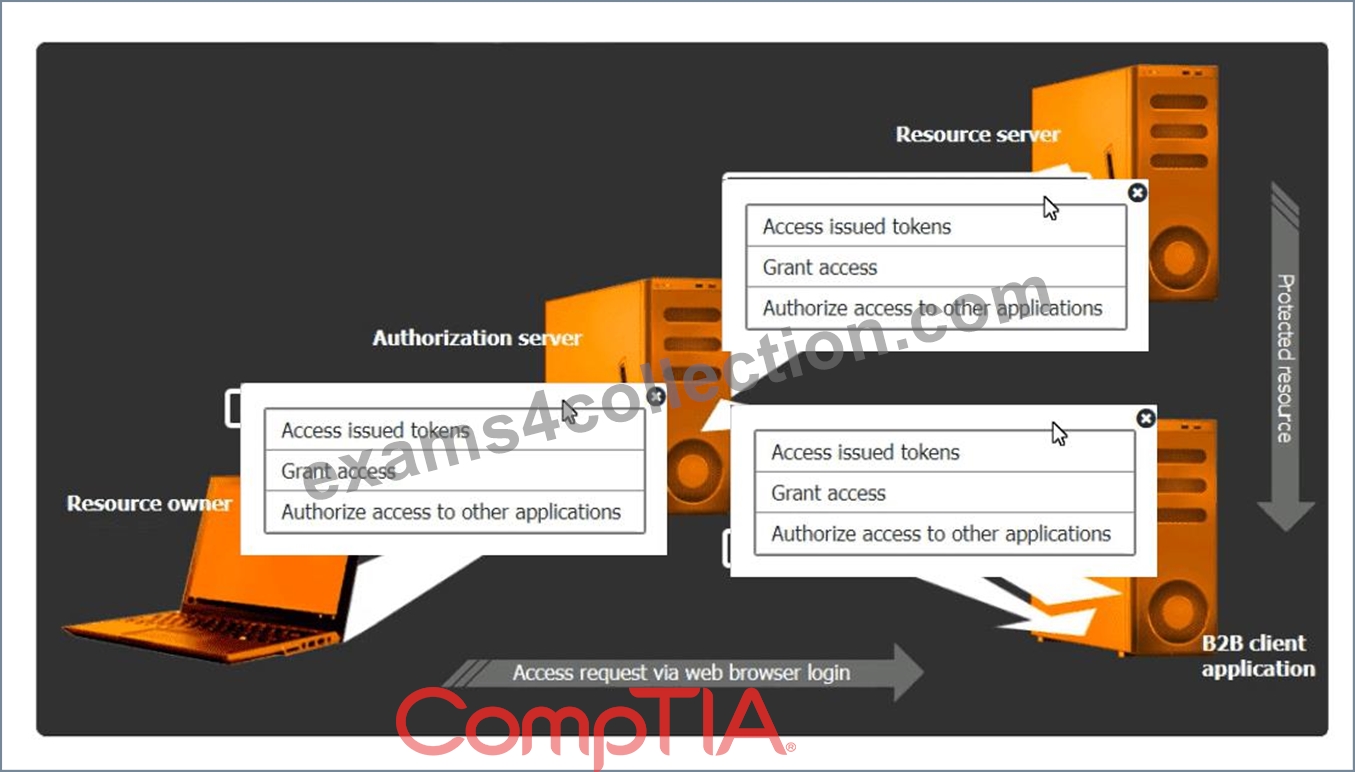
Use the drop-down menus to select the action items for the appropriate locations. All placeholders must be filled.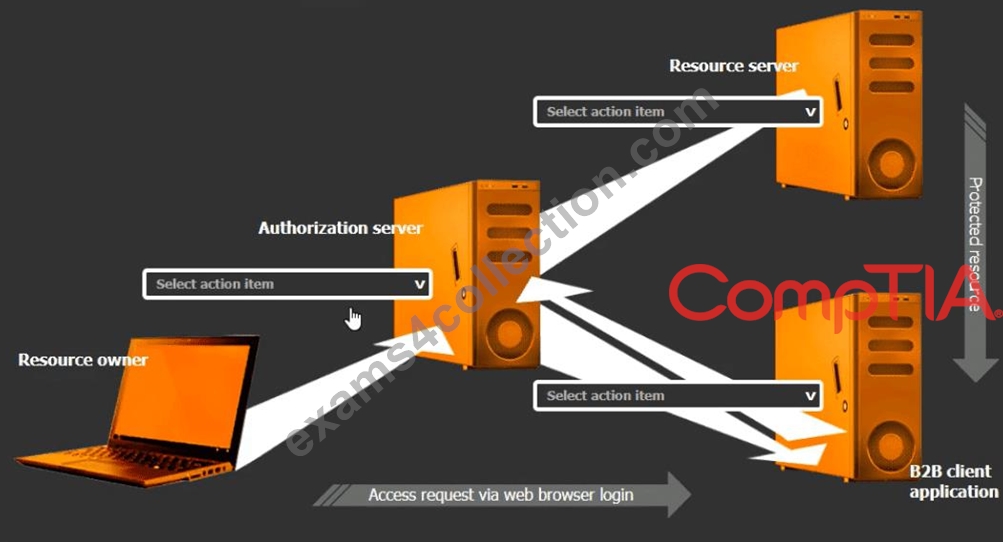
Answer:
Explanation:
See the solution below in Explanation
Explanation:
Select the Action Items for the Appropriate Locations:
Authorization Server:
Action Item: Grant access
The authorization server's role is to authenticate the user and then issue an authorization code or token that the client application can use to access resources. Granting access involves the server authenticating the resource owner and providing the necessary tokens for the client application.
Resource Server:
Action Item: Access issued tokens
The resource server is responsible for serving the resources requested by the client application. It must verify the issued tokens from the authorization server to ensure the client has the right permissions to access the requested data.
B2B Client Application:
Action Item: Authorize access to other applications
The B2B client application must handle the OAuth flow to authorize access on behalf of the user without requiring direct knowledge of the user's credentials. This includes obtaining authorization tokens from the authorization server and using them to request access to the resource server.
Detailed
OAuth 2.0 is designed to provide specific authorization flows for web applications, desktopapplications, mobile phones, and living room devices. The integration involves multiple steps and components, including:
Resource Owner (User):
The user owns the data and resources that are being accessed.
Client Application (B2B Client Application):
Requests access to the resources controlled by the resource owner but does not directly handle the user's credentials. Instead, it uses tokens obtained through the OAuth flow.
Authorization Server:
Handles the authentication of the resource owner and issues the access tokens to the client application upon successful authentication.
Resource Server:
Hosts the resources that the client application wants to access. It verifies the access tokens issued by the authorization server before granting access to the resources.
OAuth Workflow:
The resource owner accesses the client application.
The client application redirects the resource owner to the authorization server for authentication.
The authorization server authenticates the resource owner and asks for consent to grant access to the client application.
Upon consent, the authorization server issues an authorization code or token to the client application.
The client application uses the authorization code or token to request access to the resources from the resource server.
The resource server verifies the token with the authorization server and, if valid, grants access to the requested resources.
Reference:
CompTIA Security+ Study Guide: Provides comprehensive information on various authentication and authorization protocols, including OAuth.
OAuth 2.0 Authorization Framework (RFC 6749): The official documentation detailing the OAuth 2.0 framework, its flows, and components.
OAuth 2.0 Simplified: A book by Aaron Parecki that provides a detailed yet easy-to-understand explanation of the OAuth 2.0 protocol.
By ensuring that each component in the OAuth workflow performs its designated role, the B2B client application can securely access the necessary resources without compromising user credentials, adhering to the principle of least privilege.
NEW QUESTION # 143
......
CompTIA CAS-005 Exam Syllabus Topics:
| Topic | Details |
|---|---|
| Topic 1 |
|
| Topic 2 |
|
| Topic 3 |
|
| Topic 4 |
|
Free CAS-005 Exam Files Downloaded Instantly 100% Dumps & Practice Exam: https://www.exams4collection.com/CAS-005-latest-braindumps.html
Updated Verified CAS-005 dumps Q&As - 100% Pass Guaranteed: https://drive.google.com/open?id=13CWCFtb_kwFeWjDa13TCF4qd9MC-s9p0
