

Google Certified Professional - Cloud Architect (GCP) Practice Tests 2023 | Pass Professional-Cloud-Architect with confidence!
Practice Google Cloud Certified Professional-Cloud-Architect exam. Online Exam Practice Tests with detailed explanations!
Google Professional Cloud Architect Prerequisites
There are no official prerequisites for taking the Professional Cloud Architect exam, except passing a single qualifying exam. However, it is recommended that the candidates have about three years of practical experience, including one year of designing and managing solutions with the help of Google Cloud Platform.
Who should take the Google Professional Cloud Architect exam
Individuals should pursue the Google Professional Cloud Architect Exam if they want to demonstrate their expertise and ability to design and develop Google Cloud architectures. It's perfect for solutions and/or enterprise architects, systems administrators or operations team members or simply any professional who wants in on this specific area of IT and cloud.
NEW QUESTION 114
Your company just finished a rapid lift and shift to Google Compute Engine for your compute needs. You have another 9 months to design and deploy a more cloud-native solution. Specifically, you want a system that is no-ops and auto-scaling. Which two compute products should you choose? Choose 2 answers
- A. Google Kubernetes Engine with containers
- B. Compute Engine with containers
- C. Compute Engine with custom instance types
- D. Google App Engine Standard Environment
- E. Compute Engine with managed instance groups
Answer: A,D
Explanation:
B: With Container Engine, Google will automatically deploy your cluster for you, update, patch, secure the nodes.
Kubernetes Engine's cluster autoscaler automatically resizes clusters based on the demands of the workloads you want to run.
C: Solutions like Datastore, BigQuery, AppEngine, etc are truly NoOps.
App Engine by default scales the number of instances running up and down to match the load, thus providing consistent performance for your app at all times while minimizing idle instances and thus reducing cost.
Note: At a high level, NoOps means that there is no infrastructure to build out and manage during usage of the platform. Typically, the compromise you make with NoOps is that you lose control of the underlying infrastructure.
References:
https://www.quora.com/How-well-does-Google-Container-Engine-support-Google-Cloud-Platform%E2%80%99s-NoOps-claim
NEW QUESTION 115
You are building a continuous deployment pipeline for a project stored in a Git source repository and want to ensure that code changes can be verified deploying to production. What should you do?
- A. Use Jenkins to monitor tags in the repository. Deploy staging tags to a staging environment for testing.
After testing, tag the repository for production and deploy that to the production environment. - B. Use Jenkins to build the staging branches and the master branch. Build and deploy changes to production for 10% of users before doing a complete rollout.
- C. Use Spinnaker to deploy builds to production and run tests on production deployments.
- D. Use Spinnaker to deploy builds to production using the red/black deployment strategy so that changes can easily be rolled back.
Answer: B
Explanation:
Reference: https://github.com/GoogleCloudPlatform/continuous-deployment-on-kubernetes/blob/master/ README.md
NEW QUESTION 116
For this question, refer to the TerramEarth case study. To be compliant with European GDPR regulation, TerramEarth is required to delete data generated from its European customers after a period of 36 months when it contains personal data. In the new architecture, this data will be stored in both Cloud Storage and BigQuery. What should you do?
- A. Create a BigQuery time-partitioned table for the European data, and set the partition period to 36 months. For Cloud Storage, use gsutil to create a SetStorageClass to NONE action with an Age condition of 36 months.
- B. Create a BigQuery table for the European data, and set the table retention period to 36 months. For Cloud Storage, use gsutil to enable lifecycle management using a DELETE action with an Age condition of 36 months.
- C. Create a BigQuery table for the European data, and set the table retention period to 36 months. For Cloud Storage, use gsutil to create a SetStorageClass to NONE action when with an Age condition of 36 months.
- D. Create a BigQuery time-partitioned table for the European data, and set the partition expiration period to
36 months. For Cloud Storage, use gsutil to enable lifecycle management using a DELETE action with an Age condition of 36 months.
Answer: D
Explanation:
Explanation
https://cloud.google.com/bigquery/docs/managing-partitioned-tables#partition-expiration
https://cloud.google.com/storage/docs/lifecycle
Topic 7, Mountkrik Games Case 2
Company Overview
Mountkirk Games makes online, session-based, multiplayer games for mobile platforms. They build all of their games using some server-side integration. Historically, they have used cloud providers to lease physical servers.
Due to the unexpected popularity of some of their games, they have had problems scaling their global audience, application servers, MySQL databases, and analytics tools.
Their current model is to write game statistics to files and send them through an ETL tool that loads them into a centralized MySQL database for reporting.
Solution Concept
Mountkirk Games is building a new game, which they expect to be very popular. They plan to deploy the game's backend on Google Compute Engine so they can capture streaming metrics, run intensive analytics, and take advantage of its autoscaling server environment and integrate with a managed NoSQL database.
Business Requirements
* Increase to a global footprint.
* Improve uptime - downtime is loss of players.
* Increase efficiency of the cloud resources we use.
* Reduce latency to all customers.
Technical Requirements
Requirements for Game Backend Platform
* Dynamically scale up or down based on game activity.
* Connect to a transactional database service to manage user profiles and game state.
* Store game activity in a timeseries database service for future analysis.
* As the system scales, ensure that data is not lost due to processing backlogs.
* Run hardened Linux distro.
Requirements for Game Analytics Platform
* Dynamically scale up or down based on game activity
* Process incoming data on the fly directly from the game servers
* Process data that arrives late because of slow mobile networks
* Allow queries to access at least 10 TB of historical data
* Process files that are regularly uploaded by users' mobile devices
Executive Statement
Our last successful game did not scale well with our previous cloud provider, resulting in lower user adoption and affecting the game's reputation. Our investors want more key performance indicators (KPIs) to evaluate the speed and stability of the game, as well as other metrics that provide deeper insight into usage patterns so we can adapt the game to target users. Additionally, our current technology stack cannot provide the scale we need, so we want to replace MySQL and move to an environment that provides autoscaling, low latency load balancing, and frees us up from managing physical servers.
NEW QUESTION 117
Your company is developing a new application that will allow globally distributed users to upload pictures and share them with other selected users. The application will support millions of concurrent users. You want to allow developers to focus on just building code without having to create and maintain the underlying infrastructure. Which service should you use to deploy the application?
- A. Cloud Endpoints
- B. App Engine
- C. Google Kubernetes Engine
- D. Compute Engine
Answer: B
NEW QUESTION 118
For this question, refer to the Dress4Win case study.
Dress4Win has configured a new uptime check with Google Stackdriver for several of their legacy services.
The Stackdriver dashboard is not reporting the services as healthy. What should they do?
- A. Install the Stackdriver agent on all of the legacy web servers.
- B. Configure their load balancer to pass through the User-Agent HTTP header when the value matches GoogleStackdriverMonitoring-UptimeChecks (https://cloud.google.com/monitoring)
- C. Configure their legacy web servers to allow requests that contain user-Agent HTTP header when the value matches GoogleStackdriverMonitoring- UptimeChecks (https://cloud.google.com/monitoring)
- D. In the Cloud Platform Console download the list of the uptime servers' IP addresses and create an inbound firewall rule
Answer: C
Explanation:
Topic 5, Dress4Win Case 2
Company Overview
Dress4win is a web-based company that helps their users organize and manage their personal wardrobe using a website and mobile application. The company also cultivates an active social network that connects their users with designers and retailers. They monetize their services through advertising, e-commerce, referrals, and a freemium app model. The application has grown from a few servers in the founder's garage to several hundred servers and appliances in a collocated data center. However, the capacity of their infrastructure is now insufficient for the application's rapid growth. Because of this growth and the company's desire to innovate faster. Dress4Win is committing to a full migration to a public cloud.
Solution Concept
For the first phase of their migration to the cloud, Dress4win is moving their development and test environments. They are also building a disaster recovery site, because their current infrastructure is at a single location. They are not sure which components of their architecture they can migrate as is and which components they need to change before migrating them.
Existing Technical Environment
The Dress4win application is served out of a single data center location. All servers run Ubuntu LTS v16.04.
Databases:
MySQL. 1 server for user data, inventory, static data:
- MySQL 5.8
- 8 core CPUs
- 128 GB of RAM
- 2x 5 TB HDD (RAID 1)
Redis 3 server cluster for metadata, social graph, caching. Each server is:
- Redis 3.2
- 4 core CPUs
- 32GB of RAM
Compute:
40 Web Application servers providing micro-services based APIs and static content.
- Tomcat - Java
- Nginx
- 4 core CPUs
- 32 GB of RAM
20 Apache Hadoop/Spark servers:
- Data analysis
- Real-time trending calculations
- 8 core CPUS
- 128 GB of RAM
- 4x 5 TB HDD (RAID 1)
3 RabbitMQ servers for messaging, social notifications, and events:
- 8 core CPUs
- 32GB of RAM
Miscellaneous servers:
- Jenkins, monitoring, bastion hosts, security scanners
- 8 core CPUs
- 32GB of RAM
Storage appliances:
iSCSI for VM hosts
Fiber channel SAN - MySQL databases
- 1 PB total storage; 400 TB available
NAS - image storage, logs, backups
- 100 TB total storage; 35 TB available
Business Requirements
Build a reliable and reproducible environment with scaled parity of production.
Improve security by defining and adhering to a set of security and Identity and Access Management (IAM) best practices for cloud.
Improve business agility and speed of innovation through rapid provisioning of new resources.
Analyze and optimize architecture for performance in the cloud.
Technical Requirements
Easily create non-production environment in the cloud.
Implement an automation framework for provisioning resources in cloud.
Implement a continuous deployment process for deploying applications to the on-premises datacenter or cloud.
Support failover of the production environment to cloud during an emergency.
Encrypt data on the wire and at rest.
Support multiple private connections between the production data center and cloud environment.
Executive Statement
Our investors are concerned about our ability to scale and contain costs with our current infrastructure. They are also concerned that a competitor could use a public cloud platform to offset their up-front investment and free them to focus on developing better features. Our traffic patterns are highest in the mornings and weekend evenings; during other times, 80% of our capacity is sitting idle.
Our capital expenditure is now exceeding our quarterly projections. Migrating to the cloud will likely cause an initial increase in spending, but we expect to fully transition before our next hardware refresh cycle. Our total cost of ownership (TCO) analysis over the next 5 years for a public cloud strategy achieves a cost reduction between 30% and 50% over our current model.
NEW QUESTION 119
The current Dress4Win system architecture has high latency to some customers because it is located in one data center.
As of a future evaluation and optimizing for performance in the cloud, Dresss4Win wants to distribute its system architecture to multiple locations when Google cloud platform.
Which approach should they use?
- A. Use a global load balancer with a set of virtual machines that forward the requests to a closer group of virtual machines as part of a separate managed instance groups.
- B. Use a global load balancer with a set of virtual machines that forward the requests to a closer group of virtual machines managed by your operations team.
- C. Use regional managed instance groups and a global load balancer to increase performance because the regional managed instance group can grow instances in each region separately based on traffic.
- D. Use regional managed instance groups and a global load balancer to increase reliability by providing automatic failover between zones in different regions.
Answer: C
Explanation:
Explanation/Reference:
Dress4Win, B
Testlet 1
Company Overview
Dress4Win is a web-based company that helps their users organize and manage their personal wardrobe using a web app and mobile application. The company also cultivates an active social network that connects their users with designers and retailers. They monetize their services through advertising, e-commerce, referrals, and a freemium app model. The application has grown from a few servers in the founder's garage to several hundred servers and appliances in a colocated data center. However, the capacity of their infrastructure is now insufficient for the application's rapid growth. Because of this growth and the company's desire to innovate faster, Dress4Win is committing to a full migration to a public cloud.
Solution Concept
For the first phase of their migration to the cloud, Dress4Win is moving their development and test environments. They are also building a disaster recovery site, because their current infrastructure is at a single location. They are not sure which components of their architecture they can migrate as is and which components they need to change before migrating them.
Existing Technical Environment
The Dress4Win application is served out of a single data center location. All servers run Ubuntu LTS v16.04.
Databases:
* MySQL. 1 server for user data, inventory, static data:
- MySQL 5.8
- 8 core CPUs
- 128 GB of RAM
- 2x 5 TB HDD (RAID 1)
* Redis 3 server cluster for metadata, social graph, caching. Each server is:
- Redis 3.2
- 4 core CPUs
- 32GB of RAM
Compute:
* 40 Web Application servers providing micro-services based APIs and static content.
- Tomcat - Java
- Nginx
- 4 core CPUs
- 32 GB of RAM
* 20 Apache Hadoop/Spark servers:
- Data analysis
- Real-time trending calculations
- 8 core CPUs
- 128 GB of RAM
- 4x 5 TB HDD (RAID 1)
* 3 RabbitMQ servers for messaging, social notifications, and events:
- 8 core CPUs
- 32GB of RAM
* Miscellaneous servers:
- Jenkins, monitoring, bastion hosts, security scanners
- 8 core CPUs
- 32GB of RAM
Storage appliances:
* iSCSI for VM hosts
* Fiber channel SAN - MySQL databases
- 1 PB total storage; 400 TB available
* NAS - image storage, logs, backups
- 100 TB total storage; 35 TB available
Business Requirements
* Build a reliable and reproducible environment with scaled parity of production.
* Improve security by defining and adhering to a set of security and Identity and Access Management (IAM) best practices for cloud.
* Improve business agility and speed of innovation through rapid provisioning of new resources.
* Analyze and optimize architecture for performance in the cloud.
Technical Requirements
* Easily create non-production environments in the cloud.
* Implement an automation framework for provisioning resources in cloud.
* Implement a continuous deployment process for deploying applications to the on-premises datacenter or cloud.
* Support failover of the production environment to cloud during an emergency.
* Encrypt data on the wire and at rest.
* Support multiple private connections between the production data center and cloud environment.
Executive Statement
Our investors are concerned about our ability to scale and contain costs with our current infrastructure. They are also concerned that a competitor could use a public cloud platform to offset their up-front investment and free them to focus on developing better features. Our traffic patterns are highest in the mornings and weekend evenings; during other times, 80% of our capacity is sitting idle.
Our capital expenditure is now exceeding our quarterly projections. Migrating to the cloud will likely cause an initial increase in spending, but we expect to fully transition before our next hardware refresh cycle. Our total cost of ownership (TCO) analysis over the next 5 years for a public cloud strategy achieves a cost reduction between 30% and 50% over our current model.
NEW QUESTION 120
A lead software engineer tells you that his new application design uses websockets and HTTP sessions that are not distributed across the web servers. You want to help him ensure his application will run property on Google Cloud Platform. What should you do?
- A. Help the engineer redesign the application to use a distributed user session service that does not rely on websockets and HTTP sessions.
- B. Meet with the cloud operations team and the engineer to discuss load balancer options.
- C. Review the encryption requirements for websocket connections with the security team.
- D. Help the engineer to convert his websocket code to use HTTP streaming.
Answer: B
Explanation:
Google Cloud Platform (GCP) HTTP(S) load balancing provides global load balancing for HTTP(S) requests destined for your instances.
The HTTP(S) load balancer has native support for the WebSocket protocol.
Incorrect Answers:
A: HTTP server push, also known as HTTP streaming, is a client-server communication pattern that sends information from an HTTP server to a client asynchronously, without a client request. A server push architecture is especially effective for highly interactive web or mobile applications, where one or more clients need to receive continuous information from the server.
References:
https://cloud.google.com/compute/docs/load-balancing/http/
NEW QUESTION 121
For this question, refer to the TerramEarth case study.
TerramEarth's 20 million vehicles are scattered around the world. Based on the vehicle's location its telemetry data is stored in a Google Cloud Storage (GCS) regional bucket (US. Europe, or Asia). The CTO has asked you to run a report on the raw telemetry data to determine why vehicles are breaking down after 100 K miles.
You want to run this job on all the data. What is the most cost-effective way to run this job?
- A. Launch a cluster in each region to preprocess and compress the raw data, then move the data into a multi region bucket and use a Dataproc cluster to finish the job.
- B. Move all the data into 1 zone, then launch a Cloud Dataproc cluster to run the job.
- C. Launch a cluster in each region to preprocess and compress the raw data, then move the data into a regional bucket and use a Cloud Dataproc cluster .....
- D. Move all the data into 1 region, then launch a Google Cloud Dataproc cluster to run the job.
Answer: A
Explanation:
Explanation
Storageguarantees 2 replicates which are geo diverse (100 miles apart) which can get better remote latency and availability.
More importantly, is that multiregional heavily leverages Edge caching and CDNs to provide the content to the end users.
All this redundancy and caching means that Multiregional comes with overhead to sync and ensure consistency between geo-diverse areas. As such, it's much better for write-once-read-many scenarios. This means frequently accessed (e.g. "hot" objects) around the world, such as website content, streaming videos, gaming or mobile applications.
References:
https://medium.com/google-cloud/google-cloud-storage-what-bucket-class-for-the-best-performance-5c847ac8f9
NEW QUESTION 122
Case Study: 7 - Mountkirk Games
Company Overview
Mountkirk Games makes online, session-based, multiplayer games for mobile platforms. They build all of their games using some server-side integration. Historically, they have used cloud providers to lease physical servers.
Due to the unexpected popularity of some of their games, they have had problems scaling their global audience, application servers, MySQL databases, and analytics tools.
Their current model is to write game statistics to files and send them through an ETL tool that loads them into a centralized MySQL database for reporting.
Solution Concept
Mountkirk Games is building a new game, which they expect to be very popular. They plan to deploy the game's backend on Google Compute Engine so they can capture streaming metrics, run intensive analytics, and take advantage of its autoscaling server environment and integrate with a managed NoSQL database.
Business Requirements
Increase to a global footprint.
* Improve uptime - downtime is loss of players.
* Increase efficiency of the cloud resources we use.
* Reduce latency to all customers.
* Technical Requirements
Requirements for Game Backend Platform
Dynamically scale up or down based on game activity.
* Connect to a transactional database service to manage user profiles and game state.
* Store game activity in a timeseries database service for future analysis.
* As the system scales, ensure that data is not lost due to processing backlogs.
* Run hardened Linux distro.
* Requirements for Game Analytics Platform
Dynamically scale up or down based on game activity
* Process incoming data on the fly directly from the game servers
* Process data that arrives late because of slow mobile networks
* Allow queries to access at least 10 TB of historical data
* Process files that are regularly uploaded by users' mobile devices
* Executive Statement
Our last successful game did not scale well with our previous cloud provider, resulting in lower user adoption and affecting the game's reputation. Our investors want more key performance indicators (KPIs) to evaluate the speed and stability of the game, as well as other metrics that provide deeper insight into usage patterns so we can adapt the game to target users.
Additionally, our current technology stack cannot provide the scale we need, so we want to replace MySQL and move to an environment that provides autoscaling, low latency load balancing, and frees us up from managing physical servers.
For this question, refer to the Mountkirk Games case study. Mountkirk Games wants you to design a way to test the analytics platform's resilience to changes in mobile network latency.
What should you do?
- A. Deploy failure injection software to the game analytics platform that can inject additional latency to mobile client analytics traffic.
- B. Create an opt-in beta of the game that runs on players' mobile devices and collects response times from analytics endpoints running in Google Cloud Platform regions all over the world.
- C. Add the ability to introduce a random amount of delay before beginning to process analytics files uploaded from mobile devices.
- D. Build a test client that can be run from a mobile phone emulator on a Compute Engine virtual machine, and run multiple copies in Google Cloud Platform regions all over the world to generate realistic traffic.
Answer: B
NEW QUESTION 123
You are monitoring Google Kubernetes Engine (GKE) clusters in a Cloud Monitoring workspace. As a Site Reliability Engineer (SRE), you need to triage incidents quickly. What should you do?
- A. Write a shell script that gathers metrics from GKE nodes, publish these metrics to a Pub/Sub topic, export the data to BigQuery, and make a Data Studio dashboard.
- B. Navigate the predefined dashboards in the Cloud Monitoring workspace, and then add metrics and create alert policies.
- C. Create a custom dashboard in the Cloud Monitoring workspace for each incident, and then add metrics and create alert policies.
- D. Navigate the predefined dashboards in the Cloud Monitoring workspace, create custom metrics, and install alerting software on a Compute Engine instance.
Answer: B
NEW QUESTION 124
Case Study: 2 - TerramEarth Case Study
Company Overview
TerramEarth manufactures heavy equipment for the mining and agricultural industries: About
80% of their business is from mining and 20% from agriculture. They currently have over 500 dealers and service centers in 100 countries. Their mission is to build products that make their customers more productive.
Company Background
TerramEarth formed in 1946, when several small, family owned companies combined to retool after World War II. The company cares about their employees and customers and considers them to be extended members of their family.
TerramEarth is proud of their ability to innovate on their core products and find new markets as their customers' needs change. For the past 20 years trends in the industry have been largely toward increasing productivity by using larger vehicles with a human operator.
Solution Concept
There are 20 million TerramEarth vehicles in operation that collect 120 fields of data per second.
Data is stored locally on the vehicle and can be accessed for analysis when a vehicle is serviced.
The data is downloaded via a maintenance port. This same port can be used to adjust operational parameters, allowing the vehicles to be upgraded in the field with new computing modules.
Approximately 200,000 vehicles are connected to a cellular network, allowing TerramEarth to collect data directly. At a rate of 120 fields of data per second, with 22 hours of operation per day.
TerramEarth collects a total of about 9 TB/day from these connected vehicles.
Existing Technical Environment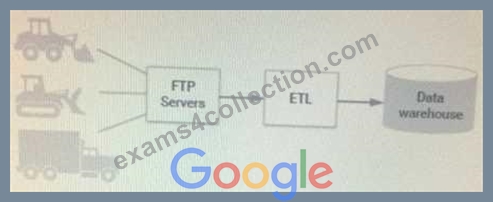
TerramEarth's existing architecture is composed of Linux-based systems that reside in a data center. These systems gzip CSV files from the field and upload via FTP, transform and aggregate them, and place the data in their data warehouse. Because this process takes time, aggregated reports are based on data that is 3 weeks old.
With this data, TerramEarth has been able to preemptively stock replacement parts and reduce unplanned downtime of their vehicles by 60%. However, because the data is stale, some customers are without their vehicles for up to 4 weeks while they wait for replacement parts.
Business Requirements
- Decrease unplanned vehicle downtime to less than 1 week, without
increasing the cost of carrying surplus inventory
- Support the dealer network with more data on how their customers use
their equipment IP better position new products and services.
- Have the ability to partner with different companies-especially with
seed and fertilizer suppliers in the fast-growing agricultural
business-to create compelling joint offerings for their customers
CEO Statement
We have been successful in capitalizing on the trend toward larger vehicles to increase the productivity of our customers. Technological change is occurring rapidly and TerramEarth has taken advantage of connected devices technology to provide our customers with better services, such as our intelligent farming equipment. With this technology, we have been able to increase farmers' yields by 25%, by using past trends to adjust how our vehicles operate. These advances have led to the rapid growth of our agricultural product line, which we expect will generate 50% of our revenues by 2020.
CTO Statement
Our competitive advantage has always been in the manufacturing process with our ability to build better vehicles for tower cost than our competitors. However, new products with different approaches are constantly being developed, and I'm concerned that we lack the skills to undergo the next wave of transformations in our industry. Unfortunately, our CEO doesn't take technology obsolescence seriously and he considers the many new companies in our industry to be niche players. My goals are to build our skills while addressing immediate market needs through incremental innovations.
Your agricultural division is experimenting with fully autonomous vehicles. You want your architecture to promote strong security during vehicle operation.
Which two architectures should you consider? (Choose two.)
- A. Treat every micro service call between modules on the vehicle as untrusted.
- B. Enclose the vehicle's drive electronics in a Faraday cage to isolate chips.
- C. Use multiple connectivity subsystems for redundancy.
- D. Use a trusted platform module (TPM) and verify firmware and binaries on boot.
- E. Use a functional programming language to isolate code execution cycles.
- F. Require IPv6 for connectivity to ensure a secure address space.
Answer: B,D
NEW QUESTION 125
You want to automate the creation of a managed instance group. The VMs have many OS package dependencies. You want to minimize the startup time for new VMs in the instance group.
What should you do?
- A. Use Terraform to create the managed instance group and a startup script to install the OS package dependencies.
- B. Create a custom VM image with all OS package dependencies. Use Deployment Manager to create the managed instance group with the VM image.
- C. Use Puppet to create the managed instance group and install the OS package dependencies.
- D. Use Deployment Manager to create the managed instance group and Ansible to install the OS package dependencies.
Answer: B
NEW QUESTION 126
Your company is running a stateless application on a Compute Engine instance. The application is used heavily during regular business hours and lightly outside of business hours. Users are reporting that the application is slow during peak hours. You need to optimize the application's performance. What should you do?
- A. Create a snapshot of the existing disk. Create an instance template from the snapshot. Create an autoscaled managed instance group from the instance template.
- B. Create a snapshot of the existing disk. Create a custom image from the snapshot. Create an autoscaled managed instance group from the custom image.
- C. Create a custom image from the existing disk. Create an instance template from the custom image. Create an autoscaled managed instance group from the instance template.
- D. Create an instance template from the existing disk. Create a custom image from the instance template. Create an autoscaled managed instance group from the custom image.
Answer: B
Explanation:
Reference:
https://cloud.google.com/compute/docs/instance-templates/create-instance-templates
NEW QUESTION 127
Your customer is moving an existing corporate application to Google Cloud Platform from an on-premises data center. The business owners require minimal user disruption. There are strict security team requirements for storing passwords. What authentication strategy should they use?
- A. Ask users to set their Google password to match their corporate password.
- B. Use G Suite Password Sync to replicate passwords into Google.
- C. Federate authentication via SAML 2.0 to the existing Identity Provider.
- D. Provision users in Google using the Google Cloud Directory Sync tool.
Answer: C
Explanation:
Reference:
https://cloud.google.com/solutions/authenticating-corporate-users-in-a-hybrid-environment
NEW QUESTION 128
One of your primary business objectives is being able to trust the data stored in your application. You want to log all changes to the application data. How can you design your logging system to verify authenticity of your logs?
- A. Create a JSON dump of each log entry and store it in Google Cloud Storage.
- B. Use a SQL database and limit who can modify the log table.
- C. Digitally sign each timestamp and log entry and store the signature.
- D. Write the log concurrently in the cloud and on premises.
Answer: C
Explanation:
Explanation
https://cloud.google.com/storage/docs/access-logs
References: https://cloud.google.com/logging/docs/reference/tools/gcloud-logging
NEW QUESTION 129
You need to upgrade the EHR connection to comply with their requirements. The new connection design must support business-critical needs and meet the same network and security policy requirements. What should you do?
- A. Add a new Dedicated Interconnect connection.
- B. Add a new Carrier Peering connection.
- C. Add three new Cloud VPN connections.
- D. Upgrade the bandwidth on the Dedicated Interconnect connection to 100 G.
Answer: B
NEW QUESTION 130
......
Designing for Compliance and Security
- Design for compliance: this covers one’s knowledge of legislation (health record privacy, data privacy, ownership, and children’s privacy); commercial (sensitive data handling and personally identifiable information); industry certifications (SOC 2); audits (such as logs).
- Design for security: the learners need to gain knowledge of penetration testing; identity and access management; resource hierarchy; separation of duties; security control; data security; customer-managed encryption key management with Cloud KMS;
Get instant access to Professional-Cloud-Architect practice exam questions: https://drive.google.com/open?id=1Ezmr97TJgFfa-62M4Igo_3AbKTWNLsm3
The best Professional-Cloud-Architect exam study material and preparation tool is here: https://www.exams4collection.com/Professional-Cloud-Architect-latest-braindumps.html
