

2025 Updated ARA-C01 PDF for the ARA-C01 Tests Free Updated Today!
Fully Updated Dumps PDF - Latest ARA-C01 Exam Questions and Answers
NEW QUESTION # 13
While using joins, non-equality join predicates might result in significantly slower processing speeds and should be avoided if possible.
- A. FALSE
- B. TRUE
Answer: B
NEW QUESTION # 14
What is a characteristic of Role-Based Access Control (RBAC) as used in Snowflake?
- A. A user can use a "super-user" access along with securityadmin to bypass authorization checks and access all databases, schemas, and underlying objects.
- B. Privileges can be granted at the database level and can be inherited by all underlying objects.
- C. A user can create managed access schemas to support current and future grants and ensure only object owners can grant privileges to other roles.
- D. A user can create managed access schemas to support future grants and ensure only schema owners can grant privileges to other roles.
Answer: B,D
Explanation:
Role-Based Access Control (RBAC) is the Snowflake Access Control Framework that allows privileges to be granted by object owners to roles, and roles, in turn, can be assigned to users to restrict or allow actions to be performed on objects. A characteristic of RBAC as used in Snowflake is:
Privileges can be granted at the database level and can be inherited by all underlying objects. This means that a role that has a certain privilege on a database, such as CREATE SCHEMA or USAGE, can also perform the same action on any schema, table, view, or other object within that database, unless explicitly revoked. This simplifies the access control management and reduces the number of grants required.
A user can create managed access schemas to support future grants and ensure only schema owners can grant privileges to other roles. This means that a user can create a schema with the MANAGED ACCESS option, which changes the default behavior of object ownership and privilege granting within the schema. In a managed access schema, object owners lose the ability to grant privileges on their objects to other roles, and only the schema owner or a role with the MANAGE GRANTS privilege can do so. This enhances the security and governance of the schema and its objects.
The other options are not characteristics of RBAC as used in Snowflake:
A user can use a "super-user" access along with securityadmin to bypass authorization checks and access all databases, schemas, and underlying objects. This is not true, as there is no such thing as a "super-user" access in Snowflake. The securityadmin role is a predefined role that can manage users and roles, but it does not have any privileges on any database objects by default. To access any object, the securityadmin role must be explicitly granted the appropriate privilege by the object owner or another role with the grant option.
A user can create managed access schemas to support current and future grants and ensure only object owners can grant privileges to other roles. This is not true, as this contradicts the definition of a managed access schema. In a managed access schema, object owners cannot grant privileges on their objects to other roles, and only the schema owner or a role with the MANAGE GRANTS privilege can do so.
Reference:
Overview of Access Control
A Functional Approach For Snowflake's Role-Based Access Controls
Snowflake Role-Based Access Control simplified
Snowflake RBAC security prefers role inheritance to role composition
Overview of Snowflake Role Based Access Control
NEW QUESTION # 15
Schema owner can grant object privileges in a regular schema
- A. FALSE
- B. TRUE
Answer: A
NEW QUESTION # 16
When loading data into a table that captures the load time in a column with a default value of either CURRENT_TIME () or CURRENT_TIMESTAMP() what will occur?
- A. All rows loaded using a specific COPY statement will have varying timestamps based on when the rows were inserted.
- B. Any rows loaded using a specific COPY statement will have varying timestamps based on when the rows were read from the source.
- C. Any rows loaded using a specific COPY statement will have varying timestamps based on when the rows were created in the source.
- D. All rows loaded using a specific COPY statement will have the same timestamp value.
Answer: D
Explanation:
According to the Snowflake documentation, when loading data into a table that captures the load time in a column with a default value of either CURRENT_TIME () or CURRENT_TIMESTAMP(), the default value is evaluated once per COPY statement, not once per row. Therefore, all rows loaded using a specific COPY statement will have the same timestamp value. This behavior ensures that the timestamp value reflects the time when the data was loaded into the table, not when the data was read from the source or created in the source.
References:
* Snowflake Documentation: Loading Data into Tables with Default Values
* Snowflake Documentation: COPY INTO table
NEW QUESTION # 17
A media company needs a data pipeline that will ingest customer review data into a Snowflake table, and apply some transformations. The company also needs to use Amazon Comprehend to do sentiment analysis and make the de-identified final data set available publicly for advertising companies who use different cloud providers in different regions.
The data pipeline needs to run continuously ang efficiently as new records arrive in the object storage leveraging event notifications. Also, the operational complexity, maintenance of the infrastructure, including platform upgrades and security, and the development effort should be minimal.
Which design will meet these requirements?
- A. Ingest the data using COPY INTO and use streams and tasks to orchestrate transformations. Export the data into Amazon S3 to do model inference with Amazon Comprehend and ingest the data back into a Snowflake table. Then create a listing in the Snowflake Marketplace to make the data available to other companies.
- B. Ingest the data using Snowpipe and use streams and tasks to orchestrate transformations. Export the data into Amazon S3 to do model inference with Amazon Comprehend and ingest the data back into a Snowflake table. Then create a listing in the Snowflake Marketplace to make the data available to other companies.
- C. Ingest the data using Snowpipe and use streams and tasks to orchestrate transformations. Create an external function to do model inference with Amazon Comprehend and write the final records to a Snowflake table. Then create a listing in the Snowflake Marketplace to make the data available to other companies.
- D. Ingest the data into Snowflake using Amazon EMR and PySpark using the Snowflake Spark connector.
Apply transformations using another Spark job. Develop a python program to do model inference by leveraging the Amazon Comprehend text analysis API. Then write the results to a Snowflake table and create a listing in the Snowflake Marketplace to make the data available to other companies.
Answer: C
Explanation:
Explanation
This design meets all the requirements for the data pipeline. Snowpipe is a feature that enables continuous data loading into Snowflake from object storage using event notifications. It is efficient, scalable, and serverless, meaning it does not require any infrastructure or maintenance from the user. Streams and tasks are features that enable automated data pipelines within Snowflake, using change data capture and scheduled execution.
They are also efficient, scalable, and serverless, and they simplify the data transformation process. External functions are functions that can invoke external services or APIs from within Snowflake. They can be used to integrate with Amazon Comprehend and perform sentiment analysis on the data. The results can be written back to a Snowflake table using standard SQL commands. Snowflake Marketplace is a platform that allows data providers to share data with data consumers across different accounts, regions, and cloud platforms. It is a secure and easy way to make data publicly available to other companies.
References:
* Snowpipe Overview | Snowflake Documentation
* Introduction to Data Pipelines | Snowflake Documentation
* External Functions Overview | Snowflake Documentation
* Snowflake Data Marketplace Overview | Snowflake Documentation
NEW QUESTION # 18
A table contains five columns and it has millions of records. The cardinality distribution of the columns is shown below: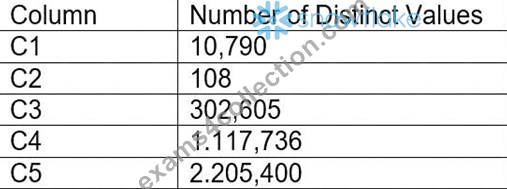
Column C4 and C5 are mostly used by SELECT queries in the GROUP BY and ORDER BY clauses.
Whereas columns C1, C2 and C3 are heavily used in filter and join conditions of SELECT queries.
The Architect must design a clustering key for this table to improve the query performance.
Based on Snowflake recommendations, how should the clustering key columns be ordered while defining the multi-column clustering key?
- A. C2, C1, C3
- B. C5, C4, C2
- C. C1, C3, C2
- D. C3, C4, C5
Answer: A
Explanation:
According to the Snowflake documentation, the following are some considerations for choosing clustering for a table1:
* Clustering is optimal when either:
* You require the fastest possible response times, regardless of cost.
* Your improved query performance offsets the credits required to cluster and maintain the table.
* Clustering is most effective when the clustering key is used in the following types of query predicates:
* Filter predicates (e.g. WHERE clauses)
* Join predicates (e.g. ON clauses)
* Grouping predicates (e.g. GROUP BY clauses)
* Sorting predicates (e.g. ORDER BY clauses)
* Clustering is less effective when the clustering key is not used in any of the above query predicates, or when the clustering key is used in a predicate that requires a function or expression to be applied to the key (e.g. DATE_TRUNC, TO_CHAR, etc.).
* For most tables, Snowflake recommends a maximum of 3 or 4 columns (or expressions) per key.
Adding more than 3-4 columns tends to increase costs more than benefits.
Based on these considerations, the best option for the clustering key columns is C. C1, C3, C2, because:
* These columns are heavily used in filter and join conditions of SELECT queries, which are the most effective types of predicates for clustering.
* These columns have high cardinality, which means they have many distinct values and can help reduce the clustering skew and improve the compression ratio.
* These columns are likely to be correlated with each other, which means they can help co-locate similar rows in the same micro-partitions and improve the scan efficiency.
* These columns do not require any functions or expressions to be applied to them, which means they can be directly used in the predicates without affecting the clustering.
References: 1: Considerations for Choosing Clustering for a Table | Snowflake Documentation
NEW QUESTION # 19
How can the Snowpipe REST API be used to keep a log of data load history?
- A. Call loadHistoryScan every minute for the maximum time range.
- B. Call insertReport every 20 minutes, fetching the last 10,000 entries.
- C. Call loadHistoryScan every 10 minutes for a 15-minute time range.
- D. Call insertReport every 8 minutes for a 10-minute time range.
Answer: C
Explanation:
* Snowpipe is a service that automates and optimizes the loading of data from external stages into Snowflake tables. Snowpipe uses a queue to ingest files as they become available in the stage. Snowpipe also provides REST endpoints to load data and retrieve load history reports1.
* The loadHistoryScan endpoint returns the history of files that have been ingested by Snowpipe within a specified time range. The endpoint accepts the following parameters2:
* pipe: The fully-qualified name of the pipe to query.
* startTimeInclusive: The start of the time range to query, in ISO 8601 format. The value must be within the past 14 days.
* endTimeExclusive: The end of the time range to query, in ISO 8601 format. The value must be later than the start time and within the past 14 days.
* recentFirst: A boolean flag that indicates whether to return the most recent files first or last. The default value is false, which means the oldest files are returned first.
* showSkippedFiles: A boolean flag that indicates whether to include files that were skipped by
* Snowpipe in the response. The default value is false, which means only files that were loaded are returned.
* The loadHistoryScan endpoint can be used to keep a log of data load history by calling it periodically with a suitable time range. The best option among the choices is D, which is to call loadHistoryScan every 10 minutes for a 15-minute time range. This option ensures that the endpoint is called frequently enough to capture the latest files that have been ingested, and that the time range is wide enough to avoid missing any files that may have been delayed or retried by Snowpipe. The other options are either too infrequent, too narrow, or use the wrong endpoint3.
References:
* 1: Introduction to Snowpipe | Snowflake Documentation
* 2: loadHistoryScan | Snowflake Documentation
* 3: Monitoring Snowpipe Load History | Snowflake Documentation
NEW QUESTION # 20
A Snowflake Architect created a new data share and would like to verify that only specific records in secure views are visible within the data share by the consumers.
What is the recommended way to validate data accessibility by the consumers?
- A. Alter the share settings as shown below, in order to impersonate a specific consumer account.
alter share sales share set accounts = 'Consumerl' share restrictions = true - B. Create a row access policy as shown below and assign it to the data share.
create or replace row access policy rap_acct as (acct_id varchar) returns boolean -> case when
'acctl_role' = current_role() then true else false end; - C. Set the session parameter called SIMULATED_DATA_SHARING_C0NSUMER as shown below in order to impersonate the consumer accounts.
alter session set simulated_data_sharing_consumer - 'Consumer Acctl* - D. Create reader accounts as shown below and impersonate the consumers by logging in with their credentials.
create managed account reader_acctl admin_name = userl , adroin_password 'Sdfed43da!44T , type = reader;
Answer: C
Explanation:
The SIMULATED_DATA_SHARING_CONSUMER session parameter allows a data provider to simulate the data access of a consumer account without creating a reader account or logging in with the consumer credentials. This parameter can be used to validate the data accessibility by the consumers in a data share, especially when using secure views or secure UDFs that filter data based on the current account or role. By setting this parameter to the name of a consumer account, the data provider can see the same data as the consumer would see when querying the shared database. This is a convenient and efficient way to test the data sharing functionality and ensure that only the intended data is visible to the consumers.
References:
* Using the SIMULATED_DATA_SHARING_CONSUMER Session Parameter
* SnowPro Advanced: Architect Exam Study Guide
NEW QUESTION # 21
What is a characteristic of loading data into Snowflake using the Snowflake Connector for Kafka?
- A. The Connector only works in Snowflake regions that use AWS infrastructure.
- B. The Connector creates and manages its own stage, file format, and pipe objects.
- C. The Connector works with all file formats, including text, JSON, Avro, Ore, Parquet, and XML.
- D. Loads using the Connector will have lower latency than Snowpipe and will ingest data in real time.
Answer: B
NEW QUESTION # 22
A company needs to have the following features available in its Snowflake account:
1. Support for Multi-Factor Authentication (MFA)
2. A minimum of 2 months of Time Travel availability
3. Database replication in between different regions
4. Native support for JDBC and ODBC
5. Customer-managed encryption keys using Tri-Secret Secure
6. Support for Payment Card Industry Data Security Standards (PCI DSS)
In order to provide all the listed services, what is the MINIMUM Snowflake edition that should be selected during account creation?
- A. Standard
- B. Business Critical
- C. Enterprise
- D. Virtual Private Snowflake (VPS)
Answer: B
Explanation:
According to the Snowflake documentation1, the Business Critical edition offers the following features that are relevant to the question:
Support for Multi-Factor Authentication (MFA): This is a standard feature available in all Snowflake editions1.
A minimum of 2 months of Time Travel availability: This is an enterprise feature that allows users to access historical data for up to 90 days1.
Database replication in between different regions: This is an enterprise feature that enables users to replicate databases across different regions or cloud platforms1.
Native support for JDBC and ODBC: This is a standard feature available in all Snowflake editions1.
Customer-managed encryption keys using Tri-Secret Secure: This is a business critical feature that provides enhanced security and data protection by allowing customers to manage their own encryption keys1.
Support for Payment Card Industry Data Security Standards (PCI DSS): This is a business critical feature that ensures compliance with PCI DSS regulations for handling sensitive cardholder data1.
Therefore, the minimum Snowflake edition that should be selected during account creation to provide all the listed services is the Business Critical edition.
Reference:
Snowflake Editions | Snowflake Documentation
NEW QUESTION # 23 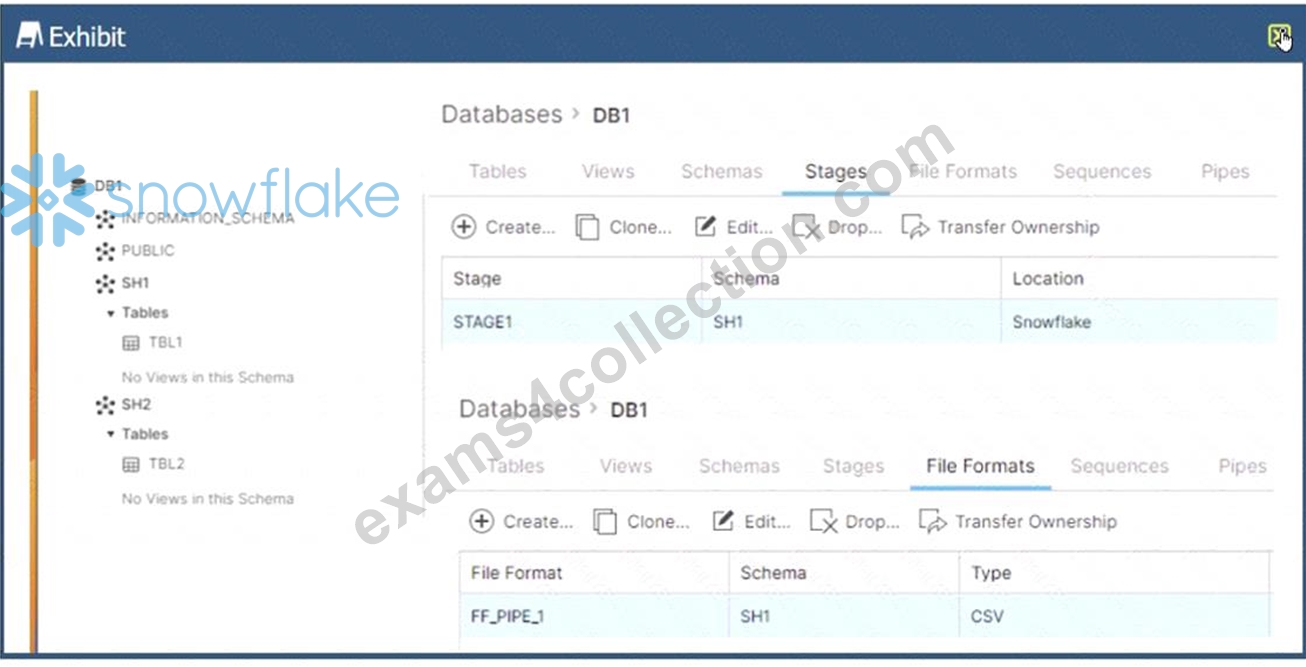
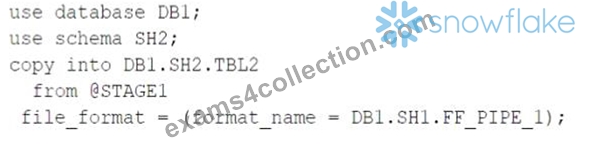
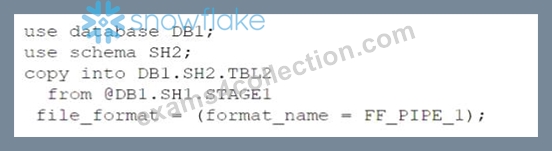
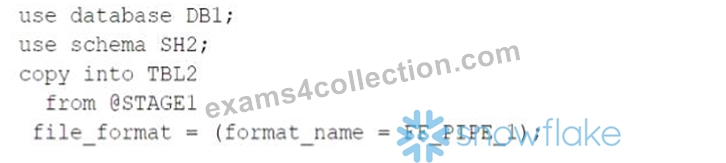
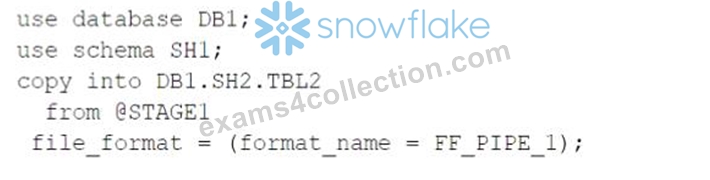
Based on the architecture in the image, how can the data from DB1 be copied into TBL2? (Select TWO).
- A.
- B.
- C.
- D.

- E.
Answer: C,D
Explanation:
* The architecture in the image shows a Snowflake data platform with two databases, DB1 and DB2, and two schemas, SH1 and SH2. DB1 contains a table TBL1 and a stage STAGE1. DB2 contains a table TBL2. The image also shows a snippet of code written in SQL language that copies data from STAGE1 to TBL2 using a file format FF PIPE 1.
* To copy data from DB1 to TBL2, there are two possible options among the choices given:
* Option B: Use a named external stage that references STAGE1. This option requires creating an external stage object in DB2.SH2 that points to the same location as STAGE1 in DB1.SH1. The external stage can be created using the CREATE STAGE command with the URL parameter specifying the location of STAGE11. For example:
SQLAI-generated code. Review and use carefully. More info on FAQ.
use database DB2;
use schema SH2;
create stage EXT_STAGE1
url = @DB1.SH1.STAGE1;
* Then, the data can be copied from the external stage to TBL2 using the COPY INTO command with the FROM parameter specifying the external stage name and the FILE FORMAT parameter specifying the file format name2. For example:
SQLAI-generated code. Review and use carefully. More info on FAQ.
copy into TBL2
from @EXT_STAGE1
file format = (format name = DB1.SH1.FF PIPE 1);
* Option E: Use a cross-database query to select data from TBL1 and insert into TBL2. This option requires using the INSERT INTO command with the SELECT clause to query data from TBL1 in DB1.SH1 and insert it into TBL2 in DB2.SH2. The query must use the fully-qualified names of the tables, including the database and schema names3. For example:
SQLAI-generated code. Review and use carefully. More info on FAQ.
use database DB2;
use schema SH2;
insert into TBL2
select * from DB1.SH1.TBL1;
* The other options are not valid because:
* Option A: It uses an invalid syntax for the COPY INTO command. The FROM parameter cannot specify a table name, only a stage name or a file location2.
* Option C: It uses an invalid syntax for the COPY INTO command. The FILE FORMAT parameter cannot specify a stage name, only a file format name or options2.
* Option D: It uses an invalid syntax for the CREATE STAGE command. The URL parameter cannot specify a table name, only a file location1.
References:
* 1: CREATE STAGE | Snowflake Documentation
* 2: COPY INTO table | Snowflake Documentation
* 3: Cross-database Queries | Snowflake Documentation
NEW QUESTION # 24
Which semi-structured data function returns an OBJECT constructed from the arguments.
- A. OBJECT_INSPECT
- B. OBJECT_ARRAY
- C. OBJECT_CONSTRUCT
Answer: C
NEW QUESTION # 25
A company wants to deploy its Snowflake accounts inside its corporate network with no visibility on the internet. The company is using a VPN infrastructure and Virtual Desktop Infrastructure (VDI) for its Snowflake users. The company also wants to re-use the login credentials set up for the VDI to eliminate redundancy when managing logins.
What Snowflake functionality should be used to meet these requirements? (Choose two.)
- A. Set up SSO for federated authentication.
- B. Provision a unique company Tri-Secret Secure key.
- C. Use private connectivity from a cloud provider.
- D. Set up replication to allow users to connect from outside the company VPN.
- E. Use a proxy Snowflake account outside the VPN, enabling client redirect for user logins.
Answer: A,C
Explanation:
According to the SnowPro Advanced: Architect documents and learning resources, the Snowflake functionality that should be used to meet these requirements are:
* Use private connectivity from a cloud provider. This feature allows customers to connect to Snowflake from their own private network without exposing their data to the public Internet. Snowflake integrates with AWS PrivateLink, Azure Private Link, and Google Cloud Private Service Connect to offer private connectivity from customers' VPCs or VNets to Snowflake endpoints. Customers can control how traffic reaches the Snowflake endpoint and avoid the need for proxies or public IP addresses123.
* Set up SSO for federated authentication. This feature allows customers to use their existing identity provider (IdP) to authenticate users for SSO access to Snowflake. Snowflake supports most SAML
2.0-compliant vendors as an IdP, including Okta, Microsoft AD FS, Google G Suite, Microsoft Azure Active Directory, OneLogin, Ping Identity, and PingOne. By setting up SSO for federated authentication, customers can leverage their existing user credentials and profile information, and provide stronger security than username/password authentication4.
The other options are incorrect because they do not meet the requirements or are not feasible. Option A is incorrect because setting up replication does not allow users to connect from outside the company VPN.
Replication is a feature of Snowflake that enables copying databases across accounts in different regions and cloud platforms. Replication does not affect the connectivity or visibility of the accounts5. Option B is incorrect because provisioning a unique company Tri-Secret Secure key does not affect the network or authentication requirements. Tri-Secret Secure is a feature of Snowflake that allows customers to manage their own encryption keys for data at rest in Snowflake, using a combination of three secrets: a master key, a service key, and a security password. Tri-Secret Secure provides an additional layer of security and control over the data encryption and decryption process, but it does not enable private connectivity or SSO6. Option E is incorrect because using a proxy Snowflake account outside the VPN, enabling client redirect for user logins, is not a supported or recommended way of meeting the requirements. Client redirect is a feature of Snowflake that allows customers to connect to a different Snowflake account than the one specified in the connection string. This feature is useful for scenarios such as cross-region failover, data sharing, and account migration, but it does not provide private connectivity or SSO7. References: AWS PrivateLink & Snowflake | Snowflake Documentation, Azure Private Link & Snowflake | Snowflake Documentation, Google Cloud Private Service Connect & Snowflake | Snowflake Documentation, Overview of Federated Authentication and SSO | Snowflake Documentation, Replicating Databases Across Multiple Accounts | Snowflake Documentation, Tri-Secret Secure | Snowflake Documentation, Redirecting Client Connections | Snowflake Documentation
NEW QUESTION # 26
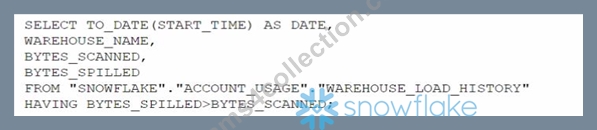
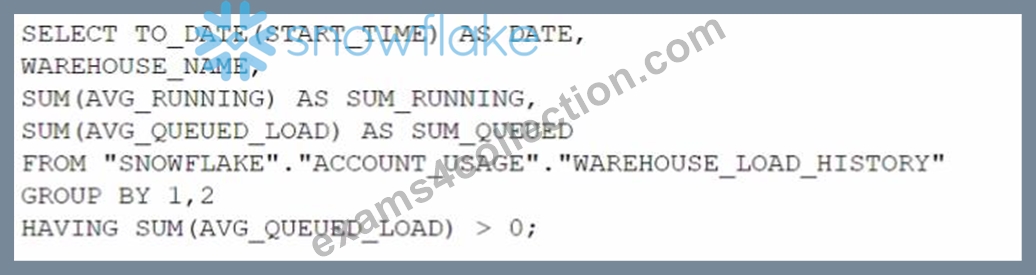
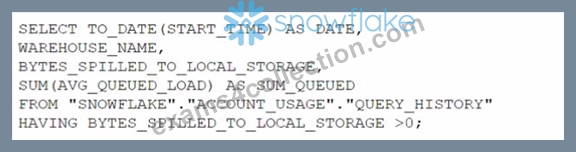
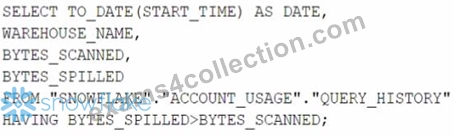
Which query will identify the specific days and virtual warehouses that would benefit from a multi-cluster warehouse to improve the performance of a particular workload?
- A.
- B.
- C.
- D.
Answer: A
Explanation:
A multi-cluster warehouse is a virtual warehouse that can scale compute resources by adding or removing clusters based on the workload demand. A multi-cluster warehouse can improve the performance of a particular workload by reducing the query queue time and the data spillage to local storage. To identify the specific days and virtual warehouses that would benefit from a multi-cluster warehouse, you need to analyze the query history and look for the following indicators:
High average queued load: This metric shows the average number of queries waiting in the queue for each warehouse cluster. A high value indicates that the warehouse is overloaded and cannot handle the concurrency demand.
High bytes spilled to local storage: This metric shows the amount of data that was spilled from memory to local disk during query processing. A high value indicates that the warehouse size is too small and cannot fit the data in memory.
High variation in workload: This metric shows the fluctuation in the number of queries submitted to the warehouse over time. A high variation indicates that the workload is unpredictable and dynamic, and requires a flexible scaling policy.
The query in option C is the best one to identify these indicators, as it selects the date, warehouse name, bytes spilled to local storage, and sum of average queued load from the query history table, and filters the results where bytes spilled to local storage is greater than zero. This query will show the days and warehouses that experienced data spillage and high queue time, and could benefit from a multi-cluster warehouse with auto-scale mode.
The query in option A is not correct, as it only selects the date and warehouse name, and does not include any metrics to measure the performance of the workload. The query in option B is not correct, as it selects the date, warehouse name, and average execution time, which is not a good indicator of the need for a multi-cluster warehouse. The query in option D is not correct, as it selects the date, warehouse name, and average credits used, which is not a good indicator of the need for a multi-cluster warehouse either.
NEW QUESTION # 27
A media company needs a data pipeline that will ingest customer review data into a Snowflake table, and apply some transformations. The company also needs to use Amazon Comprehend to do sentiment analysis and make the de-identified final data set available publicly for advertising companies who use different cloud providers in different regions.
The data pipeline needs to run continuously ang efficiently as new records arrive in the object storage leveraging event notifications. Also, the operational complexity, maintenance of the infrastructure, including platform upgrades and security, and the development effort should be minimal.
Which design will meet these requirements?
- A. Ingest the data using COPY INTO and use streams and tasks to orchestrate transformations. Export the data into Amazon S3 to do model inference with Amazon Comprehend and ingest the data back into a Snowflake table. Then create a listing in the Snowflake Marketplace to make the data available to other companies.
- B. Ingest the data using Snowpipe and use streams and tasks to orchestrate transformations. Export the data into Amazon S3 to do model inference with Amazon Comprehend and ingest the data back into a Snowflake table. Then create a listing in the Snowflake Marketplace to make the data available to other companies.
- C. Ingest the data into Snowflake using Amazon EMR and PySpark using the Snowflake Spark connector. Apply transformations using another Spark job. Develop a python program to do model inference by leveraging the Amazon Comprehend text analysis API. Then write the results to a Snowflake table and create a listing in the Snowflake Marketplace to make the data available to other companies.
- D. Ingest the data using Snowpipe and use streams and tasks to orchestrate transformations. Create an external function to do model inference with Amazon Comprehend and write the final records to a Snowflake table. Then create a listing in the Snowflake Marketplace to make the data available to other companies.
Answer: D
Explanation:
This design meets all the requirements for the data pipeline. Snowpipe is a feature that enables continuous data loading into Snowflake from object storage using event notifications. It is efficient, scalable, and serverless, meaning it does not require any infrastructure or maintenance from the user. Streams and tasks are features that enable automated data pipelines within Snowflake, using change data capture and scheduled execution. They are also efficient, scalable, and serverless, and they simplify the data transformation process. External functions are functions that can invoke external services or APIs from within Snowflake. They can be used to integrate with Amazon Comprehend and perform sentiment analysis on the data. The results can be written back to a Snowflake table using standard SQL commands. Snowflake Marketplace is a platform that allows data providers to share data with data consumers across different accounts, regions, and cloud platforms. It is a secure and easy way to make data publicly available to other companies.
Reference:
Snowpipe Overview | Snowflake Documentation
Introduction to Data Pipelines | Snowflake Documentation
External Functions Overview | Snowflake Documentation
Snowflake Data Marketplace Overview | Snowflake Documentation
NEW QUESTION # 28
A Data Engineer is designing a near real-time ingestion pipeline for a retail company to ingest event logs into Snowflake to derive insights. A Snowflake Architect is asked to define security best practices to configure access control privileges for the data load for auto-ingest to Snowpipe.
What are the MINIMUM object privileges required for the Snowpipe user to execute Snowpipe?
- A. CREATE on the named pipe, USAGE and READ on the named stage, USAGE on the target database and schema, and INSERT end SELECT on the target table
- B. OWNERSHIP on the named pipe, USAGE and READ on the named stage, USAGE on the target database and schema, and INSERT end SELECT on the target table
- C. USAGE on the named pipe, named stage, target database, and schema, and INSERT and SELECT on the target table
- D. OWNERSHIP on the named pipe, USAGE on the named stage, target database, and schema, and INSERT and SELECT on the target table
Answer: B
Explanation:
According to the SnowPro Advanced: Architect documents and learning resources, the minimum object privileges required for the Snowpipe user to execute Snowpipe are:
* OWNERSHIP on the named pipe. This privilege allows the Snowpipe user to create, modify, and drop the pipe object that defines the COPY statement for loading data from the stage to the table1.
* USAGE and READ on the named stage. These privileges allow the Snowpipe user to access and read the data files from the stage that are loaded by Snowpipe2.
* USAGE on the target database and schema. These privileges allow the Snowpipe user to access the database and schema that contain the target table3.
* INSERT and SELECT on the target table. These privileges allow the Snowpipe user to insert data into the table and select data from the table4.
The other options are incorrect because they do not specify the minimum object privileges required for the Snowpipe user to execute Snowpipe. Option A is incorrect because it does not include the READ privilege on the named stage, which is required for the Snowpipe user to read the data files from the stage. Option C is incorrect because it does not include the OWNERSHIP privilege on the named pipe, which is required for the Snowpipe user to create, modify, and drop the pipe object. Option D is incorrect because it does not include the OWNERSHIP privilege on the named pipe or the READ privilege on the named stage, which are both required for the Snowpipe user to execute Snowpipe. References: CREATE PIPE | Snowflake Documentation, CREATE STAGE | Snowflake Documentation, CREATE DATABASE | Snowflake Documentation, CREATE TABLE | Snowflake Documentation
NEW QUESTION # 29
You ran a query and the query
SELECT * FROM inventory WHERE BIBNUMBER = 2805127;
The query profile looks as below. If you would like to further tune the query, what is the best thing to do?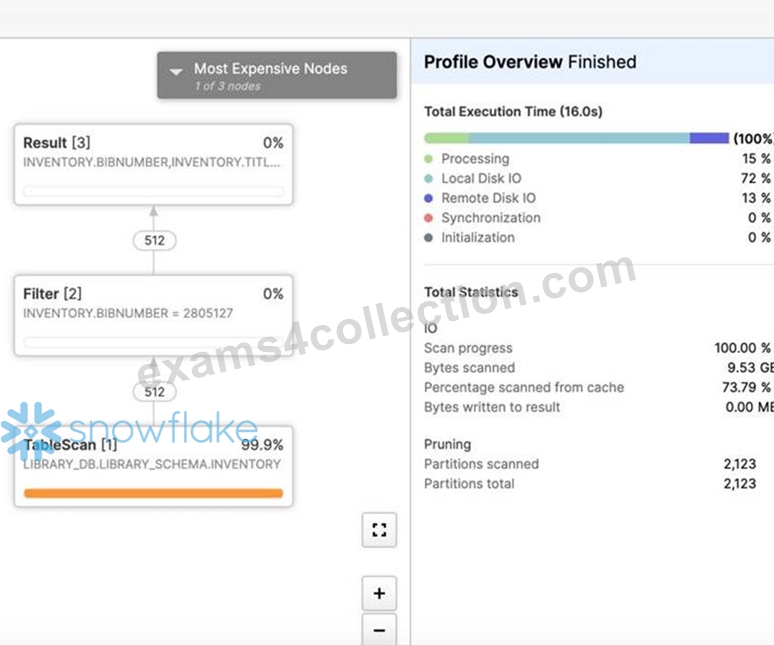
- A. Divide the table into multiple smaller tables
- B. alter table inventory cluster by (BIBNUMBER);
- C. Create an index on column BIBNUMBER
- D. Execute the below query to enable auto clustering
Answer: B
NEW QUESTION # 30
An Architect has a VPN_ACCESS_LOGS table in the SECURITY_LOGS schema containing timestamps of the connection and disconnection, username of the user, and summary statistics.
What should the Architect do to enable the Snowflake search optimization service on this table?
- A. Assume role with ALL PRIVILEGES on VPN_ACCESS_LOGS and ADD SEARCH OPTIMIZATION in the SECURITY_LOGS schema.
- B. Assume role with OWNERSHIP on VPN_ACCESS_LOGS and ADD SEARCH OPTIMIZATION in the SECURITY_LOGS schema.
- C. Assume role with ALL PRIVILEGES including ADD SEARCH OPTIMIZATION in the SECURITY LOGS schema.
- D. Assume role with OWNERSHIP on future tables and ADD SEARCH OPTIMIZATION on the SECURITY_LOGS schema.
Answer: B
NEW QUESTION # 31
......
Snowflake ARA-C01 (SnowPro Advanced Architect Certification) Exam is a prestigious certification program for professionals who work with Snowflake. It measures the candidate's ability to design and implement complex Snowflake solutions in a variety of scenarios. SnowPro Advanced Architect Certification certification program is designed to validate the candidate's knowledge of data warehousing, data modeling, ETL, security, and performance optimization best practices in a Snowflake environment. Passing the exam is a great way to demonstrate your expertise in Snowflake's advanced concepts and techniques and differentiate yourself in the competitive data analytics industry.
Free ARA-C01 Exam Questions ARA-C01 Actual Free Exam Questions: https://www.exams4collection.com/ARA-C01-latest-braindumps.html
100% Free ARA-C01 Exam Dumps to Pass Exam Easily: https://drive.google.com/open?id=1rVcFELAOQ6OH62hxbUEc1VbuKwZYM-xt
