

Unique Top-selling ISO-14001-Lead-Auditor Exams - New 2026 PECB Pratice Exam
ISO 14001 Dumps ISO-14001-Lead-Auditor Exam for Full Questions - Exam Study Guide
PECB ISO-14001-Lead-Auditor Exam Syllabus Topics:
| Topic | Details |
|---|---|
| Topic 1 |
|
| Topic 2 |
|
| Topic 3 |
|
| Topic 4 |
|
| Topic 5 |
|
| Topic 6 |
|
NEW QUESTION # 14
An audit team leader arrives at a steel fabrication organisation that manufactures fire escape stairs to carry out a Stage 2 certification audit. At a meeting with the EMS Manager, she is told that they have won their biggest contract from a construction organisation to manufacture and install fire escape stairs. They appointed a subcontractor to perform the installation work. The EMS Manager wants the ISO 14001 audit extended to cover the installation site.
Select which one of the options is the correct response by the auditor.
- A. Can you arrange to bring the installation team here so that we can include this in the audit?
- B. We have used all our allocated time in preparation for this audit so how can we extend the audit scope?
- C. Would you write to my audit programme manager with this request?
- D. Do you realise that this involves an extension to the scope of the audit and will require an application process?
Answer: D
Explanation:
According to ISO/IEC 17021-1:2015 Clause 9.3.1 and ISO 19011:2018 Clause 5.4.1:
Any change in scope requires formal review and approval through certification body's application process.
The auditor cannot unilaterally extend the scope during the audit.
The correct course of action is to inform the auditee that scope changes require an application process.
Reference: ISO/IEC 17021-1:2015 Clause 9.3.1; ISO 19011:2018 Clause 5.4.1.
NEW QUESTION # 15
XM, a chain of 25 petrol stations, established an EMS following the requirements of ISO 14001, which was third-party certified 10 years ago. You are performing an internal audit before the fourth certification cycle.
During the audit to the EMS Manager (EM), the following dialogue takes place:
You: Could you please give me some details on the inspection of underground tanks in each station?
EM: It's very simple. There is a regulation that requires an annual leak inspection.
You: Who performs these inspections?
EM: I personally contract the inspectors and submit the results to the local authority. These are the certificates submitted last year.
You: I see only 22 certificates. There are three missing.
EM: The tanks of those three stations will be removed next year and replaced by new ones. I phoned the local authority and they told me that I do not need to send any report of the tanks that will be changed.
Which one of the following would be your next question?
- A. Did you ask the local authority to send a written confirmation of their decision?
- B. Can I see the contract XM signed with the inspector?
- C. Can I see the plan for the installation of the new tanks?
- D. Have you planned any final disposal of the tanks to be removed?
Answer: A
Explanation:
According to ISO 14001:2015 Clause 9.1.2 (Compliance Obligations) and Clause 7.4 (Communication):
The organization must retain evidence of compliance obligations and communications with regulatory bodies.
Verbal confirmation from the authority is insufficient; written confirmation ensures objective evidence for audit purposes.
Reference: ISO 14001:2015 Clause 9.1.2, 7.4.
NEW QUESTION # 16
You are leading a recertification audit of XM, a manufacturer of cosmetics products. After the initial certification, XM moved to another site.
After the opening meeting, you are visiting the new site with the production manager (PM). The dialogue is as follows:
You: It seems that you are doing some work in the right-hand corner of the site.
PM: Yes, when we moved to this site, there was a very old, three-stories high building; it was almost empty, and we decided to demolish it and to build a new office for the administrative personnel. DEMO services are doing the job, which is almost over.
You: Do you know what the old building was used for?
PM: I was told that it was a warehouse for chemical storage, including a laboratory and toilets for the personnel. It had also a chimney, I do not know what for.
You: Did you consider it necessary to refer to some parts of the EMS for this work?
PM: No, we were busy moving all equipment and materials to the new site, we did not have time to care about something that was going to disappear.
Which four audit trail issues would you follow?
- A. Business information on DEMO
- B. DEMO's quality policy
- C. XM's supervision of DEMO when doing the work
- D. DEMO's environmental policy
- E. Environmental impacts related to the demolition
- F. Regulatory approval for DEMO's activities
- G. XM's contract with DEMO to conduct the work
- H. Audit DEMO's head office personnel
Answer: C,E,F,G
Explanation:
According to ISO 14001:2015:
Clause 6.1.2 & 6.1.4 (Environmental aspects and planning actions): demolition impacts must be identified and controlled (C).
Clause 8.1 (Operational planning and control): control of outsourced processes (supervision and contract requirements) (B, E).
Clause 9.1.2 (Compliance obligations): regulatory approvals for demolition (H).
The subcontractor's internal policies (A, D, F, G) are generally not part of XM's EMS obligations.
Reference: ISO 14001:2015 Clauses 6.1.2, 6.1.4, 8.1, 9.1.2.
NEW QUESTION # 17
Whistlekleen is a national dry cleaning and laundry organisation with 50 shops. You are conducting an EMS surveillance audit of Head Office and are sampling environmental performance measurement. You find that
80 per cent of failures to meet performance criteria originate from five shops in the same region. Most of these failures relate to the release of volatile organic compounds (VOCs) that exceeded regulations. The Environmental Manager tells you that these are the oldest shops in the organisation. The cleaning equipment needs replacing but the organisation cannot afford it at the moment.
On raising the matter with senior management, you are told that there are plans to replace the equipment in these shops over the next five years.
When reviewing the nonconformity report files, you find that the organisation is facing a legal dispute with the environmental authority over multiple breaches of environmental legislation.
Select the three best options for how this dispute should be handled by the organisation through its EMS.
- A. Offer to compensate employees for possible health implications.
- B. Advise the authority that the faulty equipment will be maintained more often.
- C. Advise the authority that timely corrective action will be taken.
- D. Monitor VOC emissions to ensure compliance with legal requirements.
- E. Give an explanation to the authority of what went wrong.
- F. Investigate changing the cleaning process to use chemicals with lower VOC content.
- G. Ask to settle the court case by negotiation with the authority.
- H. Conduct an internal enquiry to establish who is to blame.
Answer: C,D,F
NEW QUESTION # 18
An organisation (ABC) plans to carry out a second-party audit of the environmental management system of a supplier (XYZ). Both, ABC and XYZ, have a certified Environmental Management System (EMS) to ISO
14001 by the same certification body.
Which one of these statements is correct?
- A. ABC should request to see a copy of the last certification body audit report from XYZ.
- B. ABC should invite, as an observer, an auditor of the certification body when it carries out the audit to XYZ.
- C. ABC should not ask permission from the certification body to carry out the audit to XYZ.
- D. ABC should inform the certification body that it is planning to audit XYZ.
Answer: C
Explanation:
According to ISO 19011:2018 Clause 3.5 (Second-party audit):
Second-party audits are conducted directly by customers on their suppliers for contractual or commercial purposes.
There is no obligation to inform or involve the certification body in such audits unless contractually required.
Certification body audit reports are confidential to the certified organization and the certification body.
Reference: ISO 19011:2018 Clause 3.5; ISO 14001 Lead Auditor Course Guide.
NEW QUESTION # 19
Which one of the following options best describes the main purpose of a Stage 2 third-party audit?
- A. To identify nonconformances against a standard.
- B. To determine readiness for certification.
- C. To get to know the organisation's management system.
- D. To check for legal compliance by the organisation.
Answer: A
Explanation:
According to ISO/IEC 17021-1:2015 (used alongside ISO 14001 for certification audits), the certification process includes Stage 1 and Stage 2 audits:
The purpose of the Stage 1 audit is to review the management system documentation and assess the organization's preparedness for Stage 2.
The Stage 2 audit's main objective is to evaluate the implementation, including the effectiveness, of the organization's management system. This includes assessing conformity with all the requirements of ISO
14001:2015.
As per ISO/IEC 17021-1:2015 Clause 9.3.2.2.2:
"The stage 2 audit shall take place at the site(s) of the organization. It shall include at least the following:
information and evidence about conformity to all requirements of the applicable management system standard." Thus, the Stage 2 audit is where auditors identify nonconformities and gather evidence to support certification decisions.
Reference: ISO/IEC 17021-1:2015 Clause 9.3.2.2.2; ISO 14001 Lead Auditor Course Guide - Certification Process Module.
NEW QUESTION # 20
Which one of the following conclusions in the audit report is not required by the certification body when deciding to grant certification?
- A. The corrections taken by the organisation related to major nonconformities have been accepted.
- B. The organisation fully complies with all legal and other requirements applicable to the Environmental Management System.
- C. The plans to address corrective actions related to minor nonconformities have been accepted.
- D. The scope of certification has been fulfilled.
Answer: B
Explanation:
According to ISO/IEC 17021-1:2015 Clause 9.4.5 and 9.5.1:
Certification decisions are based on:
The audit conclusions,
Acceptance of corrective action plans for minor nonconformities (A),
Acceptance of corrections for major nonconformities (C),
Confirmation that the scope is fulfilled (B).
Full legal compliance (D) is not a requirement for certification decisions rather, it is the effectiveness of the management system to meet compliance obligations that is assessed.
Reference: ISO/IEC 17021-1:2015 Clause 9.4.5 and 9.5.1; ISO 14001:2015 Clause 9.1.2.
NEW QUESTION # 21
What are the primary purposes of implementing an EMS based on ISO 14001:2015? Select two.
- A. It is used to demonstrate to external parties that the organisation has met all its legal requirements.
- B. It provides a means by which environmental impacts are addressed at relevant stages of the life cycle.
- C. It enables the organisation to tender for government-funded contracts.
- D. It provides a framework for protecting the environment.
- E. It improves the organisation's financial results.
- F. It ensures that organisations operate fully online management systems.
Answer: B,D
Explanation:
According to ISO 14001:2015 Clause 1 (Scope) and Clause 6.1.2:
Clause 1:
"The purpose of this International Standard is to provide organizations with a framework to protect the environment and respond to changing environmental conditions in balance with socio-economic needs." Clause 6.1.2:
"The organization shall determine the environmental aspects of its activities, products and services that it can control and influence, considering a life cycle perspective." Demonstrating legal compliance (B) is part of the intended outcomes but not the primary purpose.
Tender eligibility (C), financial results (E), and system format (F) are not stated objectives of ISO 14001:2015.
Reference: ISO 14001:2015 Clauses 1, 6.1.2.
NEW QUESTION # 22
Which two of the following phrases would apply to "audit criteria"?
- A. Auditor competence
- B. Nonconformity report
- C. Management policy
- D. Audit conclusions
- E. ISO 14001 requirements
- F. Financial objectives
Answer: C,E
Explanation:
According to ISO 19011:2018 Clause 3.3 (Terms and definitions):
Audit criteria are defined as:
"Set of policies, procedures or requirements used as a reference against which objective evidence is compared." ISO 14001 requirements (F) and the organization's own management policy (A) are valid audit criteria.
Nonconformity report (C) and audit conclusions (D) are audit outputs, not criteria.
Financial objectives (B) and auditor competence (E) are not used as audit criteria.
Reference: ISO 19011:2018 Clause 3.3; ISO 14001:2015 Clause 5.2.
NEW QUESTION # 23
Sparkle is an organisation that provides mobile car cleaning services at customers' premises. It has been certified to ISO 14001 for some time and has appointed a new EMS Manager. The audit plan during a surveillance audit includes the improvement actions and the auditor asks to see the most recent management review meeting minutes.
Which six statements would represent output audit evidence for the management review?
- A. Plan to prioritise environmental improvement as a business strategy
- B. Changes in the EMS documentation
- C. Staff feedback of environmental risks
- D. Changes to the significant environmental aspects
- E. Decisions related to continual improvement opportunities
- F. Report of performance of EMS objectives in the last year
- G. Allocation of a bigger budget for the EMS department
- H. Updated environmental signs in the production facility
- I. Procurement of new spill kits for operators
- J. Minutes of previous management reviews
Answer: A,B,D,E,F,G
NEW QUESTION # 24
Sparkle is an organisation that provides mobile car cleaning services at customers' premises. It has been certified to ISO 14001 for some time and has appointed a full-time Environmental Management System Manager. The audit plan during a surveillance audit includes continual improvement and the auditor asks to see the most recent management review meeting minutes.
The minutes indicate that the Environmental Management System Manager reported that the last review of the organisation's environmental legislation register was made three years ago instead of annually as planned in the Environmental Management System. At that time, he asked for finances to employ a legislation expert to update the register but was denied the request by top management on the basis that it was unlikely that many changes to legislation had occurred. No related improvement actions were documented in the minutes.
Based on the scenario, select the two options which best describe the evidence for raising such a non- conformity.
- A. Extend the audit plan to include the five shops.
- B. Raise an opportunity for improvement (OI) to reduce damaging emissions.
- C. The organisation failed to update its legislation register following the planned frequency of review.
- D. Evaluate whether the process for measuring environmental performance is effective.
- E. Determine if the local authority has been informed that the organisation is exceeding VOC emissions.
- F. Recommend that staff in the five shops should have medical check-ups due to air pollution.
Answer: B,C
NEW QUESTION # 25
A huge public library established an EMS following the requirements of ISO 14001, which was third-party certified 10 years ago. You are performing the second surveillance audit of the third certification cycle. The audit plan included an audit to the Director as the last interview before the closing meeting.
During the interview with the Director, you audit clause 6.2 (Objectives and planning to achieve them). The dialogue is as follows:
You: Could you please tell me which were the environmental objectives defined for last year and show evidence of their achievement?
Director: Yes. We had defined three objectives. As you can see from our Annual Plan, one of them was to separate our waste in four categories: paper, plastics, metals, food - before, we had only three (plastic and paper were disposed together). We developed an Action Plan to achieve this objective.
Which six of the questions would you ask related to the Action Plan?
- A. Was it approved by the Director?
- B. When is its completion date?
- C. Who was responsible for the completion of the plan?
- D. How will you evaluate the cost savings?
- E. How was progress of the plan being monitored?
- F. Did you define any method for monitoring progress?
- G. How did you measure it?
- H. Is it consistent with the environmental policy?
- I. Were actions integrated into the organisation's business processes?
- J. Did you estimate what resources would you need?
Answer: C,E,F,H,I,J
NEW QUESTION # 26
You work for a certification body. In two months, you will have to lead an audit of a pharmaceutical organisation, ABC, that manufactures vaccines to combat a pandemic. When planning the audit team, you select one of the certification body auditors who is professionally qualified in Biochemistry and Pharmacy.
However, she is not fully aware of all legal applicable requirements. You recommend the certification body hire a compliance expert to assist the audit team. In which two clauses of ISO 14001:2015 would you consider that auditors may need the help of the expert?
- A. 9.1.2 Compliance obligations
- B. 5.1 Leadership
- C. 4.2 Understanding needs and expectations of interested parties
- D. 9.2 Internal audits
- E. 7.1 Resources
- F. 5.2 Environmental Policy
Answer: A,C
Explanation:
According to ISO 14001:2015:
Clause 4.2:
The organization must understand the needs and expectations of interested parties, which includes regulatory bodies and applicable legal requirements. Legal expertise may be necessary to fully assess this.
Clause 9.1.2:
The organization must evaluate compliance obligations, which requires understanding applicable legal requirements.
Legal compliance evaluation often requires specialized legal or regulatory knowledge, especially in highly regulated sectors like pharmaceuticals.
Reference: ISO 14001:2015 Clauses 4.2 and 9.1.2.
NEW QUESTION # 27
Whistlekleen is a national dry cleaning and laundry organisation with 50 shops. You are conducting an EMS surveillance audit of Head Office and are sampling environmental performance measurement. You find that
80 per cent of failures to meet performance criteria originate from five shops in the same region. Most of these failures relate to the release of volatile organic compounds (VOCs) that exceeds regulations. The Environmental Manager tells you that these are the oldest shops in the organisation. The cleaning equipment needs replacing but the organisation cannot afford it at the moment.
On raising the matter with senior management, you are told that there are plans to replace the equipment in these shops over the next five years.
Select two options that apply to how you should respond to the information given.
- A. Raise an opportunity for improvement (OI) to reduce damaging emissions
- B. Determine if the local authority has been informed that the organisation is exceeding VOC emissions
- C. Evaluate whether the process for measuring environmental performance is effective
- D. Criticise the equipment replacement period as being too environmentally damaging for too long
- E. Extend the audit plan to include the five shops
- F. Recommend that staff in the five shops should have medical check-ups due to air pollution
Answer: B,C
NEW QUESTION # 28
A key audit process is the way auditors gather information and determine the findings' characteristics. Put the actions in the correct order to complete this process.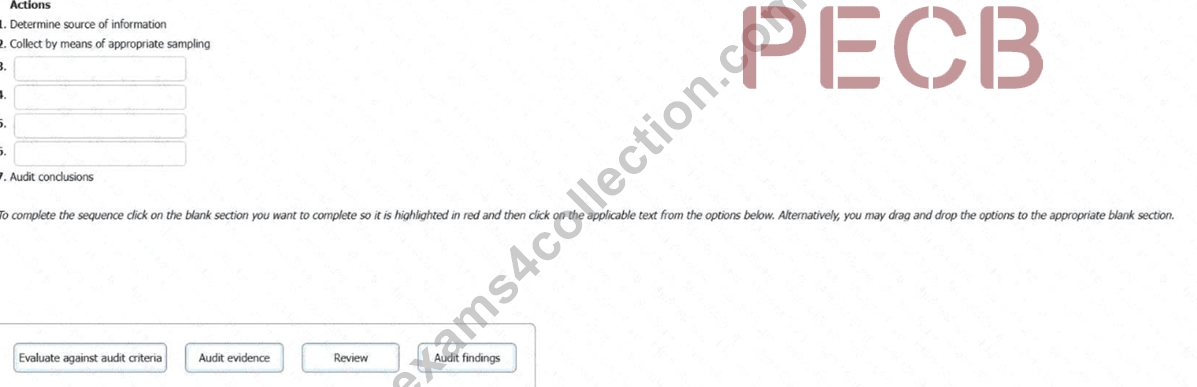
Answer:
Explanation: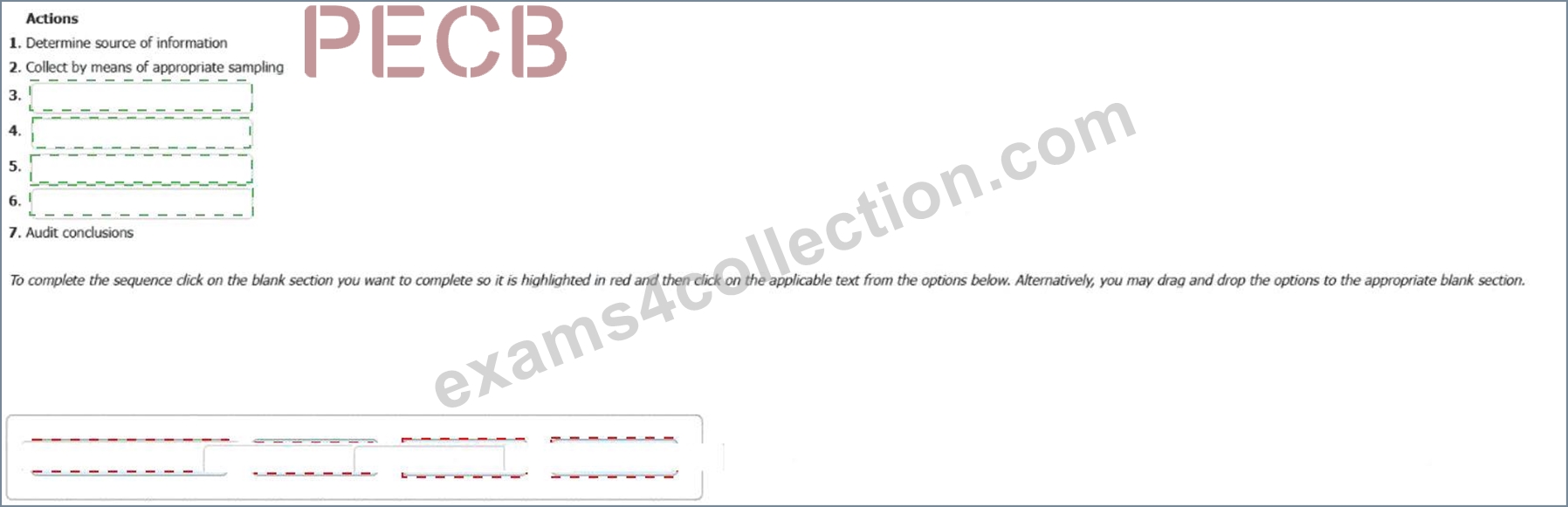
Explanation:
A screenshot of a computer AI-generated content may be incorrect.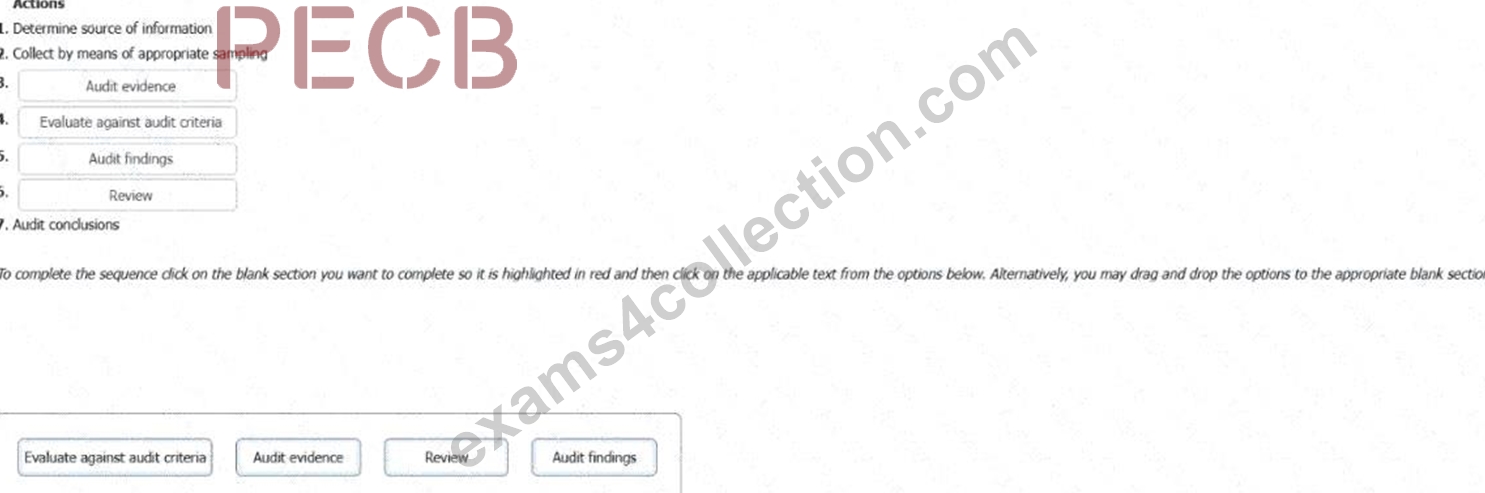
This sequence is derived from ISO 19011:2018 - Guidelines for Auditing Management Systems, which is used in conjunction with ISO 14001:2015 by auditors. Specifically, the audit process steps during the
"conducting the audit" phase include:
Determining the source of information (Clause 6.4.5): Includes documents, interviews, records, and observations.
Collecting data by sampling (Clause 6.4.6): Sampling helps in managing resources and gathering relevant evidence effectively.
Gathering audit evidence (Clause 3.8): Audit evidence is the data collected and verified to support findings.
Evaluating against audit criteria (Clause 3.9): Evidence must be evaluated against standards such as ISO
14001 requirements, internal policies, etc.
Developing audit findings (Clause 6.4.9): Conclusions regarding conformance, nonconformance, and opportunities for improvement.
Review of findings (Clause 6.4.10): Cross-verification and validation before finalizing results.
Audit conclusions (Clause 6.4.11): Final statements summarizing the audit based on findings.
This structured process ensures audits are performed impartially, with verifiable, evidence-based outcomes that contribute to continual improvement.
Reference:
ISO 19011:2018, Clauses 6.4.5 to 6.4.11
ISO 14001:2015, Clause 9.2 - Internal audit requirements
NEW QUESTION # 29
You are conducting a Stage 2 certification audit of VitalSpark, a pharmaceutical organisation manufacturing vitamins and other healthcare medicines. In a separate area in the centre of their large site, a supplier produces oxygen supplies piped directly into the manufacturing processes of VitalSpark. They also deliver oxygen in bulk tankers to other customers. When you review the environmental aspects register, you find that the only environmental aspect recorded for this arrangement relates to the heavy goods vehicles of the supplier transiting the site.
You ask the EMS Manager about the environmental consequences to VitalSpark of this arrangement and are told that they are not significant since the supplier has its own services for water, sewage, waste and energy.
The EMS Manager tried unsuccessfully to communicate with the supplier who is located inside the VitalSpark site and outside the scope of the EMS.
You raise a non-conformance against clause 6.1.2 of ISO 14001:
"VitalSpark does not maintain documented information on aspects/impacts related to activities, products and services of the oxygen supplier." Which combination of two of the following actions proposed by VitalSpark would permit you to close out the nonconformity?
- A. VitalSpark will update its documented information on aspects/impacts to include those related to the oxygen supplier.
- B. The oxygen supplier will be requested to undertake a full environmental survey of its processes.
- C. VitalSpark will expand its audit programme to include audits of the oxygen supplier's organisation.
- D. VitalSpark will retrieve environmental data on a monthly basis from the on-site supplier.
- E. VitalSpark will suggest that the oxygen supplier should undertake training in environmental awareness.
- F. The oxygen supplier will be requested to implement an ISO 14001 management system within the next
3 months.
Answer: A,D
NEW QUESTION # 30
......
Best way to practice test for PECB ISO-14001-Lead-Auditor: https://www.exams4collection.com/ISO-14001-Lead-Auditor-latest-braindumps.html
ISO-14001-Lead-Auditor Dump Ready - Exam Questions and Answers: https://drive.google.com/open?id=1rFgNRGRxoGG5nGV-eZUMlot16eYq5XkF
