

100% Reliable Microsoft 300-510 Exam Dumps Test Pdf Exam Material
Based on Official Syllabus Topics of Actual Cisco 300-510 Exam
To prepare for the Cisco 300-510 certification exam, candidates can take advantage of various training resources provided by Cisco, including instructor-led training courses, e-learning modules, and practice exams. The training courses cover the key concepts and technologies related to advanced routing solutions, such as MPLS VPNs, BGP routing policies, and SR architecture. The e-learning modules offer interactive learning experiences that allow candidates to study at their own pace, while the practice exams help them assess their knowledge and readiness for the actual exam.
NEW QUESTION # 69
Which types of multicast distribution tree can PIM-SM use?
- A. Only shared tree rooted at the source
- B. Only shortest path tree rooted at the RP
- C. Shared tree rooted at the source and shortest path tree switchover
- D. Shared tree rooted at the RP and shortest path tree switchover
- E. Only shared tree rooted at the RP
- F. Shared tree rooted at the first-hop router and shortest path tree rooted at the RP
Answer: D
NEW QUESTION # 70
Refer to the exhibit.
Which effect of this configuration is true?
- A. It sets the hold timer to 30 seconds and the keepalive timer to 240 seconds
- B. It sets the keepalive timer to 30 milliseconds and the hold timer to 240 milliseconds
- C. It sets the hold timer to 30 milliseconds and the keepalive timer to 240 milliseconds
- D. It sets the keepalive timer to 30 seconds and the hold timer to 240 seconds.
Answer: D
Explanation:
Reference:
html#wp1552800140
NEW QUESTION # 71
Refer to the exhibit.
After troubleshooting BGP traffic steering issue, which action did the network operator take to achieve the correct effect of this configuration?
- A. Routes directly attached to AS 65517 have the local preference set to 150.
- B. Routes that have passed through AS 65517 have the local preference set to 150.
- C. Routes that have passed through AS 65517 have the local preference set to 150 and the traffic is denied.
- D. Routes that have originated through AS 65517 have the local preference set to 150.
Answer: B
NEW QUESTION # 72
An engineer is troubleshooting a connectivity issue across the MPLS network and is verifying the forwarding behavior of packets.
Which table does the engineer look at to verify the forwarding behavior of an IP packet as it enters the MPLS network at the ingress LSR?
- A. LFIB
- B. LIB
- C. RIB
- D. FIB
Answer: A
NEW QUESTION # 73
Refer to the exhibit.
Refer to the exhibit After recent configuration changes to a customer's network, a network engineer notices that R2 cannot communicate with R3 Both FastEthemet interfaces on R2 and R3 are up and configured with the correct IP addresses MD5 password configured en R2 and R3 match with no issues What is the minimum change the engineer must make to enable R2 and R3 to communicate and fix the problem?
- A. Configure virtual links between RI and R3.
- B. Configure interface F0/0 on RI and R2 to be in area O.
- C. Configure a loopback interface on R2 and assign it to area 0.
- D. Define area 2 as a NSSA on R2 and R3
Answer: C
NEW QUESTION # 74
Refer io the exhibit.
While applying the configurations on two routers an engineer notices that OSPF adjacency Between them remains down Through the ping test the engineer confirmed that both me routers have Layer 3 reachability between them Which action should me engineer take to make the adjacencies to full?
- A. Enter the command ip ospf authentication in R2 interface
- B. Delete the area 0 authentication message-digest command from the OSPF process in R1
- C. Delete the area 0 authentication message-digest command from the OSPF process in R2
- D. Enable OSPF just inside the router OSPF process not in the interfaces of any router
Answer: A
NEW QUESTION # 75
Refer to the exhibit.
An engineer is addressing an IS-IS design issue which is running within the topology. All links are running on FastEthernet, except the link between R5 and R4, which is Gigabit Ethernet. Which statement about the design is true?
- A. R4 prefer to reach R5 using R1 as the next hop
- B. R1 prefer to use R5 as the next hop to reach R4
- C. R5 prefers to use R4 as the next hop for all routes
- D. All links have equal cost if the default metric is used
Answer: D
NEW QUESTION # 76
Refer to the exhibit. Why is neighbor 10.1.5.5 stuck in "2WAY" state?
- A. OSPF parameters (Area ID or hello interval) are mismatched between R2 and 10.1.5.5
- B. OSPF authentication has failed between R2 and 10.1.5.5
- C. Router ID 10.1.5.5 is not reachable from R2
- D. It is an expected behavior when OSPF network type is broadcast
Answer: D
Explanation:
https://www.cisco.com/c/en/us/support/docs/ip/open-shortest-path-first-ospf/13683-11.html
NEW QUESTION # 77
Refer to the exhibit.
Refer to the exhibit. Mid-sized company Z connected two branch offices via a multicast-enabled ISP using the BGP routing protocol. PIM was implemented to support multicast streaming between the branches via MSDP Client A cannot connect to the multicast stream source of company Z. The network engineer ran a debug on the edge of the network as shown. Which action resolves the issue?
- A. Implement MBGP and enable a multicast address family on R2
- B. Enable the BGP routing protocol and advertise the 10 10.10.0/24 subnet on R1.
- C. Deploy BSR on routers R1 and R2 and enable multicast on both LAN segments.
- D. Configure the PIM protocol on the Serial 1/1 interface and enable Auto-RP
Answer: C
NEW QUESTION # 78
Refer to the exhibit. R3 is:
* failing to accept multicast RP information from Domain-A
* advertising MSDP SA messages to R1 and R4
* receiving SA messages only from R4
Which command must the engineer implement to resolve the issue?
- A. R3# no ip msdp peer 192.168.1.1
- B. R3# no ip msap sa-filter in 192.168.1.1
- C. R3# ip msdp sa-filter out 192.168.1.1
- D. R3# ip msdp sa-filter in 192.168.3.1
Answer: D
Explanation:
https://allthingsnetworking.wordpress.com/2014/06/27/pim-msdp-sa-filter/
NEW QUESTION # 79
What is used by SR-TE to steer traffic through the network?
- A. dynamic rules
- B. path policy
- C. shortest path calculated by IGP
- D. explicit maps
Answer: B
Explanation:
Reference:
https://www.cisco.com/c/en/us/td/docs/routers/asr9000/software/segment-routing/configuration/guide/b-seg-routing-cg-asr9k/b-seg-routing-cg-asr9k_chapter_0100.html
NEW QUESTION # 80
Refer to the exhibit.
A network engineer applied configuration on R5 to summarize all OSPF routes, but R4 is still receiving specific routes from R5. The engineer has confirmed that both R5 and R4 routers are configured with correct summarization configuration but R5 Is not sending the summary routes What action must the engineer take to fix the problem?
- A. Move R4 and R5 in separate areas as now they maintain the same link-state database
- B. Configure a sham link between R4 and R5 to support summarization within Area 2
- C. Clear link-state database on both R4 and R5 routers for summarization to work
- D. Remove summarization configuration on R5 and configure it on R4
Answer: A
NEW QUESTION # 81
Refer to the exhibit.
Refer to the exhibit. A network engineer just replaced five routers on this OSPF network. When the routing protocol is brought up, R5 cannot reach routes that originate on R1. The engineer verified that all connected links have established neighbor relationships. R5 reaches routes originating on R3 and R4. Which action resolves the issue?
- A. Configure automatic neighbor discovery on RI and R5.
- B. Configure OSPF to have a contiguous Area O.
- C. Configure an OSPF virtual link to bridge Area 0 on routers R3 and R4.
- D. Configure each link to be point-to-point.
Answer: C
NEW QUESTION # 82
Refer to the exhibit.
Refer to the exhibit While troubleshooting a networking issue an engineer identified a suboptimal communication issue on route reflector RR2 In the current environment Router A is a non-route-reflector client for RR1 and RR2 Routers D and E are directly connected iBGP peers.
Router F is not an iBGP peer of routers D and E
Which action resolves the issue?
- A. Enable next-hop-self for BGP peering on router C.
- B. Remove the route-reflector configuration on router RR2.
- C. Disable BGP Client-to-Client reflection on router RR2.
- D. Enable next-hop-self for BGP peering on router D.
Answer: A
NEW QUESTION # 83
Refer to the exhibit.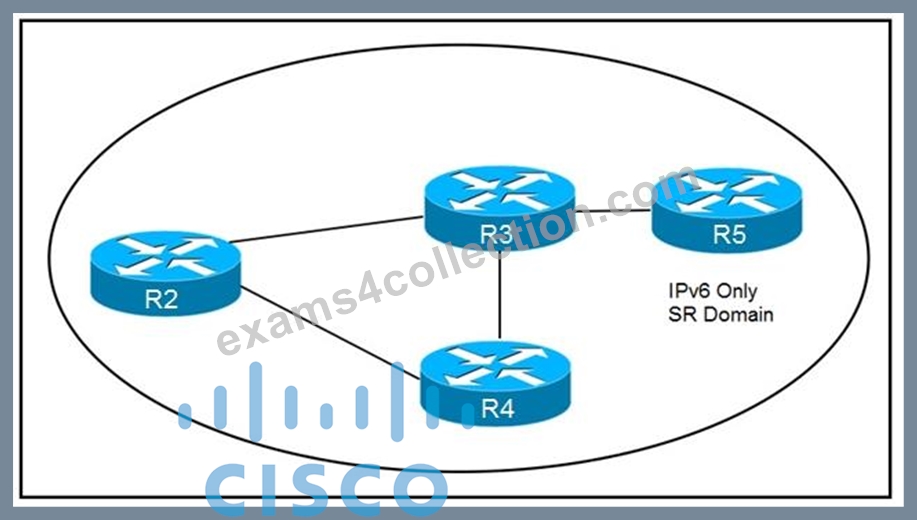
How are packets directed through the data plane when SRv6 is implemented?
- A. A stack of labels represents an ordered list of segments
- B. The MPLS data plane is used to push labels onto IGP routes
- C. An ordered list of segments is encoded in a routing extension header
- D. The packet is encapsulated with a header and trailer encoding the ordered list of segments
Answer: C
NEW QUESTION # 84
......
Cisco 300-510 exam is a challenging but rewarding certification exam that validates the skills and knowledge of IT professionals in implementing advanced routing solutions in service provider environments. With the right preparation and experience, candidates can successfully pass the exam and achieve the CCNP Service Provider certification.
Free 300-510 Dumps are Available for Instant Access: https://www.exams4collection.com/300-510-latest-braindumps.html
View All 300-510 Actual Exam Questions Answers and Explanations for Free: https://drive.google.com/open?id=1KrcZLvkyYPOfiB_Cq2asdqqQnntgu2AW
