

Avaya 71301X Dumps Updated Aug 23, 2024 WIith 136 Questions
View All 71301X Actual Free Exam Questions Aug 23, 2024 Updated
Avaya 71301X exam is an essential certification for professionals who want to work with Avaya Aura® Communication Applications. Avaya Aura® Communication Applications Implement Certified Exam certification validates the candidate's skills and expertise in deploying, configuring, and managing Avaya's communication applications. It is also an excellent way to increase your earning potential and career opportunities in the IT industry. If you are interested in taking 71301X exam, be sure to prepare thoroughly to increase your chances of passing on the first attempt.
What is the salary of an Avaya 71301X Exam?
The Average salary of different countries for Avaya 71301X professionals:
India - INR 4209934 per year
United States - USD 54,000 per year
UK - Pounds 44150 per year
Avaya 71301X certification exam is a highly sought-after certification in the field of communication applications implementation. Avaya Aura® Communication Applications Implement Certified Exam certification is recognized globally and is highly valued by organizations that use Avaya Aura® Communication Applications. Avaya Aura® Communication Applications Implement Certified Exam certification is a testament to the candidate's expertise in implementing and configuring the platform, making them a valuable asset to any organization.
NEW QUESTION # 60
Which four kinds of services does the TSAPI standard provide for third-party call control over Avaya Aura Communication Manager (CM)? (Choose four.)
- A. controlling specific calls or stations
- B. receiving notifications of events
- C. adding new feature buttons to agent sets
- D. performing a remote reboot to the CM server
- E. completing the routing of incoming calls
- F. invoking CM features
Answer: A,B,E,F
NEW QUESTION # 61
Refer to the exhibit.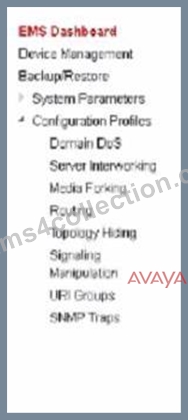
Which type of a Configuration Profile in the Avaya Session Border Controller for Enterprise (ASBCE) allows to set Timers, URI Manipulation and Header Manipulation, and can be linked to a SIP Server Profile?
- A. Signaling Manipulation
- B. Routing
- C. Server Interworking
- D. Topology Hiding
Answer: C
Explanation:
Explanation
A Server Interworking Profile is a type of a Configuration Profile in the Avaya Session Border Controller for Enterprise (ASBCE) that allows setting Timers, URI Manipulation and Header Manipulation, and can be linked to a SIP Server Profile. A Configuration Profile is a configuration object that defines how the ASBCE server handles different aspects of SIP signaling and media processing. A Server Interworking Profile is a Configuration Profile that defines how the ASBCE server interworks with different types of SIP servers, such as Communication Manager, Session Manager, or third-party servers. A Server Interworking Profile can include parameters such as Timers, which specify the timeout values for various SIP transactions; URI Manipulation, which specifies how to modify the user part or domain part of SIP URIs; and Header Manipulation, which specifies how to add, delete, or modify SIP headers. A Server Interworking Profile can be linked to a SIP Server Profile, which is another Configuration Profile that defines the identity and characteristics of a SIP server that communicates with the ASBCE server.
NEW QUESTION # 62
You need to connect the Avaya Breeze® platform that is hosting an Avaya Aura® Presence Services snap-in with the Avaya Aura® Session Manager (SM). Which three are required to set up this connection? (Choose three.)
- A. One Entity Link from SM to Avaya Breeze®
- B. one Entity Link from SM to Avaya Aura® Presence Services Snap-in
- C. TLS ports 5061 and TLS 5062
- D. TCP port 5060 and UDP port 5060
- E. UDP port 5060 and TLS port 5061
Answer: A,C,E
Explanation:
Explanation
To connect the Avaya Breeze® platform that is hosting an Avaya Aura® Presence Services snap-in with the Avaya Aura® Session Manager (SM), you need to configure the following:
* One Entity Link from SM to Avaya Breeze®: This is a SIP trunk that connects the SM and the Avaya Breeze® server for SIP signaling and media. You need to create an Entity Link in System Manager, under Elements > Routing > Entity Links, and specify the IP address or FQDN of the SM and the Avaya Breeze® server Security Module (SM100). You also need to select TLS as the SIP Link Transport Type56
* TLS ports 5061 and TLS 5062: These are the ports used by the Entity Link for secure SIP signaling between SM and Avaya Breeze®. Port 5061 is used by SM to send SIP requests to Avaya Breeze®, while port 5062 is used by Avaya Breeze® to send SIP responses to SM. These ports require a valid certificate on both SM and Avaya Breeze® servers56
* UDP port 5060 and TLS port 5061: These are the ports used by the Presence Services snap-in for XMPP federation with other XMPP servers or clients. Port 5060 is used for unencrypted XMPP traffic over UDP, while port 5061 is used for encrypted XMPP traffic over TLS. These ports enable presence and instant messaging features across different domains or platforms34
NEW QUESTION # 63
Avaya Aura Presence Services 7.x is implemented on Avaya Breeze (formerly Engagement Development Platform (EDP)).
When looking at Elements > Breeze > Service Management > Services, which status would you expect for a Presence Services snap-in that is ready to support Avaya Aura Presence Services?
- A. Loaded
- B. Accepting
- C. Installed
- D. Active
Answer: B
NEW QUESTION # 64
When Avaya Aura Presence Services is implemented, which statement is true about Port Management?
- A. It allows independent management capabilities to filter out undesired message to every Avaya Aura Presence Services user.
- B. It collects statistics about Port-Usage from each Presence-compatible endpoint across the network.
- C. Port 5222 is used for one-X Endpoints, while Port 5269 is open for connecting with other XMPP 3rd-Party Servers.
- D. It allows multi-media services over a standard Web-Browser.
Answer: C
NEW QUESTION # 65
Which two pieces of information in an output from the show mgc command (issued on a G430/G450 Gateway CLI), indicate that the G430/G450 is operating as an Internet Friendly (Edge) Gateway as opposed to an Enterprise Gateway? (Choose two.)
- A. The H.248 Link Mode displays IFG.
- B. The Controller displays sbc@.
- C. The H.248 Link Status displays UP/Encrypted.
- D. The Gateway Mode displays Edge.
- E. The Management Link Mode displays Tunnelled.
Answer: A,C
Explanation:
Explanation
The output from the show mgc command (issued on a G430/G450 Gateway CLI) can indicate whether the G430/G450 is operating as an Internet Friendly (Edge) Gateway or an Enterprise Gateway. An Internet Friendly (Edge) Gateway is a device that provides secure and reliable connectivity between endpoints on different networks, such as the public internet and a private enterprise network. An Enterprise Gateway is a device that provides connectivity between endpoints on the same network, such as a LAN or a WAN. The show mgc command displays information about the Media Gateway Controller (MGC), which is the entity that controls the media gateway functions of the G430/G450, such as call processing, routing, and signaling.
The MGC can be an Avaya Communication Manager (CM) server or an Avaya Session Border Controller for Enterprise (ASBCE) server. The output from the show mgc command includes these fields:
* Management Link Mode: This field indicates how the G430/G450 communicates with the MGC for management purposes, such as configuration, monitoring, and troubleshooting. The possible values are Direct or Tunnelled. Direct means that the G430/G450 communicates with the MGC using a direct IP connection over TCP port 5022. Tunnelled means that the G430/G450 communicates with the MGC using a tunnel over TCP port 2944 and secured using TLS. This mode is used when the G430/G450 operates as an Internet Friendly (Edge) Gateway and communicates with ASBCE as the MGC.
* H.248 Link Mode: This field indicates how the G430/G450 communicates with the MGC for media gateway control purposes, such as controlling media streams, allocating resources, and creating connections. The possible values areEGW or IFG. EGW means that the G430/G450 communicates with the MGC using H.248 protocol over UDP port 2944. This mode is used when the G430/G450 operates as an Enterprise Gateway and communicates with CM as the MGC. IFG means that the G430/G450 communicates with the MGC using H.248 protocol over TCP port 2944 and secured using TLS. This mode is used when the G430/G450 operates as an Internet Friendly (Edge) Gateway and communicates with ASBCE as the MGC.
* H.248 Link Status: This field indicates whether the H.248 link between the G430/G450 and the MGC is
* up or down, and whether it is encrypted or not. The possible values are UP/Encrypted, UP/Unencrypted, DOWN/Encrypted, or DOWN/Unencrypted. UP means that the H.248 link is established and functional.
DOWN means that the H.248 link is not established or not functional. Encrypted means that the H.248 link is secured using TLS encryption. Unencrypted means that the H.248 link is not secured using TLS encryption.
Therefore, to determine whether the G430/G450 is operating as an Internet Friendly (Edge) Gateway or an Enterprise Gateway, you can look at these two fields in the output from the show mgc command:
* If the H.248 Link Mode displays IFG, it means that the G430/G450 is operating as an Internet Friendly (Edge) Gateway and communicating with ASBCE as the MGC using H.248 over TCP port 2944 and secured using TLS.
* If the H.248 Link Status displays UP/Encrypted, it means that the G430/G450 is operating as an Internet Friendly (Edge) Gateway and communicating with ASBCE as the MGC using a secure and functional
H.248 link.
NEW QUESTION # 66
You are preparing to obtain a server identity certificate from a Certificate Authority (CA) for the installation on the Avaya Session Border Controller for Enterprise (ASBCE).
What should be done prior to obtaining a server identity certificate from the CA?
- A. Run initTM -f from the ASBCE CLI.
- B. Create a TLS Profile in the ASBCE.
- C. Configure an Enrollment Password in the System Manager.
- D. Generate a Certificate Signing Request (CSR).
Answer: D
Explanation:
Explanation
Before obtaining a server identity certificate from a Certificate Authority (CA) for the installation on the Avaya Session Border Controller for Enterprise (ASBCE), you need to generate a Certificate Signing Request (CSR). A CSR is a file that contains information about the identity and public key of the ASBCE server, as well as a digital signature that proves the ownership of the public key. A CSR is used to request a server identity certificate from a CA, which is an entity that issues and verifies certificates. The CA will check the information in the CSR and issue a server identity certificate that contains the same information and public key, as well as the CA's signature and validity period. The server identity certificate is used to authenticate the ASBCE server to other entities that communicate with it using HTTPS or SIP over TLS. To generate a CSR for the ASBCE server, you can use tools such as OpenSSL or Keytool, or use the ASBCE web interface or CLI.
NEW QUESTION # 67
To allow trust between Avaya Aura System Manager (SMGR) and Avaya Aura Messaging (AAM), there is a password set when you add the Trusted Server on AAM. This password must match with the password also configured in SMGR.
Which statement about the password in SMGR is true?
- A. It needs to match the Attributes of the Messaging Managed Element in the Inventory.
- B. It needs to match the admin password used to login to SMGR using a web browser.
- C. It needs to match the Enrollment Password.
- D. It needs to match the root password used to login to SMGR command line.
Answer: A
NEW QUESTION # 68
In the context of Avaya Aura Presence Services 7.x, what is a Fetcher?
- A. It is the presence information about a user that the system reports.
- B. It is a user whose devices are sending status or presentity information on his behalf using a Publish message regarding his communication status.
- C. It is a watcher that is subscribing to current and future presentity information from another user.
- D. It is a kind of watcher that requests a one-time view of the user's current presentity information, but does not get future presentity information for a user.
Answer: D
NEW QUESTION # 69
A user is calling the helpdesk to ask how the Avaya Spaces Calling extension can be added, to allow calling from their Avaya Spaces session. How should the helpdesk engineer respond?
- A. Make sure your PC has internet access, use your preferred browser to navigate to www.support.avaya.com, and then find the Avaya Spaces Calling app, download and install it.
- B. Use your preferred browser to navigate to the AAWG web interface, log in with your company credentials, and use the hyperlink at the bottom-right corner of the home page to download and install Avaya Spaces Calling.
- C. Make sure your PC has internet access, use the Google Chrome browser to open the Chrome Web Store, search for the Avaya Spaces Calling extension, and add this extension to the Chrome browser.
- D. Make sure your PC has internet access, and use the Microsoft Store to find, download and install the Avaya Spaces Calling app.
Answer: C
Explanation:
Explanation
The Avaya Spaces Calling extension is a softphone that provides calling features to users of Avaya Spaces by leveraging their existing Avaya infrastructure. This extension can be used alongside the Avaya Spaces web application or desktop client to make and receive audio calls through the Avaya Aura® Web Gateway (AAWG). To add the Avaya Spaces Calling extension, you need to have internet access and use the Google Chrome browser to open the Chrome Web Store. Then, you need to search for the Avaya Spaces Calling extension and click on the Add to Chrome button. The extension will be installed and added to your Chrome browser. You can then use the extension icon in the browser toolbar to access the Avaya Spaces Calling settings and features12
NEW QUESTION # 70
The Avaya WebRTC solution uses the web intensively to make media calls from a standard web browser in the internet, into internal and secure communication premises in the enterprise.
Which statement about security between the Enterprise-edge and those standard Web browsers in the internet is true?
- A. A trust relationship based on certificates must be built to make WebRTC work.
- B. WebRTC only works within the Enterprise network. External Web Browsers must connect through an Avaya Session Border Controller for Enterprise (SBCE) via a SIP trunk.
- C. There must be a VPN connection between the Web Browser and the Enterprise-edge to build a WebRTC link.
- D. No trust relationship exists between enterprise edge security and web browsers; therefore, the security strategy is based on an Authorization Token instead.
Answer: D
NEW QUESTION # 71
You are deploying the Avaya Aura® Presence Services on Avaya Breeze®.
When looking under Elements > Avaya Breeze> Service Management > Services in Avaya Aura® System Manager, which status would you expect to see for a Presence Services snap-in that is ready to support Presence and IM?
- A. Loaded
- B. Accepting
- C. Installed
- D. Active
Answer: D
Explanation:
Explanation
When deploying the Avaya Aura® Presence Services on Avaya Breeze®, you can check the status of the Presence Services snap-in in System Manager, under Elements > Avaya Breeze> Service Management > Services. The status indicates the state of the snap-in on the Avaya Breeze® cluster. The status Active means that the snap-in is running and ready to support Presence and IM. The other statuses are either intermediate or error states that indicate that the snap-in is not fully functional or operational.
NEW QUESTION # 72
To trace SIP messages exchanged during a Remote Worker registration in real-time, which Avaya Session Border Controller for Enterprise (ASBCE) CLI tool is used?
- A. traceReg
- B. traceRW
- C. tracexu
- D. tracesbc
Answer: D
Explanation:
Explanation
To trace SIP messages exchanged during a Remote Worker registration in real-time, you can use the tracesbc CLI tool on the Avaya Session Border Controller for Enterprise (ASBCE). The tracesbc tool is used to capture and display SIP messages and media statistics for calls that traverse the ASBCE server. You can use various filters and options to specify which calls or messages you want to trace. For example, you can filter by source or destination IP address, port, protocol, or call ID. You can also specify how long you want to run the trace and how many messages you want to display. The tracesbc tool can help you troubleshoot and diagnose issues with Remote Worker registration and call setup
NEW QUESTION # 73
When planning the Avaya Session Border Controller for an Enterprise (ASBCE) deployment, what is a good practice to adopt?
- A. Use dedicated ASBCEs on the internal and external sides of the network.
- B. Use the same IP address sub-net for both internal and external Interfaces.
- C. Name interfaces consistently, for example, Al as "Internal" or "Private" for connectivity to the Call Server.
- D. Use the same name for all internal and external interfaces.
Answer: A
Explanation:
Explanation
When planning the Avaya Session Border Controller for an Enterprise (ASBCE) deployment, a good practice to adopt is to name interfaces consistently, for example, Al as "Internal" or "Private" for connectivity to the Call Server. The ASBCE server has four network ports that can be configured as logical interfaces with different IP addresses, subnet masks, gateways, and VLAN IDs. The logical interfaces are named Al, A2, Bl, and B2. A good practice is to use a consistent naming convention for the interfaces that reflects their purpose and function. For example, you can name Al as "Internal" or "Private" because it connects the ASBCE server to the internal network and the Call Server. Similarly, you can name Bl as "External" or "Public" because it connects the ASBCE server to the external network and the Internet. This naming convention can help you avoid confusion and errors when configuring the interfaces and assigning them to zones.
NEW QUESTION # 74
In the context of Avaya Aura® Presence Services, what is a Watcher?
- A. It represents a Presence information about a user that the system reports.
- B. It represents a user whose device is sending status on their behalf using a Publish message.
- C. It is a user who requests a one-time view of another user's current presence status. However, it does not get the future presentity updates.
- D. It is a user who is subscribing to the current and future presence status of another user.
Answer: D
Explanation:
Explanation
In the context of Avaya Aura® Presence Services, a Watcher is a user who is interested in the presence information of another user, called a Presentity. A Watcher sends a Subscribe message to the Presence Services snap-in on the Avaya Breeze® server, requesting to receive notifications about the current and future presence status of the Presentity. The Presence Services snap-in then sends a Notify message to the Watcher, containing the presence information of the Presentity. The Watcher can use this information to decide how and when to communicate with the Presentity12
NEW QUESTION # 75
......
New 71301X Exam Questions Real Avaya Dumps: https://www.exams4collection.com/71301X-latest-braindumps.html
Pass Authentic Avaya 71301X with Free Practice Tests and Exam Dumps: https://drive.google.com/open?id=175GxUtZFvg7M4zNFrV2CqwbEsZTn3Hkl
