

Try 100% Updated CTFL-AcT Exam Questions [2021]
Pass CTFL-AcT Exam - Real Questions & Answers
NEW QUESTION 14
Assume you are testing functionality of the interface of an elevator. One of the requirements is that the elevator can work only if the total weight of the passengers does not exceed 200 kg. The elevator can reach the following floors: Ground Floor, 1st floor and 2nd floor. You want to create an acceptance test using the Gherkin language. You can use the following phrases for this purpose:
i.the total weight of passengers is greater than 200 kg
ii.the elevator is on the Ground Floor
iii.a button '1st floor' was pressed
iv.the elevator goes to the 1st floor
v.a passenger standing at the 2nd floor calls the elevator
vi.a message 'too many passengers' is displayed on the screen
Which of the following statements correctly matches constructs of Given/When/Then with a relevant phrase in order to create a correct test case for the given requirement?
- A. GIVEN ii)
WHEN iv)
THEN v) - B. GIVEN ii)
WHEN i)
THEN vi) - C. GIVEN iii)
WHEN ii)
THEN iv) - D. GIVEN ii)
WHEN v) AND vi) THEN i)
Answer: B
NEW QUESTION 15
Which one of the following statements regarding ATDD / BDD is true?
- A. Behavior-Driven Development (BDD. considers acceptance test design as an activity to be handled by the test team after requirements have been finalized.
- B. In both Acceptance-Test Driven Development (ATD and Behavior-Driven Development (BD, acceptance test cases are written by a test automation engineer as test automation code.
- C. In both Acceptance-Test Driven Development (ATDD. and Behavior-Driven Development (BDD., test cases provide examples of product use.
- D. In Acceptance-Test Driven Development (ATDD., test cases are written prior to the acceptance criteria.
Answer: C
NEW QUESTION 16
As an acceptance tester you want to test the $100 withdrawal process described by the following Business Process Model and Notation (BPMN) model.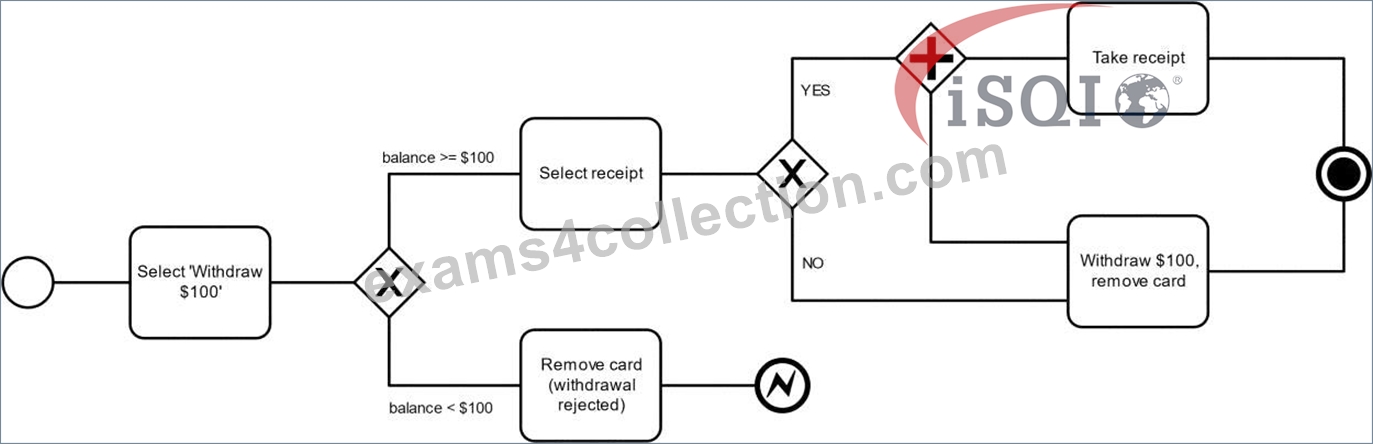
You would like to achieve the following coverage criterion "execute all possible process tasks". Consider the following test cases:
Test 1: balance = $100, receipt = YES
Test 2: balance = $120, receipt = NO
Test 3: balance = $85
Test 4: balance = $20, receipt = YES
Which of the following is the minimal set of test cases allowing to achieve required coverage?
- A. Test 2, Test 4
- B. Test 1, Test 2, Test 4
- C. Test 1, Test 3
- D. Test 1, Test 2, Test 3
Answer: C
NEW QUESTION 17
Which of the following statements corresponds BEST to a UX requirement analysis activity?
- A. Environmental conditions such as light conditions are obtained from a task analysis.
- B. Personas are used to analyze products or solutions from competitors.
- C. Security requirements are derived from usage scenarios.
- D. User profiles are used to determine different levels of business knowledge.
Answer: D
NEW QUESTION 18
Which one of the following combinations of given perspective and statement matches BEST?
- A. From a business perspective, computing power and architecture are major parameters for fine- tuning the system.
- B. From a user perspective, missing feedback from the system when processing a request it is a problem.
- C. From a technical perspective, the number of concurrent user and the types of transactions performed are major elements.
- D. From a business perspective, the choice of performance test tools strongly depends on the applied test techniques.
Answer: B
NEW QUESTION 19
The project team is currently facing a difficult situation originating from their difficulty in envisioning the future and the necessary steps to reach it together with a certain loss of motivation due to a strong feeling of stagnation. You try to unlock the situation by proposing a workshop. Which one would fit the best?
- A. You draw a staircase with 11 steps, each of them representing a major milestone of the project. The bottom of the stairs corresponds to the first day of the project and the upper step means that the project is released. You locate the present situation in the middle of the stairs. The team is asked to identify and discuss the major steps down and up.
- B. You ask two volunteers to play a part in front of the team. One will try to defend the project and propose positive arguments and ways forward. The other will do the opposite. You then recapitulate the major arguments of both sides and debate them openly with the team.
- C. You visualize all remaining major milestones of the project, starting with today and ending with project release. Then, you ask the team to identify and discuss the necessary actions to move forward from the present situation and to reach the milestones.
- D. You organize a day out with challenging physical exercises practiced in teams followed by an afterwork dinner and drink. After all, nothing is best for motivation than hard times together, strong common objectives and a promise of good time.
Answer: A
NEW QUESTION 20
Which of the following activities is most likely performed by the business analyst as part of defect analysis?
- A. Assess the impact of corrective actions on other parts of the system's implementation.
- B. Identify the requirements / user stories that are not satisfied.
- C. Check, whether other paths in the business process model perform as intended.
- D. Analyze the function that failed step by step to identify the cause of the defect.
Answer: B
NEW QUESTION 21
Given the following attributes:
i.commercializability
ii.functional suitability
iii.viability
iv.reliability
v.security
vi.cognitive ability
vii.maintainability
Which one of the following answers contains quality attributes that are MOST relevant for acceptance testing?
- A. ii, v and vi
- B. i, ii and vi
- C. iii, iv and v
- D. ii, v and vii
Answer: B
NEW QUESTION 22
Which one of the following statements regarding ATDD / BDD is true?
- A. Behavior-Driven Development (BDD. considers acceptance test design as an activity to be handled by the test team after requirements have been finalized.
- B. In both Acceptance-Test Driven Development (ATDD. and Behavior-Driven Development (BDD., test cases provide examples of product use.
- C. In both Acceptance-Test Driven Development (ATDD. and Behavior-Driven Development (BDD., acceptance test cases are written by a test automation engineer as test automation code.
- D. In Acceptance-Test Driven Development (ATDD., test cases are written prior to the acceptance criteria.
Answer: B
NEW QUESTION 23
What is considered as good practice regarding business process modeling?
- A. Business analysts should finalize their process models before showing them to acceptance testers.
- B. Keeping all model element in one diagram considerably improves the readability of BMPN models.
- C. Links to requirements or risks should be well separated from the workflow description.
- D. BPMN diagrams and DMN tables should include information such as traceability to user stories.
Answer: D
NEW QUESTION 24
Which one of the following statements describes the relation between business goals, business needs and requirements BEST?
- A. Business needs address the business solution whereas business requirements define the business problem or opportunity.
- B. Business goals and business needs are synonyms.
- C. Business goals, business needs and requirements describe at different levels of abstraction, what shall be achieved.
- D. To derive the business needs, the business analyst first has to understand the business goals and requirements.
Answer: C
NEW QUESTION 25
Which one of the following statements describes an exploratory test charter BEST?
- A. The test charter is elaborated during the testing session according to test execution results.
- B. Indicating that the tester should take the role of a novice user can be part of an exploratory test charter.
- C. Acceptance testers use the exploratory test charter during the testing session to define the test oracle.
- D. Each exploratory test charter is based on a previously defined list of activities that would be interesting to test.
Answer: B
NEW QUESTION 26
Which one of the following statements regarding the graphical representation of business processes is true?
- A. Using decision tables in BPMN allows defining test conditions corresponding to the business rules under test.
- B. Business processes should be described graphically using the DMN standard and completed with decision tables.
- C. For acceptance testing, graphical business process models should focus on the user workflows to be tested.
- D. Graphical representations of business processes must describe the complete workflow in detail, including alternative and error scenarios.
Answer: C
NEW QUESTION 27
Which one of the following statements regarding the quality of requirements is MOST correct?
- A. Testers may complete unclear requirements by assumptions, as long as they discuss those assumptions with at least one stakeholder.
- B. Vague or ambiguous requirements may lead to misunderstandings both during implementation and testing.
- C. INVEST is a technique that ensure the quality of user stories or requirements, thus replacing regular reviews.
- D. In Agile development lifecycle models, requirement engineering becomes less important due to the product owner role.
Answer: B
NEW QUESTION 28
As an acceptance tester you want to test the $100 withdrawal process described by the following BPMN model.
You would like to achieve decision coverage. Consider the following test cases: Test 1: balance = $100, receipt = YES Test 2: balance = $99 Test 3: balance = $120, receipt = NO Test 4: balance = $2500, receipt = YES Which of the following is the minimal set of test cases allowing to achieve full decision coverage?
- A. Test 1, Test 2, Test 3
- B. Test 2, Test 3
- C. Test 1, Test 2, Test 4
- D. Test 1, Test 2
Answer: A
NEW QUESTION 29
Which one of the following statements describes correctly how acceptance testing may be augmented with other test techniques or approaches?
- A. In a risk-based testing approach, acceptance criteria are derived from the tester's experience and intuition.
- B. In a black-box testing approach, acceptance test scenarios follow the implemented sequence of function calls in the code.
- C. In a priority-based testing approach, prioritization of acceptance tests depends on identified product risks.
- D. In a model-based testing approach, acceptance tests are generated from graphical or textual models.
Answer: D
NEW QUESTION 30
......
CTFL-AcT Exam Questions Get Updated [2021] with Correct Answers: https://www.exams4collection.com/CTFL-AcT-latest-braindumps.html
Free ISQI CTFL-AcT Test Practice Test Questions Exam Dumps: https://drive.google.com/open?id=1H-uATnNeuRQ_OsZSbsZAbtYyzo5cZedF
