

[Mar 21, 2026] Get New AZ-120 Practice Test Questions Answers
AZ-120 Dumps and Exam Test Engine
NEW QUESTION # 40
You are planning an SAP NetWeaver deployment on Azure. The database tier will consist of two Azure virtual machines that have Microsoft SQL Server 2017 installed. Each virtual machine will be deployed to a separate availability zone.
You need to perform the following:
* Minimize network latency between the virtual machines.
* Measure network latency between the virtual machines.
What should you do? To answer, select the appropriate options in the answer area. NOTE: Each correct selection is worth one point.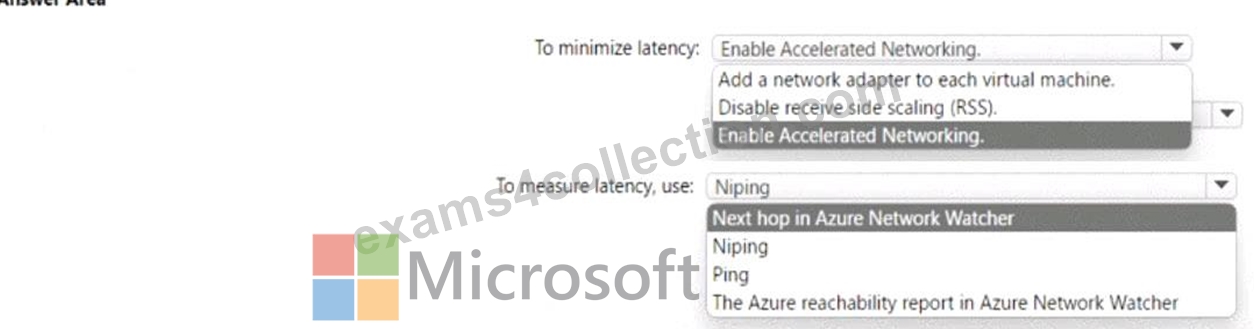
Answer:
Explanation: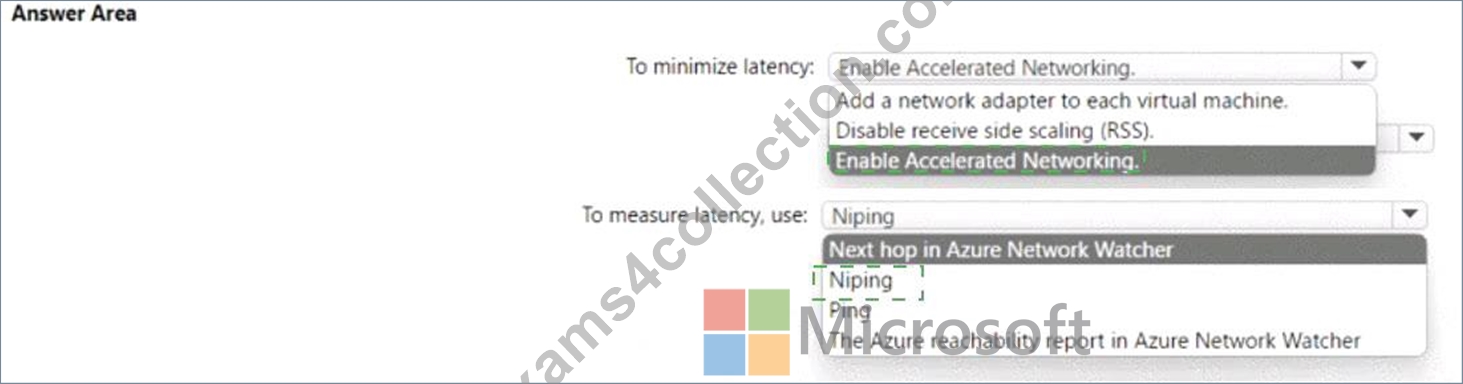
Explanation: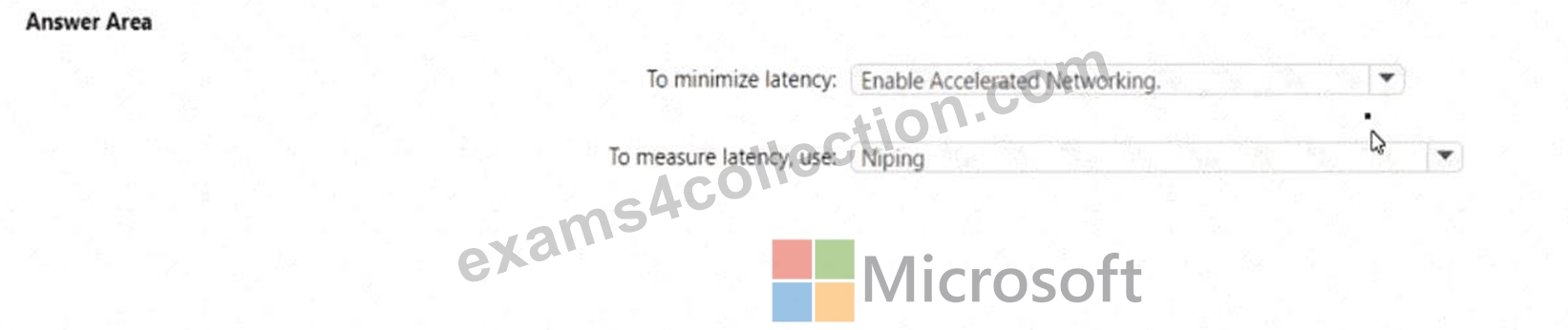
NEW QUESTION # 41
You plan to deploy a scale-out SAP HANA deployment on Azure virtual machines that will contain a standby node.
You need to recommend a storage solution for the deployment.
What should you recommend? To answer, select the appropriate options in the answer area.
NOTE: Each correct selection is worth one point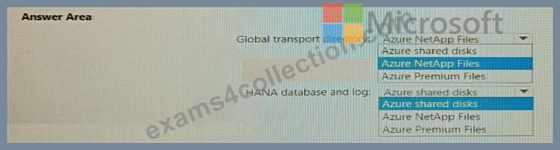
Answer:
Explanation: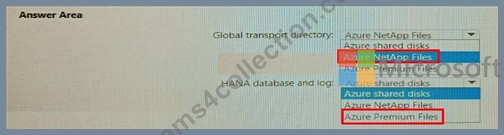
NEW QUESTION # 42
You have ah SAP environment on Azure that contains a single-tenant SAP NANA server at instance 03.
You need to monitor the network throughput from an SAP application server to the SAP HANA server.
How should you complete the script? To answer, select the appropriate options in the answer are.
NOTE: Each correct selection is worth one point.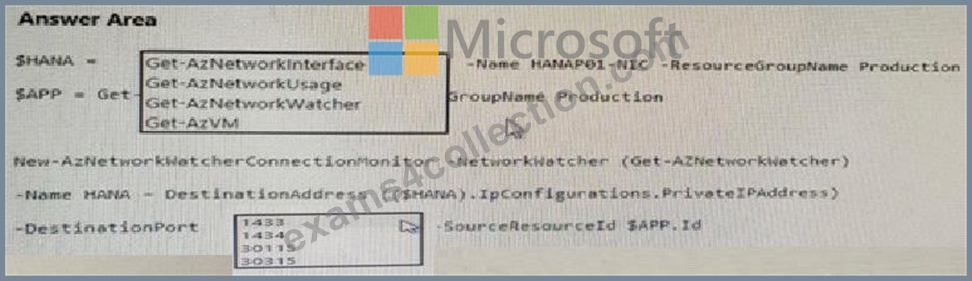
Answer:
Explanation: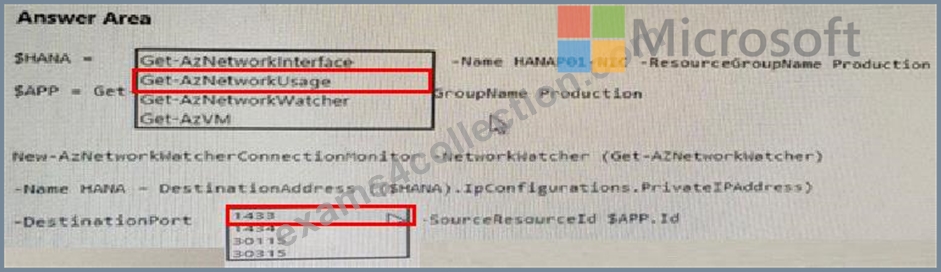
NEW QUESTION # 43
You migrate SAP ERP Central Component (SAP ECC) production and non-production landscapes to Azure.
You are licensed for SAP Landscape Management (LaMa).
You need to refresh from the production landscape to the non-production landscape.
Which four actions should you perform in sequence? To answer, move the appropriate actions from the list of actions to the answer area and arrange them in the correct order.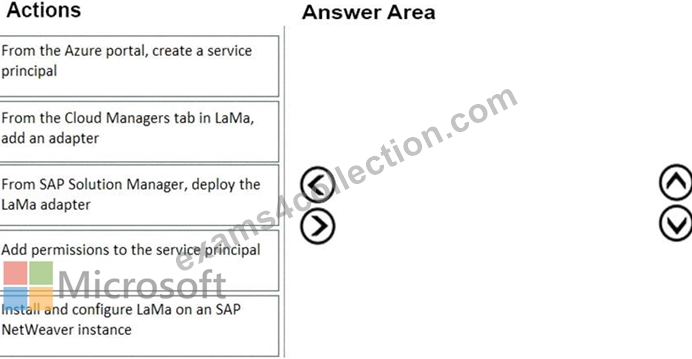
Answer:
Explanation: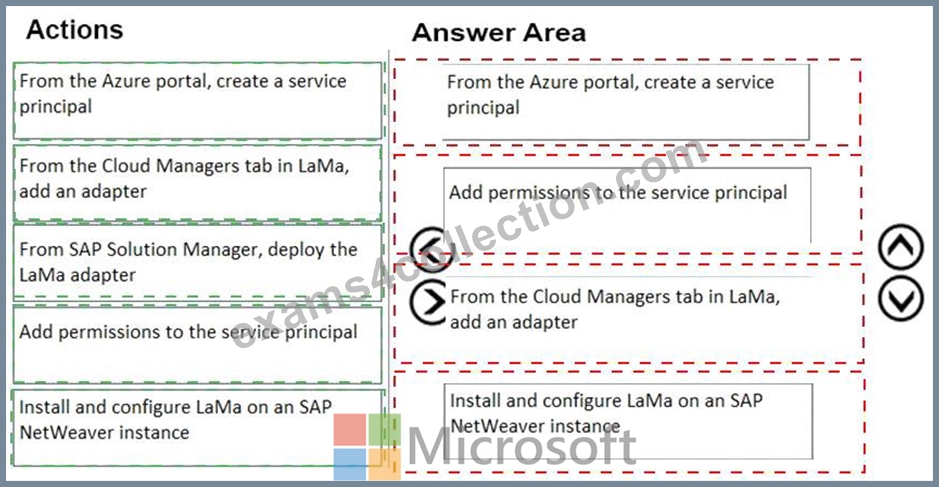
Explanation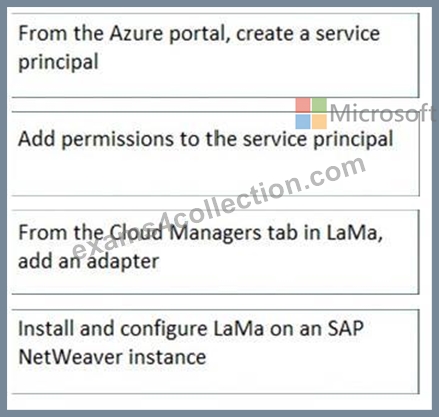
Step 1: From the Azure portal, create a service principal
The Azure connector can use a Service Principal to authorize against Microsoft Azure. Follow these steps to create a Service Principal for SAP Landscape Management (LaMa).
Step 2: Add permissions to the service principal
The Service Principal does not have permissions to access your Azure resources by default. You need to give the Service Principal permissions to access them.
Step 3: From the Cloud Managers tab in LaMa, add an adapter
Create a new connector in SAP LaMa
Open the SAP LaMa website and navigate to Infrastructure. Go to tab Cloud Managers and click on Add.
Select the Microsoft Azure Cloud Adapter
Step 4: Install and configure LaMA on an SAP NetWeater instance
Provision a new adaptive SAP system
You can manually deploy a new virtual machine or use one of the Azure templates in the quickstart repository.
It contains templates for SAP NetWeaver ASCS, SAP NetWeaver application servers, and the database. You can also use these templates to provision new hosts as part of a system copy/clone etc.
Note: To support customers on their journey into a cloud model (hybrid or entirely public cloud), SAP and Microsoft partnered to create an adapter that integrates the SAP management capabilities of LaMa with the IaaS advantages of Microsoft Azure.
References:
https://docs.microsoft.com/en-us/azure/virtual-machines/workloads/sap/lama-installation
https://docs.microsoft.com/en-us/learn/modules/maintain-azure-sap-workloads/2-set-up-remote-management
NEW QUESTION # 44
You have an on-premises SAP landscape that uses a DB2 database and contains an SAP Financial Accounting (SAP FIN) deployment. The deployment contains a file share that stores 50 TB of bitmap files. You plan to migrate the on-premises SAP landscape to SAP HANA on Azure (Large Instances) and Azure Files shares.
The solution must meet the following requirements:
* Minimize downtime.
* Minimize administrative effort.
You need to recommend a migration solution.
What should you recommend for each resource? To answer, drag the appropriate services to the correct resources. Each service may be used once, more than once, or not at all. You may need to drag the split bar between panes or scroll to view content.
NOTE: Each correct selection is worth one point.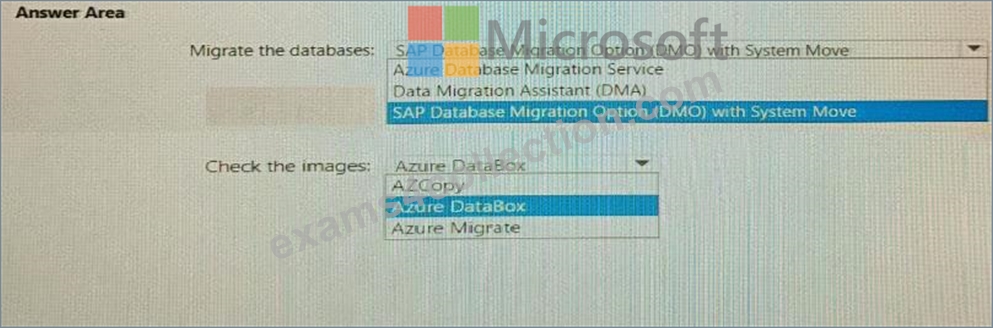
Answer:
Explanation: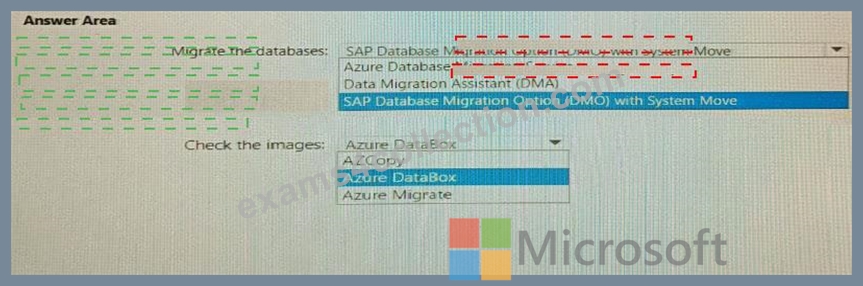
Explanation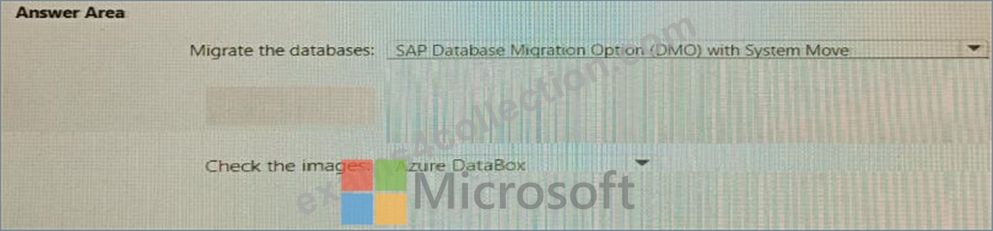
NEW QUESTION # 45
For each of the following statements, select Yes if the statement is true. Otherwise, select No.
NOTE: Each correct selection is worth one point.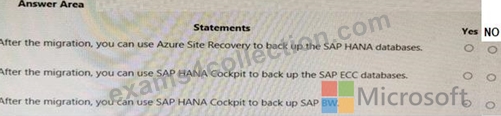
Answer:
Explanation: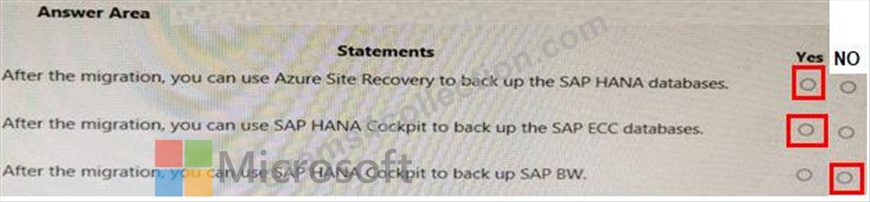
NEW QUESTION # 46
You have an Azure Availability Set that is configured as shown in the following exhibit.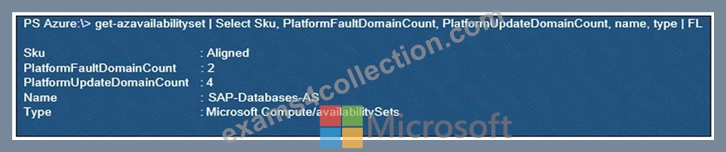
Use the drop-down menus to select the answer choice that completes each statement based on the information presented in the graphic.
NOTE: Each correct selection is worth one point.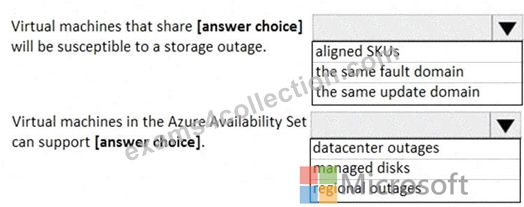
Answer:
Explanation: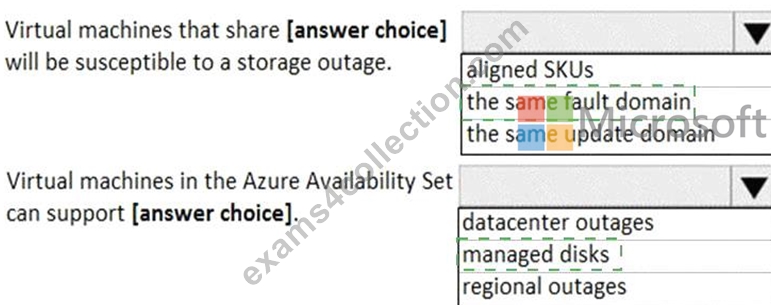
Explanation: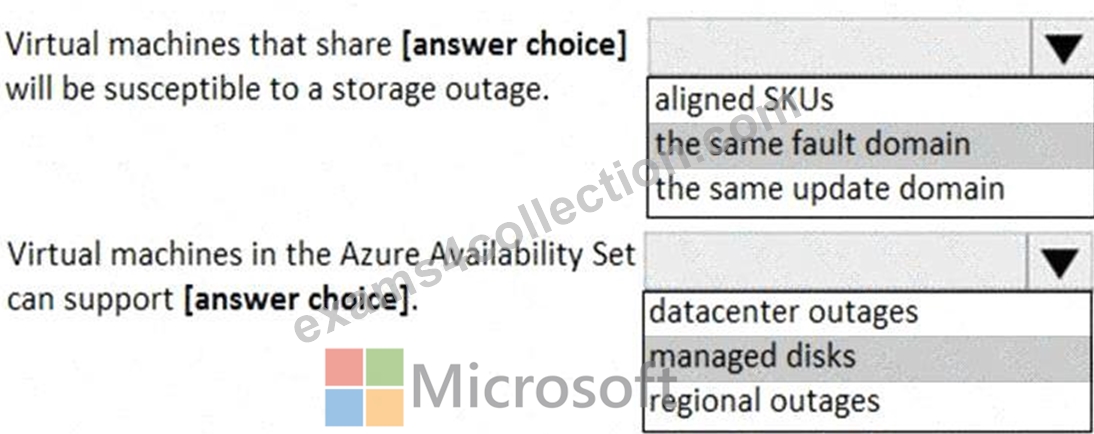
Box 1: the same fault domain
Fault domains define the group of virtual machines that share a common power source and network switch. If a storage fault domain fails due to hardware or software failure, only the VM instance with disks on the storage fault domain fails.
Box 2: managed disks
Managed disks provide better reliability for Availability Sets by ensuring that the disks of VMs in an Availability Set are sufficiently isolated from each other to avoid single points of failure. It does this by automatically placing the disks in different storage fault domains (storage clusters) and aligning them with the VM fault domain.
References:
https://docs.microsoft.com/en-us/azure/virtual-machines/windows/manage-availability
NEW QUESTION # 47
You need direct connectivity from an on-premises network to SAP HANA (Large Instances). The solution must meet the following requirements:
* Minimize administrative effort.
* Provide the highest level of resiliency.
What should you use?
- A. ExpressRoute
- B. Linux IPTables
- C. NGINX as a reverse proxy
- D. ExpressRoute Global Reach
Answer: A
Explanation:
The Azure network functionality used is:
* Azure virtual networks are connected to the ExpressRoute circuit that connects to your on-premises network assets.
* An ExpressRoute circuit that connects on-premises to Azure should have a minimum bandwidth of 1 Gbps or higher. This minimal bandwidth allows adequate bandwidth for the transfer of data between on-premises systems and systems that run on VMs. It also allows adequate bandwidth for connection to Azure systems from on-premises users.
* All SAP systems in Azure are set up in virtual networks to communicate with each other.
Reference:
https://docs.microsoft.com/en-us/azure/virtual-machines/workloads/sap/hana-network-architecture
NEW QUESTION # 48
You have an Azure subscription that contains a highly available SAP NetWeaver deployment. The deployment contains four virtual machines.
You need to monitor the NetWeaver deployment by using Azure Monitor for SAP Solutions. During the implementation of Azure Monitor for SAP Solutions, downtime of the deployment must be minimized.
Which three actions should you perform in sequence? To answer, move the appropriate actions from the list of actions to the answer area and arrange them in the correct order.
Answer:
Explanation:
Explanation
NEW QUESTION # 49
You plan to deploy multiple SAP HANA virtual machines to Azure by using an Azure Resource Manager template.
How should you configure Accelerated Networking and Write Accelerator in the template? To answer, drag the appropriate values to the correct targets. Each value may be used once, more than once, or not at all. You may need to drag the split bar between panes or scroll to view content.
NOTE: Each correct selection is worth one point.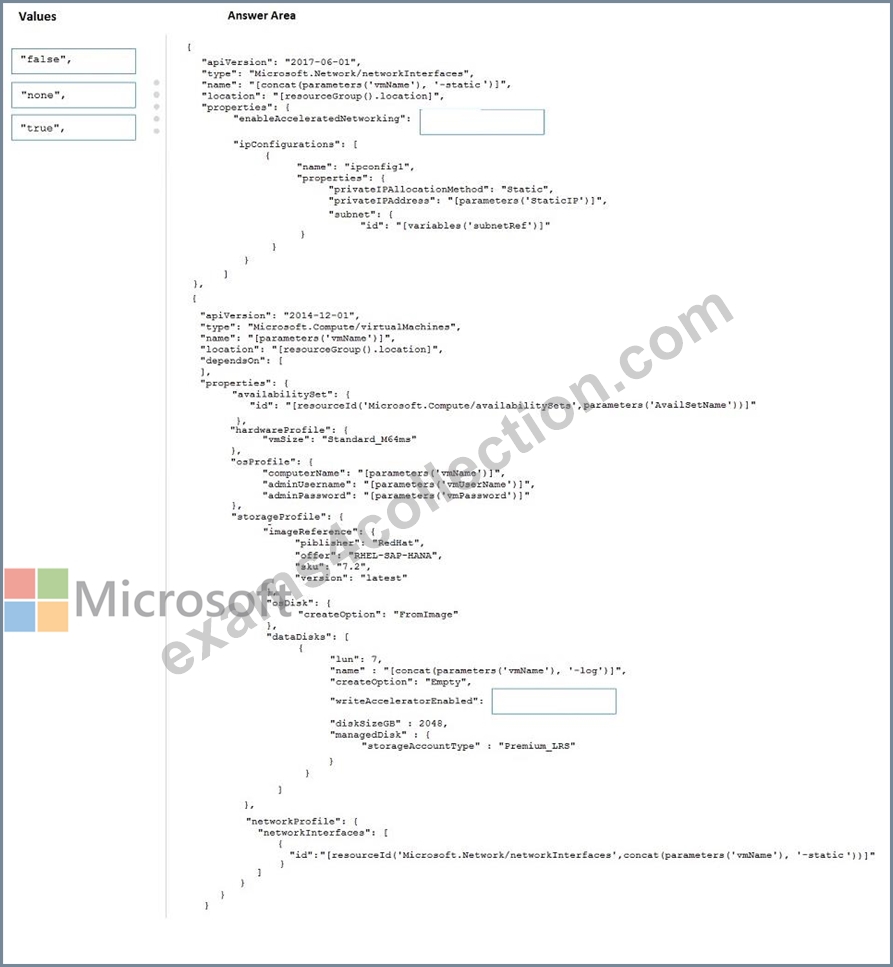
Answer:
Explanation: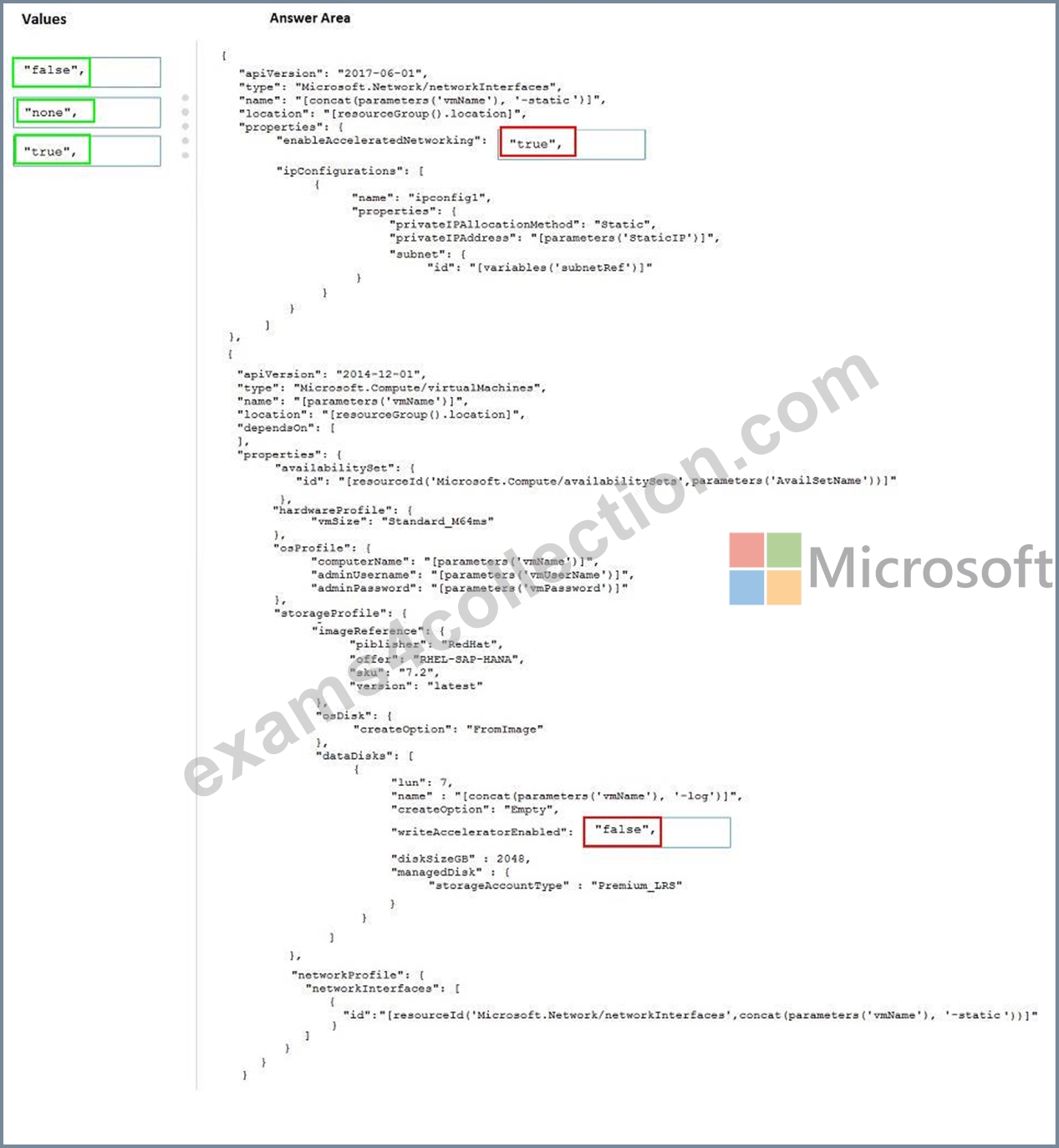
Reference:
https://docs.microsoft.com/en-us/azure/virtual-machines/workloads/sap/dbms_guide_general
NEW QUESTION # 50
You need to recommend a solution to reduce the cost of the SAP non-production landscapes after the migration.
What should you include in the recommendation?
- A. Deploy non-production landscapes to Azure Devlest Labs.
- B. Deallocate virtual machines when not In use.
- C. Configure scaling of Azure App Service.
- D. Migrate the SQL Server databases to Azure SQL Data Warehouse.
Answer: C
NEW QUESTION # 51
You have an Azure Availability Set that is configured as shown in the following exhibit.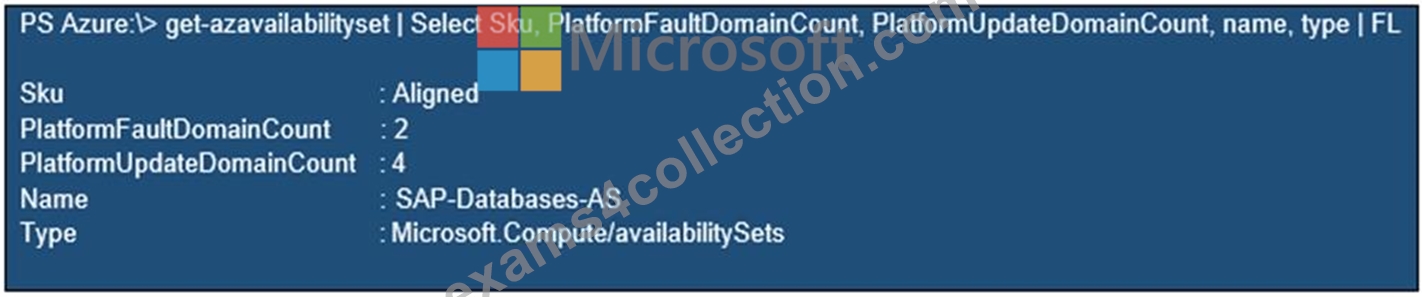
Use the drop-down menus to select the answer choice that completes each statement based on the information presented in the graphic.
NOTE: Each correct selection is worth one point.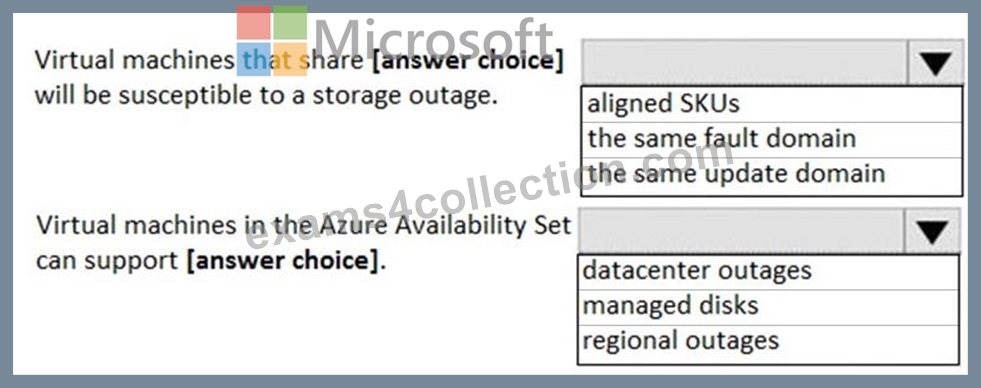
Answer:
Explanation: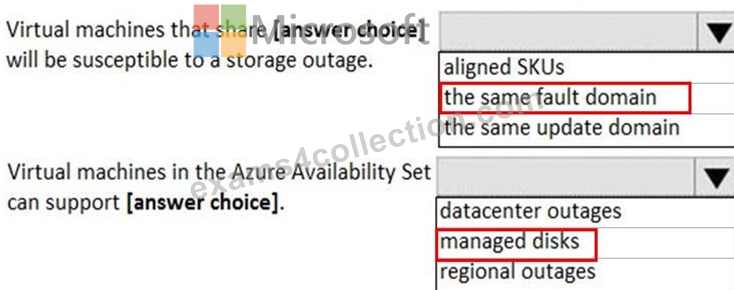
Reference:
https://docs.microsoft.com/en-us/azure/virtual-machines/windows/manage-availability
NEW QUESTION # 52
You are integrating SAP HANA and Azure Active Directory (Azure AD).
For each of the following statements, select Yes if the statement is true. Otherwise, select No.
NOTE: Each correct selection is worth one point.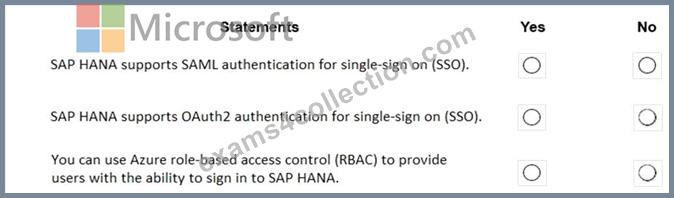
Answer:
Explanation: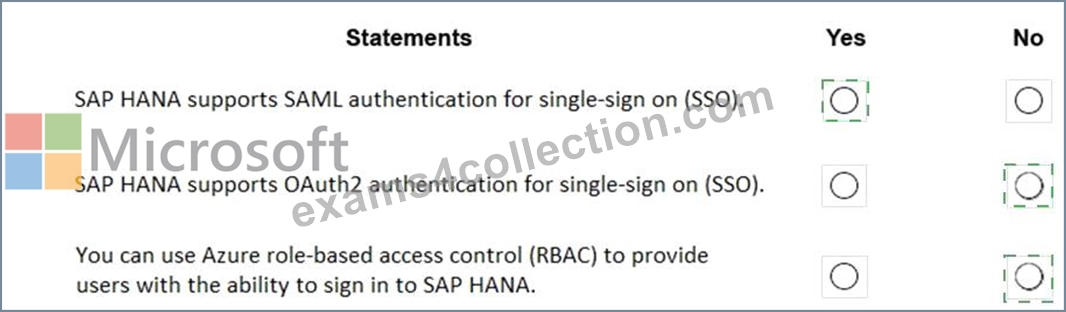
Explanation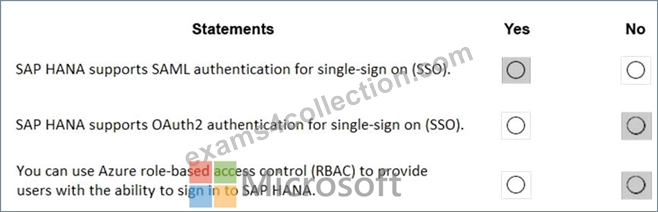
Box 1: Yes
To configure Azure AD single sign-on with SAP HANA, perform the following steps:
1. In the Azure portal, on the SAP HANA application integration page, select Single sign-on.
2. On the Select a Single sign-on method dialog, select SAML/WS-Fed mode to enable single sign-on.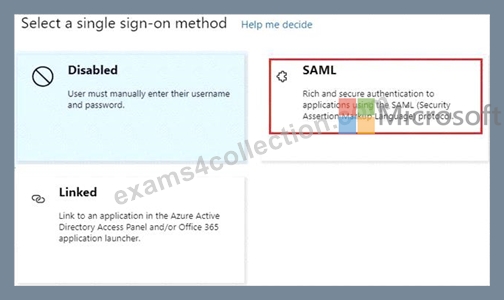
Box 2: No
Box 3: No
Key security considerations for deploying SAP on Azure
References:
https://docs.microsoft.com/en-us/azure/active-directory/saas-apps/saphana-tutorial
https://docs.microsoft.com/en-us/azure/active-directory/saas-apps/saphana-tutorial
NEW QUESTION # 53
You are evaluating which migration method Litware can implement based on the current environment and the business goals.
Which migration method will cause the least amount of downtime?
- A. Use Near-Zero Downtime (NZDT) to migrate to SAP HANA and Azure during the same maintenance window.
- B. Use the Database Migration Option (DMO) to migrate to SAP HANA and Azure during the same maintenance window.
- C. Migrate SAP ECC to SAP Business Suite in HANA, and then migrate SAP to Azure.
- D. Migrate SAP to Azure, and then migrate SAP ECC to SAP Business Suite on HANA.
Answer: B
Explanation:
The SAP Database Migration Option (DMO) with System Move option of SUM, used as part of the migration allows customer the options to perform the migration in a single step, from source system on-premises, or to the target system residing in Microsoft Azure, minimizing overall downtime.
Reference:
https://blogs.sap.com/2017/10/05/your-sap-on-azure-part-2-dmo-with-system-move/ Migrate SAP Workloads to Azure Testlet 2 Case Study This is a case study. Case studies are not timed separately. You can use as much exam time as you would like to complete each case. However, there may be additional case studies and sections on this exam. You must manage your time to ensure that you are able to complete all questions included on this exam in the time provided.
To answer the questions included in a case study, you will need to reference information that is provided in the case study. Case studies might contain exhibits and other resources that provide more information about the scenario that is described in the case study. Each question is independent of the other questions in this case study.
At the end of this case study, a review screen will appear. This screen allows you to review your answers and to make changes before you move to the next section of the exam. After you begin a new section, you cannot return to this section.
To start the case study
To display the first question in this case study, click the Next button. Use the buttons in the left pane to explore the content of the case study before you answer the questions. Clicking these buttons displays information such as business requirements, existing environment, and problem statements. If the case study has an All Information tab, note that the information displayed is identical to the information displayed on the subsequent tabs. When you are ready to answer a question, click the Question button to return to the question.
Overview
Contoso, Ltd. is a manufacturing company that has 15,000 employees.
The company uses SAP for sales and manufacturing.
Contoso has sales offices in New York and London and manufacturing facilities in Boston and Seattle.
Existing Environment
Active Directory
The network contains an on-premises Active Directory domain named ad.contoso.com. User email addresses use a domain name of contoso.com.
SAP Environment
The current SAP environment contains the following components:
* SAP Solution Manager
* SAP ERP Central Component (SAP ECC)
* SAP Supply Chain Management (SAP SCM)
* SAP application servers that run Windows Server 2008 R2
* SAP HANA database servers that run SUSE Linux Enterprise Server 12 (SLES 12) Problem Statements Contoso identifies the following issues in its current environment:
* The SAP HANA environment lacks adequate resources.
* The Windows servers are nearing the end of support.
* The datacenters are at maximum capacity.
Requirements
Planned Changes
Contoso identifies the following planned changes:
* Deploy Azure Virtual WAN.
* Migrate the application servers to Windows Server 2016.
* Deploy ExpressRoute connections to all of the offices and manufacturing facilities.
* Deploy SAP landscapes to Azure for development, quality assurance, and production.
All resources for the production landscape will be in a resource group named SAPProduction.
Business goals
Contoso identifies the following business goals:
* Minimize costs whenever possible.
* Migrate SAP to Azure without causing downtime.
* Ensure that all SAP deployments to Azure are supported by SAP.
* Ensure that all the production databases can withstand the failure of an Azure region.
* Ensure that all the production application servers can restore daily backups from the last 21 days.
Technical Requirements
Contoso identifies the following technical requirements:
* Inspect all web queries.
* Deploy an SAP HANA cluster to two datacenters.
* Minimize the bandwidth used for database synchronization.
* Use Active Directory accounts to administer Azure resources.
* Ensure that each production application server has four 1-TB data disks.
* Ensure that an application server can be restored from a backup created during the last five days within 15 minutes.
* Implement an approval process to ensure that an SAP administrator is notified before another administrator attempts to make changes to the Azure virtual machines that host SAP.
It is estimated that during the migration, the bandwidth required between Azure and the New York office will be
1 Gbps. After the migration, a traffic burst of up to 3 Gbps will occur.
Proposed Backup Policy
An Azure administrator proposes the backup policy shown in the following exhibit.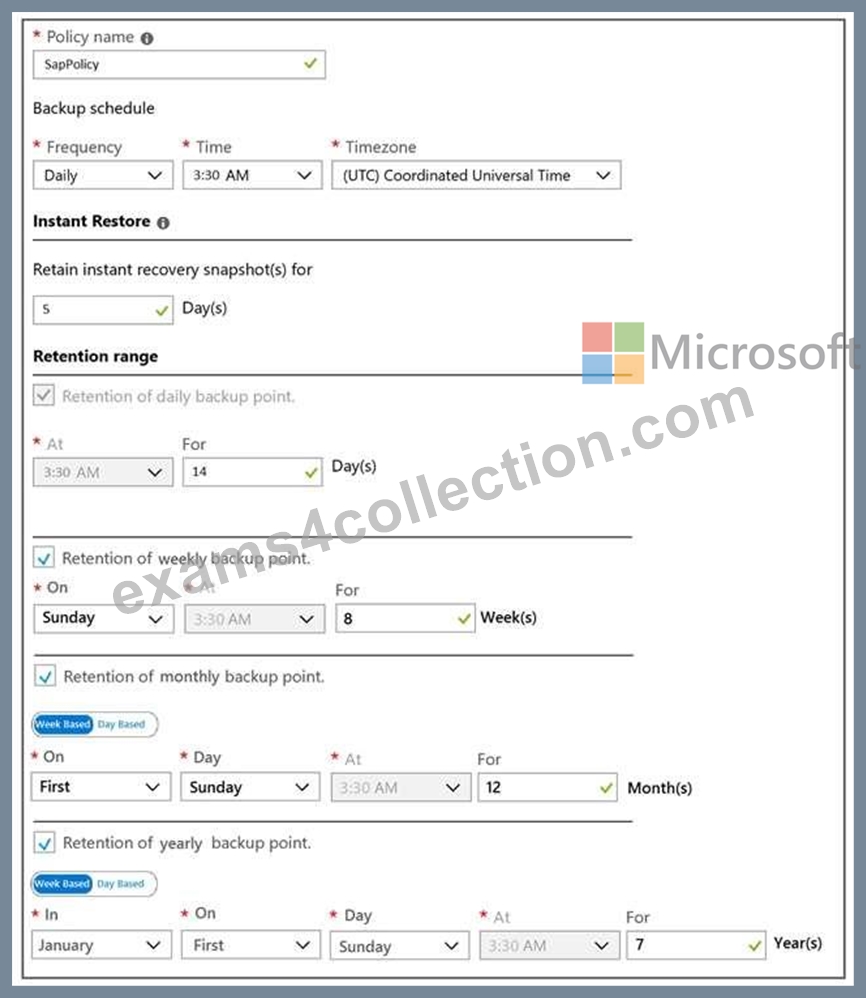
Azure Resource Manager Template
An Azure administrator provides you with the Azure Resource Manager template that will be used to provision the production application servers.

NEW QUESTION # 54
You have an SAP production landscape on Azure that contains the resources shown in the following table.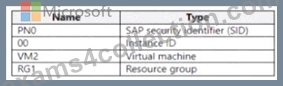
You need to stop the SAP services so that you can perform monthly maintenance.
Which command should you run from the Azure Cloud Shell? To answer, select the appropriate options in the answer area NOTE: Each correct selection is worth one point.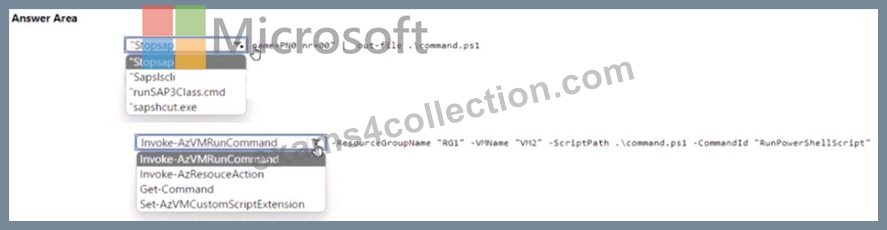
Answer:
Explanation: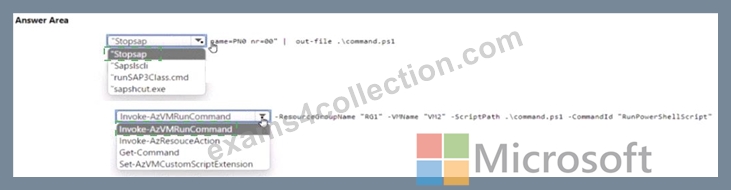
Explanation
NEW QUESTION # 55
......
The AZ-120 exam is part of the Microsoft Certified: Azure for SAP Workloads Specialty certification. Planning and Administering Microsoft Azure for SAP Workloads certification validates your expertise in planning, implementing, and managing SAP solutions on Azure, and is highly sought after by employers around the world. By passing the AZ-120 exam, you will join a community of certified professionals who are recognized as experts in SAP workloads on Azure, and who are well-equipped to help businesses migrate their SAP systems to the cloud.
2026 New Exams4Collection AZ-120 PDF Recently Updated Questions: https://www.exams4collection.com/AZ-120-latest-braindumps.html
Microsoft AZ-120 DUMPS WITH REAL EXAM QUESTIONS: https://drive.google.com/open?id=1V_hsd3L9PUszy4K9tQqM3CCQJ_DR9zLL
